




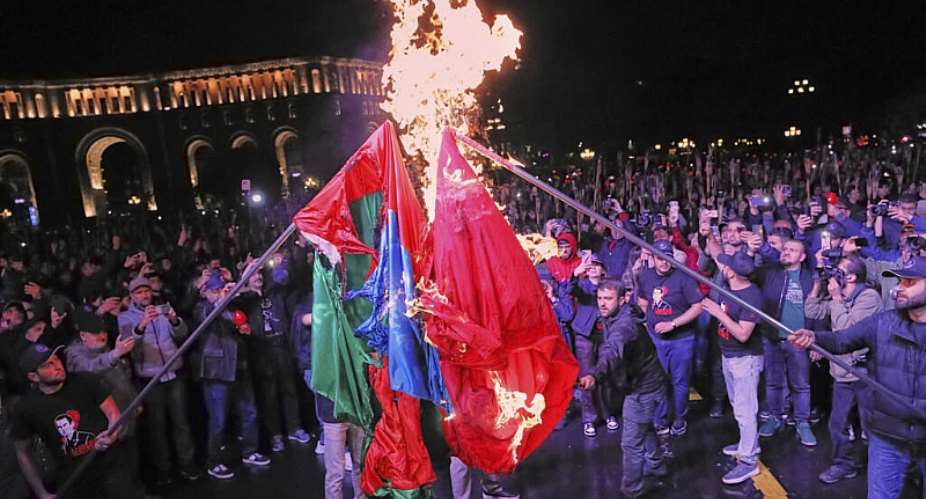
Foreign Minister Gideon Sa'ar, who proposed the measure, called the recognition a "moral and historical duty", saying Israel, "as a Jewish state" – built on memories of the genocide of its own people during the Second World War – "had to reject denial and distortion of the historical record".
He also said the Armenian genocide – the state-sponsored ethnic cleansing launched by the Ottoman Empire in 1915 that killed up to 1.5 million ethnic Armenians – had been the subject of an "institutionalised campaign of denial", mainly by the Turkish government.
"It is never too late to do the right thing," Sa'ar added.
Political motives
Not everyone accepts the government's explanation.
"This decision is strictly political," said Professor Gerald Steinberg of Bar Ilan University.
"There's a lot of criticism within Israel, including in diplomatic and security circles that are close to the government. This is about Turkey," he said.
For years, Israel's ties with Turkey discouraged recognition of the Armenian genocide, Steinberg said.
"That's removed from the agenda: there is an ongoing escalation of conflict with... Turkey. Turkey now has become, in many ways, a source of conflict," he said.
Armenia's response was restrained rather than celebratory. Prime Minister Nikol Pashinyan said Yerevan saw "no need to respond" and did not want to be drawn into the "weaponisation" of the genocide issue in current politics.
"It was generally seen as too little too late," Richard Giragosian, director of the Regional Studies Centre in Yerevan, told RFI.
"Coupled with Israeli military support for neighbouring Azerbaijan in the war of 2020, this was much less of a welcome positive move than would be expected.
"There's a degree of resentment in Armenia that the genocide issue has become ammunition in the conflict between the Israeli government and the Turkish leadership". Armenia genocide monument in Yerevan.
Angry response
Turkey reacted angrily, accusing Israel of political hypocrisy and of trying to distract attention from the war in Gaza.
Its foreign ministry said Israel, which it described as being accused of genocide against Palestinians, was trying to "cover up its own crimes" through the recognition decision.
Ankara also rejected the genocide label, maintaining that the 1915 events "should not be described as genocide".
"The general feeling is that Turks are being unfairly picked on for having committed terrible deeds," said ltar Turan a professor at Bilgi University in Istanbul.
"Which at a time when nationalism in an environment where many races lived in an intermingled fashion meant that many races committed terrible things against the others."
Armenians warn ethnic cleansing risks being forgotten – again
Turan argued that Israel hoped the decision would divert attention from its actions in Gaza.
"I don't see anything moral about what Israel is doing," he added.
Others believe Ankara's anger was directed less at the recognition itself than at Israel's government.
"The Turkish reaction was 90 percent criticising [Israeli PM Benjamin] Netanyahu and Israeli policy, and a mere 10 percent reacting to the genocide recognition itself," said Giragosian.
For Turkey, he said, "it's also seen as Israel being an interloper, interfering in an issue that's really between Turkey and Armenia."
Steinberg sees the dispute as part of a broader regional rivalry.
He said Turkey wanted to become a "regional superpower" in the Middle East, possibly replacing Iran, while "harbouring a number of Hamas officials that are accused of having planned terror attacks" and "trying to resuscitate the organization from within Turkey."
Who gets to be remembered under France's contentious 'memory laws'?
Diplomatic costs
The criticism did not come from Turkey alone.
Its ally Azerbaijan also condemned the decision and called on Israel to reconsider. The foreign ministry said the move "distorted historical facts, would not promote reconciliation or mutual understanding, and risked deepening divisions rather than helping regional peace."
The response carries particular weight because Azerbaijan is one of Israel's closest regional partners. It also fought a bloody war with Armenia over the Nagorno-Karabakh enclave that ended in 2023 with Turkish support. Clashes between Azerbaijan and Armenia ended in 2023 with Azerbaijan taking over the Nagorno-Karabakh enclave after decades of Armenian occupation.
"Azerbaijan's vehement criticism of the Israeli move is a step backwards, because it follows a year and a half of unprecedented progress in diplomatic negotiations between Armenia and Azerbaijan," Giragosian said.
He argued that Azerbaijan should not be part of the dispute.
"Azerbaijan has no direct relevance to an issue between Armenia and Turkey and to global genocide recognition," Giragosian said.
"It's Turkey that has to deal with a painful, difficult past and come to terms with the Armenian genocide. And it's Turkey more than any other country that has this burden of responsibility."
The diplomatic picture is complicated by Israel's long-standing security ties with Azerbaijan.
Relations between Israel and Armenia "are not good", Steinberg said, adding that Israel works closely with Azerbaijan, which has "major advanced Israeli weapons cooperation", while Iran is "an enemy, both of Azerbaijan and Israel" – with "Armenia, seen as on the other side."
Turan said Azerbaijan's criticism was aimed primarily at Israel rather than Turkey.
"Being critical of Israel is a message to Israel, not to Turkey," he said. "We must not forget that Azeri oil is being shipped to Israel through Turkish ports."
Despite Israel's change in policy, Steinberg does not expect relations with Armenia to improve significantly.
He said the recognition was unlikely to "lead to a major improvement in the relations" between Israel and Armenia.
In fact, he argued, Israel is "shooting in its own goal".
"Recognising the Armenian genocide was seen as a means of embarrassing Turkey. But it complicated Israel's diplomatic isolation."

 Transport Ministry defends purchase of diesel locomotives, rejects NPP criticism
 Outdoor air pollution costs Ghana more than GH¢28 billion - UNDP
 Yagbonwura joins Asantehene for fifth Awukudae celebration
 How US lawmaker Carol Ammons traces ancestry to Paga, enskinned as Queen Mother
 NDC signs cooperation agreement with Russia's United Russia Party
 Canada-Ghana trade rises 56% to US$752 Million
 Foreign Affairs Ministry to replace passports lost, damaged in floods
 Two bodies retrieved after flooding at Adakope near Weija
 Heartbreaking moment as Senegalese fan reportedly passes out after Belgium's dra...
 Elderly man allegedly throws stone at resident after being caught dumping refuse...
