




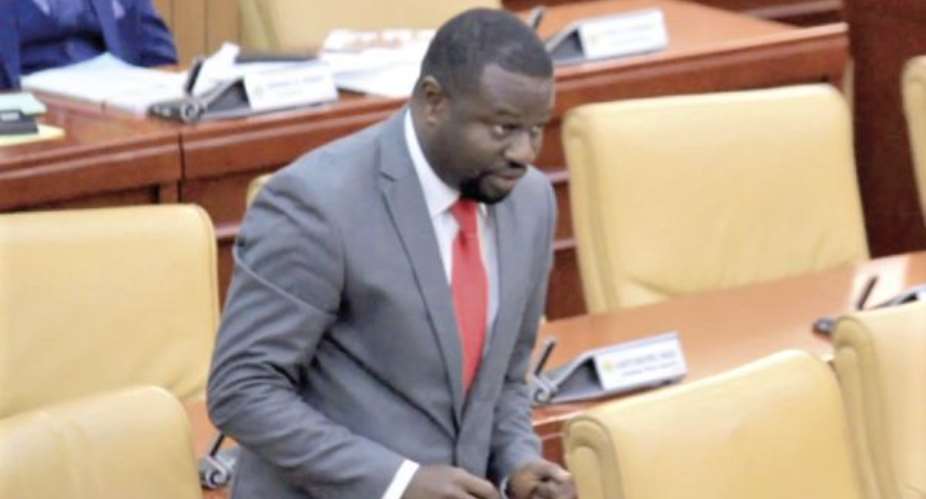
Minority Chief Whip and Member of Parliament for Nsawam-Adoagyiri, Frank Annoh-Dompreh, has called on the government to adopt stringent measures to ensure Ghana's carbon credit market is built on transparency, environmental integrity and meaningful community participation.
The lawmaker stated that the country should not compromise standards in its quest to benefit from the growing global carbon market.
Speaking on the floor of Parliament on Thursday, July 2, Annoh-Dompreh said Ghana has an opportunity to establish itself as a trusted player in carbon finance by prioritising projects that deliver genuine climate benefits while improving livelihoods.
"Ghana must also insist on high integrity carbon credits. The global carbon market has suffered credibility challenges because of weak projects, inflated claims, double counting, poor community consultation, and questionable additionality. Ghana must not become a destination for low-quality carbon projects. Every project must demonstrate environmental integrity and transparent benefit sharing," he said.
Annoh-Dompreh stressed that communities must remain at the centre of all carbon projects since many initiatives rely on forests, farmlands and other natural resources owned or managed by local people.
He said projects should only proceed after proper stakeholder engagement, free and informed community participation, accessible grievance mechanisms and equitable sharing of benefits.
The Minority Chief Whip further urged the government to deliberately develop a strong pipeline of domestic carbon projects across sectors including renewable energy, methane reduction, landfill gas management, regenerative agriculture, forest restoration, mangrove conservation, climate-smart irrigation, public transport, industrial energy efficiency and water purification.
According to him, such investments would not only reduce greenhouse gas emissions but also create jobs, strengthen food security and support Ghana's broader economic development agenda.
"Government must build national capacity. Carbon market development requires specialised skills, including project design, carbon accounting, legal contracting, Article 6 authorisation, registry management, financing, and community benefit sharing. Ghana should not rely excessively on foreign consultants. The country must train Ghanaian experts, universities, private firms, district assemblies, NGOs and financial institutions to participate meaningfully in the market," he stated.


 64.7% of Ghanaians say Double-Track system has reduced SHS quality – IEA
 I felt very ashamed Accra lost major international conferences to Dakar over ina...
 'He is ignorant' – Mahama hits back at Paul Yandoh over soldiers constructing ro...
 OpenAI, Anthropic and Google in talks to create a standards body as AI fears ris...
 Don’t trust anybody; take your partner to test for HIV before any relationship –...
 Dr Ayew Afriye sues Rev. Owusu Bempah for GH¢10m over alleged defamatory comment...
 Atewa Forest under siege: Five million Ghanaians risk losing water source
 TRAFFITECH-GH: Police to use cameras, PDAs to detect traffic offences from Octob...
 AMA gives Dogo Beach squatters one week to vacate ahead of demolition
 Twin brother of late CLOGSAG executive Isaac Bampoe Addo also dies



Comments
I strongly believe that if, during the eight years of ridiculed governance of the Akufo-Addo-Bawumia government, if the NPP had built low-quality carbon credit projects, the NPP would still have gone to the opposition.