




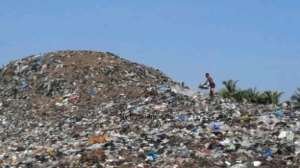
Mountains of uncollected refuse are reappearing at markets, bus terminals, gutters, and communal collection points across Accra. From Kaneshie to Agbogbloshie and parts of Mamprobi, overflowing waste containers have become an increasingly familiar sight.
While residents often blame delayed collections or poor sanitation habits, waste management experts say the deeper problem lies elsewhere: Greater Accra is running out of landfill space.
With the Kpone landfill nearing the end of its operational life, disposal trucks travelling up to 100 kilometres to alternative sites, and recent floods disrupting access to waste facilities, the capital faces what the Minister for Local Government, Chieftaincy and Religious Affairs, Ahmed Ibrahim, has described as a "ticking sanitation time bomb."
A City Running Out of Disposal Space
The Kpone Waste Landfill, commissioned in 1996 to serve Tema, has gradually become the primary disposal site for several metropolitan, municipal and district assemblies across eastern Greater Accra, including Tema, Ashaiman and Kpone-Katamanso.
Today, however, the landfill has reached its design limits.
Government officials have warned that without an immediate replacement, several assemblies could soon have nowhere to dispose of domestic, industrial and even medical waste.
The Environmental Service Providers Association also notes that Greater Accra no longer has sufficient operational landfill capacity within the Greater Accra Metropolitan Area (GAMA), forcing waste contractors to transport refuse to distant disposal sites, including Adepa in the Eastern Region.
The longer journeys reduce the number of collection trips trucks can make each day while significantly increasing fuel and operational costs.
Floods Have Made the Situation Worse
Heavy rains in recent weeks exposed another weakness in Accra's waste management system.
Floodwaters rendered access to some disposal facilities difficult, affecting thousands of tricycle operators—popularly known as aboboyaa—who collect waste from homes and communities.
In response, government and waste management authorities reopened the Achimota-Abofu Transfer Station to temporarily ease pressure on the city's collection system.
Although the measure has helped, officials acknowledge that it is only a short-term intervention rather than a permanent solution.
Residents Feel the Impact
The effects are already visible.
Overflowing skips at markets and collection points have forced the Accra Metropolitan Assembly (AMA) to undertake emergency evacuation exercises in areas including Kaneshie Market, Agbogbloshie, Korle-Bu Bus Stop and Mamprobi.
Waste left unattended attracts flies, rodents and mosquitoes, blocks drainage channels and increases the risk of flooding during heavy rains.
Public health experts warn that prolonged refuse accumulation could contribute to outbreaks of cholera, typhoid and other sanitation-related diseases if not addressed quickly.
A Growing Waste Challenge
Ghana generates approximately 4,400 tonnes of solid waste every day, equivalent to about 1.6 million tonnes annually.
Urbanisation, population growth and changing consumption patterns continue to increase these volumes every year.
The Kpone landfill was originally designed to receive around 500 tonnes of waste daily, but reports indicate it has been receiving nearly twice that amount, accelerating its deterioration.
Meanwhile, hundreds of informal waste pickers depend on the landfill for their livelihoods by recovering recyclable materials before final disposal.
Their future remains uncertain if the site closes without a transition plan.
Government Faces Difficult Choices
Authorities have acknowledged the urgency of the crisis.
Emergency evacuations, reopening transfer stations and discussions over payments to waste contractors may temporarily improve collections, but they do not solve the underlying shortage of disposal infrastructure.
Waste management experts argue that Ghana can no longer rely almost exclusively on landfills.
Instead, they recommend expanding recycling programmes, enforcing household waste segregation, investing in composting facilities, developing engineered sanitary landfills and accelerating waste-to-energy projects capable of reducing the volume of refuse requiring final disposal.
They also stress that any transition should protect the livelihoods of informal waste pickers through consultation, training and integration into formal recycling systems.
The Way Forward
Accra's refuse problem is no longer simply a collection issue—it is an infrastructure crisis.
Without new engineered landfill facilities, sustainable financing for waste operators and greater investment in recycling and resource recovery, refuse will continue to accumulate despite emergency clean-up exercises.
As Greater Accra's population continues to grow, so too will the volume of waste it produces.
The city's sanitation future will depend not only on keeping streets clean today but on building the infrastructure needed to manage tomorrow's waste safely and sustainably.
The warning from government is clear: time is running out. Unless decisive action is taken, Ghana's capital risks turning a waste management challenge into a full-scale public health emergency.

 South Africa coach Broos urges squad to savour achievements at 2026 World Cup
 Ghana Moves Nearly 900 Citizens to Safe Havens Ahead of June 30 Anti‑Immigrant P...
 Canada reach last 16 with stoppage-time win over South Africa
 Iran attacks Bahrain and Kuwait, threatens to halt talks after fresh US strikes
 Ukrainian strike ignites Russian oil refinery, as Putin acknowledges 'difficult ...
 Ticket Chaos Leaves Hundreds of Ghanaian Fans Stranded Outside World Cup Stadium
 BoG Governor: Ghana’s Recovery Proves Africa Must Build Stronger Domestic Debt M...
 China Throws Full Support Behind Ghana’s Energy Independence Drive
 “Stop the Live Bullets Now”: MP Cudjoe Warns Festival Gunfire Is Becoming Deadly
 “No One Is Above the Law”: NPA Boss Says Ken Ofori‑Atta Cannot Escape Accountabi...


