




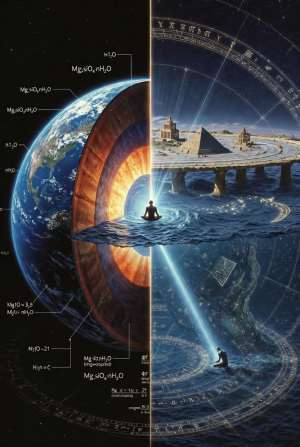
Dr. Michio Kaku's blueprint of the cosmos is a mirror — and what it reflects about our national priorities is deeply uncomfortable.
There is an old saying among the Akan people that a child who is not embraced by the village will burn it down to feel its warmth. I have thought about that proverb often in recent years, watching a generation of young Ghanaians — brilliant, restless, hungry — being handed mobile phones with access to the entire recorded knowledge of human civilization, and being given nothing meaningful to do with that access. No laboratories. No serious science programs in our secondary schools. No national conversation about what the next fifty years of human existence will actually look like and where Ghana intends to position itself within it.
Instead, we give them funerals to attend and political arguments to rehearse.
I write this not in contempt of my people, for whom I carry a deep and abiding love. I write it as a man who has watched too many gifted minds in this country spend their sharpest years solving problems that should have been solved decades ago, while the world beyond our borders is asking questions of an entirely different magnitude. Dr. Michio Kaku — one of the foremost theoretical physicists alive, a man who has dedicated seventy years of rigorous intellectual life to understanding the architecture of existence itself — recently laid out what the next century of human civilization will look like. When I sat with his words, my first thought was not of laboratories or equations.
My first thought was of Ghana. And whether we will be present when the future arrives, or whether we will once again be reading about it from the outside.
Let us begin where all honest conversations must begin — with the question of what we believe reality to be.
The average educated Ghanaian will tell you, without embarrassment, that the world is fundamentally spiritual in its operation. That behind every event — every illness, every business failure, every car accident on the Accra-Kumasi highway — there is a supernatural explanation waiting to be uncovered. This is not a mark of ignorance. It reflects a deep cultural inheritance, a way of making meaning in a world that has historically offered our people very little control over their material circumstances.
But there is a critical difference between spiritual depth and intellectual surrender. And increasingly, what I observe in our national discourse is not the former but the latter.
Dr. Kaku reminds us that our five human senses — the very instruments through which we perceive everything we call reality — detect only a vanishingly small fraction of what actually exists in the universe. Ninety-five percent of the universe is composed of dark matter and dark energy, forces and substances that are utterly invisible to us, that pass through our bodies and our buildings and our churches without our knowledge, that exert gravitational influence on entire galaxies, and that we have not yet found a single instrument capable of directly measuring.
We are, in the most precise scientific sense, profoundly blind.
Now I do not raise this to diminish faith. A man of genuine faith should not fear the expansion of knowledge, for if God is the author of the cosmos, then understanding the cosmos more fully is an act of reverence, not rebellion. What I am saying is this: a society that treats the visible world as the entire world, and explains every gap in its understanding with supernatural attribution rather than investigation, is a society that will always be dependent on others to decode reality on its behalf.
We cannot afford that dependence any longer.
On the question of what is coming — and whether we are preparing for any of it.
Dr. Kaku speaks of quantum computers with the measured urgency of a man who understands that most of the world's governments and institutions are not yet taking the threat seriously enough. Allow me to translate what this means in terms that our daily Ghanaian life makes immediately concrete.
Every mobile money transaction processed in this country, every Ghana Card database entry, every bank account, every password, every encrypted government communication — all of it rests on a mathematical principle that has protected digital information for decades. That principle works because breaking the encryption requires a conventional computer to perform calculations that would take millions of years to complete.
A quantum computer does not work by conventional means. It computes using the behavior of atoms themselves, exploiting principles of quantum mechanics that allow it to process vast numbers of possibilities simultaneously. When quantum computing reaches full operational scale — and the leading scientific consensus is that this is a matter of when, not if — standard digital encryption will be breakable in seconds.
Not hours. Seconds.
I ask this question with genuine seriousness and without political motive: is the Bank of Ghana thinking about this? Is the Ghana Revenue Authority thinking about this? Are our telecommunications companies, who hold the financial data of millions of Ghanaians in their mobile money platforms, engaged in any meaningful conversation about post-quantum cryptography?
Because the nations that are building quantum computers — and they are being built, right now, in laboratories in the United States, China, and the European Union — are simultaneously developing new encryption systems designed to withstand quantum attack. They are having this conversation at the highest levels of government and industry. If we are not having it, we will not be caught unprepared in some distant future. We will be caught unprepared in the lifetime of people who are young adults today.
The universe, the multiverse, and the smallness of our arguments.
There are moments in a man's life when he encounters an idea so vast that it temporarily dissolves every petty concern he was carrying. Dr. Kaku's work on string theory and the multiverse produces exactly that effect in me, and I believe it should produce it in all of us.
The theory, expressed with the rigour of advanced mathematics that I will not pretend to fully master, suggests that our universe — with its billions of galaxies, each containing billions of stars, across distances so enormous that light itself requires billions of years to traverse them — is not the whole of existence. It is one bubble among an infinite number of bubbles, each a universe unto itself, each born from its own originating event, each perhaps operating under its own version of the laws of physics.
New universes, according to this framework, are being born at this very moment.
I do not present this to undermine anyone's theology. I present it because I believe it is the duty of an educated, thinking society to sit with ideas of this magnitude and allow them to do their proper work — which is to humble us. To remind us that the boundaries of our local politics, our ethnic affiliations, our regional competitions, and our daily performances of status and prestige are, when measured against the scale of actual existence, almost incomprehensibly small.
We are, as Dr. Kaku elegantly observes, like ants on a leaf, confident that the leaf is the world.
On the matter of artificial intelligence, let us be precise rather than panicked.
Ghana's professional class is currently engaged in a kind of low-grade collective anxiety about artificial intelligence, and I understand the feeling. But anxiety without understanding is not useful, and I think Dr. Kaku's assessment here is both more reassuring and more demanding than the popular narrative suggests.
Current artificial intelligence systems — including the most sophisticated language models that have captured global attention — are not, in any meaningful scientific sense, intelligent. Dr. Kaku describes them as sophisticated pattern-matching engines: extraordinarily capable at identifying and reproducing the statistical relationships within whatever data they have been trained on, but entirely incapable of genuine understanding, original conceptual creation, or the kind of intuitive leap that produces genuinely new knowledge.
They are, in his memorable formulation, glorified tape recorders.
This does not mean they are harmless to ignore. A tape recorder placed in the right position can still record something you said in confidence. Artificial intelligence applied to repetitive, formulaic, data-intensive work can and will displace workers who have not developed skills that machines cannot replicate. The Ghanaian professional who spends his career doing work that is essentially procedural — producing standard reports, processing routine transactions, generating templated communications — is right to be concerned.
But the Ghanaian who thinks, who creates, who synthesizes across disciplines, who builds genuine relationships and exercises contextual judgment in complex human situations — that person is not being replaced. That person is being given tools. The question is whether we are educating our children to be the kind of people who use tools, or the kind of people who are replaced by them.
On mortality, and the questions we are not yet asking.
Dr. Kaku's assessment of where biomedical science is headed by the end of this century is perhaps the most quietly revolutionary part of his work, and it is the part I suspect we are least prepared to engage with as a society.
Aging, he explains, is not a mystical inevitability written into the human condition by divine decree. It is a biological accumulation of cellular errors — a process that, as genetic science and nanotechnology advance, we will increasingly be able to interrupt, repair, and eventually reverse. The possibility of human beings living well beyond one hundred and fifty years, in conditions of sustained physical and mental vitality, is being treated not as fantasy but as a research objective in the world's leading laboratories.
I raise this not to make predictions about timelines, but to ask a simple institutional question: what happens to our inheritance systems when people routinely outlive what our traditional succession structures were designed to accommodate? What happens to our pension frameworks, our land tenure arrangements, our family-based systems of elder care, when the concept of elderhood itself is fundamentally transformed? What happens to our funeral culture — an institution so central to Ghanaian social life that it shapes our economics, our calendars, and our community bonds — when the relationship between human life and death is medically renegotiated?
These are not frivolous questions. They are the questions that serious societies plan for in advance. And they require the kind of long-horizon national thinking that, at present, we do not appear to be doing.
The existential question — and the one I leave with you.
Dr. Kaku closes his reflections with a warning that carries the weight of everything that precedes it. As a civilization advances technologically, it passes through a period of extreme danger — a transition point at which it has developed the capacity to destroy itself but has not yet developed the wisdom to choose not to. The weapons exist. The biological agents exist. The environmental disruptions exist. The question is whether human civilization will mature quickly enough to survive its own capabilities.
Ghana is not separate from this question. We are part of the human story, and the human story is at an inflection point.
What I ask of my countrymen and women — particularly those who are young, who are curious, who feel the inadequacy of the conversations we are currently having — is this: do not wait for permission to think at the scale the moment demands. Do not allow the smallness of our current national discourse to become the ceiling of your intellectual ambition. The cosmos is not waiting for our politics to settle. The quantum computers are being built. The genetic codes are being rewritten. The multiverse, if it exists, will not pause for our prayer rallies.
Read. Study. Demand that our institutions take seriously the difference between the world as it appears and the world as it is. And refuse — firmly and completely — to accept a future in which Ghana is once again a spectator at the frontier of human civilization rather than a participant in its making.
We have the minds for it. The question that remains is whether we have the will.
Chief Tutu Baffour Asare Brownsy Williams | Brownsy Silva Company

 South Africa coach Broos urges squad to savour achievements at 2026 World Cup
 Ghana Moves Nearly 900 Citizens to Safe Havens Ahead of June 30 Anti‑Immigrant P...
 Canada reach last 16 with stoppage-time win over South Africa
 Iran attacks Bahrain and Kuwait, threatens to halt talks after fresh US strikes
 Ukrainian strike ignites Russian oil refinery, as Putin acknowledges 'difficult ...
 Ticket Chaos Leaves Hundreds of Ghanaian Fans Stranded Outside World Cup Stadium
 BoG Governor: Ghana’s Recovery Proves Africa Must Build Stronger Domestic Debt M...
 China Throws Full Support Behind Ghana’s Energy Independence Drive
 “Stop the Live Bullets Now”: MP Cudjoe Warns Festival Gunfire Is Becoming Deadly
 “No One Is Above the Law”: NPA Boss Says Ken Ofori‑Atta Cannot Escape Accountabi...


