




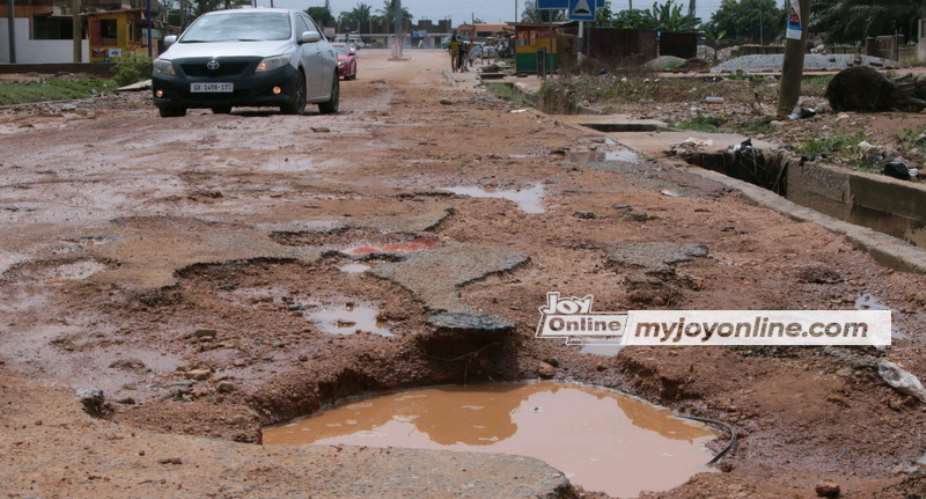
Every rainy season tells the same story. Freshly constructed roads develop potholes, sections collapse, and expensive rehabilitation works begin all over again. Meanwhile, taxpayers continue to finance repairs on roads that should have lasted for decades.
The contrast with the Tema Motorway—constructed in the late 1950s and still serving as one of Ghana's major transport corridors—is striking. The lesson is straightforward: durable roads are built through sound engineering, quality materials, rigorous supervision, and strict accountability.
If Ghana is to obtain value for money from its road infrastructure, one principle should guide every contract: No quality, no payment.
A Sector Under Financial and Quality Pressure
Ghana's road sector faces two interconnected challenges: mounting debt and inconsistent construction quality.
By the end of 2024, unpaid road contractor certificates reportedly exceeded GH¢20 billion, while government commitments across the sector had risen to about GH¢105 billion. Delayed payments have contributed to the stalling of many road projects, affecting contractors, communities, and economic activity.
However, delayed payments alone do not explain the sector's difficulties. Weak contract management, inadequate supervision, and insufficient quality control have also resulted in significant losses to the public purse.
Recent inspections and audits have uncovered troubling examples. In one case, a contractor reportedly received approximately US$30 million in mobilisation funds under an externally financed project without commencing substantial work. Another inspection on the Techiman–Wenchi Road found that after receiving GH¢66 million in mobilisation funds, little more than vegetation clearing had been completed months later, with critical construction works yet to begin.
A government validation exercise on road payment certificates also reportedly identified inflated claims, inaccurate measurements, and instances of duplicate payments, saving the state potentially billions of cedis.
These cases demonstrate why payment certification must go beyond paperwork.
Stronger Accountability Measures
Roads and Highways Minister Governs Kwame Agbodza has pledged tougher enforcement against poor workmanship and contract breaches.
Among the measures announced are:
Enforcing performance bonds where contractors fail to deliver quality work.
Requiring supervising consultants to maintain professional indemnity insurance, allowing government to recover losses arising from negligent supervision.
Holding ministry officials personally accountable through surcharges where they approve payments for defective or incomplete work.
The minister has repeatedly stressed that political affiliation will not shield contractors from sanctions, insisting that poor-quality work will result in contract termination regardless of who is involved.
Such measures send an important signal: accountability must apply throughout the entire delivery chain—from contractor to consultant to supervising public official.
What Effective Quality Control Should Look Like
Improving Ghana's roads requires systematic quality assurance at every stage of project delivery.
Independent validation of payment certificates should become standard practice. Before public funds are released, quantities, completed works, and material quality should be verified by qualified professionals independent of the project team.
Large infrastructure programmes should also undergo independent technical audits. The Ghana Institution of Engineering has called for rigorous oversight of major government road investments to ensure engineering standards are maintained and public funds protected.
Equally important is regular site inspection. Engineers should physically verify progress rather than relying solely on contractor reports. Modern technologies—including drones, geotagged photographs, satellite imagery, and digital project management systems—can further strengthen monitoring and reduce opportunities for fraud.
Road durability also depends on protecting completed infrastructure. Strict enforcement of axle-load regulations is essential, as overloaded trucks significantly shorten pavement life regardless of construction quality. Recent increases in penalties for overloading are therefore a welcome step, provided enforcement remains consistent.
Timely Payments Matter Too
Quality assurance should not become an excuse for unnecessary payment delays.
Contractors require predictable cash flow to maintain equipment, pay workers, and complete projects efficiently. Government's commitment to faster payment after proper certification is therefore important. But prompt payment must always follow thorough inspection—not replace it.
The objective is simple: contractors who meet specifications should be paid quickly; those who do not should not be paid until defects are corrected.
Building Roads That Last
Road infrastructure represents one of Ghana's largest public investments. Every cedi spent should produce roads capable of serving communities for decades—not months.
Countries that consistently build durable roads share common practices: proper design, laboratory testing of materials, continuous engineering supervision, independent quality verification, and strict enforcement of defect liability obligations.
Ghana should institutionalise a simple sequence for every road project:
Approved engineering design.
Laboratory testing of construction materials.
Continuous inspection during construction.
Independent verification of completed work.
Payment only after quality certification.
Strict enforcement of defect liability provisions.
This approach protects taxpayers, rewards competent contractors, and discourages poor workmanship.
The Way Forward
Ghana cannot continue spending billions rehabilitating roads that should never have failed in the first place. Stronger quality control is not merely an engineering issue—it is a matter of fiscal responsibility and public trust.
The country needs roads that withstand heavy traffic and changing weather, not infrastructure that requires reconstruction after every rainy season.
Pay contractors fairly. Pay them promptly.
But above all, pay only after quality has been independently proven.
Otherwise, Ghana will continue investing not in roads, but in the potholes that inevitably follow.


 Brazil's President Lula da Silva beats Flavio Bolsonaro to win re-election
 Nurse rescues mother and baby after unplanned delivery in bush
 McCarthy-Mallam road rehabilitation begins amid commuters’ complaints of heavy t...
 TOR briefs IMF on recovery efforts, inherited debt and sustainability plans
 Aseidu Nketia urges NDC contestants to unite after constituency elections
 EC yet to announce Dormaa Central NDC constituency results
 Baaba Cann questions Obuasi SHTS handling of sexual misconduct allegations again...
 Obuasi SHS headmaster case: “It is better to pay for sex with prostitute than ra...
 NDC not worried about NPP’s Kojo Bamba, he is small boy – Azorka
 Resource exploitation fuelling Africa’s conflicts – Mahama


