




Since Israel and the US attacked Hezbollah's ally Iran on February 28, Hezbollah has begun to employ a new type of weapon: first-person view drones, or FPVs. The Israeli army told FRANCE 24 it had registered 645 Hezbollah FPV drone attacks on military and civilian targets in northern Israel and southern Lebanon since a partial ceasefire went into effect on April 17.
These deadly small drones have proven their effectiveness in the Ukraine-Russia war for years. They are hard to detect and too small to shoot down easily but deadly against military vehicles, positions and, especially, soldiers.
Since Hezbollah began deploying these new weapons, its propaganda branch has posted videos of FPV attacks carried out by the group on Israeli targets, including military vehicles, tanks, garrisons and soldiers. The Israeli Defense Forces (IDF) said five soldiers were injured on June 17 when two Hezbollah FPVs struck them next to a tank in the village of Kfar Tebnit in southern Lebanon.
Hezbollah also claims its FPV drones have hit Israel's renowned Iron Dome air defence batteries.
The Iron Dome anti-missile system is an essential last line of defence for Israel against short-range rockets and artillery shells – weapons Hezbollah has used for years. In use since 2011, the system includes a purpose-built radar system designed to detect rockets and artillery shells, and portable launchers, each capable of firing 20 Tamir interceptor missiles. The system was not, however, designed to detect small quadcopter drones.
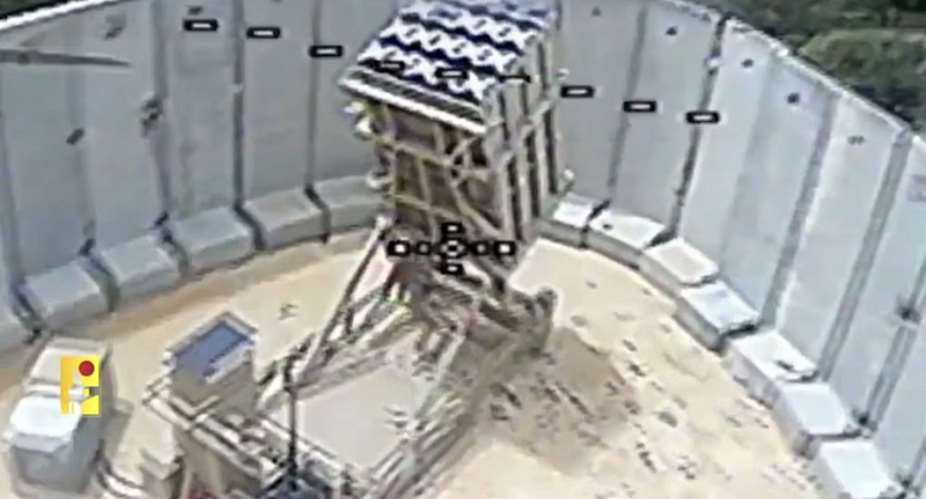
According to videos posted by Hezbollah's propaganda branch, Iron Dome launchers are among the preferred targets of Hezbollah FPV operators. The group has posted at least 10 videos on Telegram, which they claim document FPV strikes on Iron Dome launchers.
But there is a problem. Based on the videos published by Hezbollah, these FPV attacks appear to be mostly targeting decoys rather than real Iron Dome systems.
According to an investigation by FRANCE 24's Observers team in Paris, nine out of the 10 videos of Hezbollah's attacks on Iron Dome launchers appear to show strikes on Iron Dome launchers that were inactive, or decoys.
How can we assess that these are not real Iron Dome launchers?
Iron Dome launchers have a specific profile with four hydraulic supports, two vertical ones and two diagonal, that help position the launcher towards the threat detected by its computers. There is also a box-shaped structure on the launcher bed, as well as cables emerging from the end of the launch tubes, and a telescoping antenna mast. This undated file photo of an Iron Dome launcher shows the launching tubes that hold 20 Tamir interceptor missiles, along with a box-shaped structure, cables leading from the bottom of the launch tubes, and a telescoping antenna mast.
Farzin Nadimi, a defence and security analyst and senior fellow with The Washington Institute, confirms that Israel is using decoy launchers to protect its real Iron Dome systems.
Among all the videos that Hezbollah has published so far, I see only one case where the target that was hit could be a real Iron Dome system, although whether that system was operational or not is hard to say. All the other cases are decoys.”
The Iron Dome decoys used by the IDF to lure Hezbollah operators are realistic but they are missing several details. All of these decoys lack at least two internal hydraulic struts and have only two external struts on the missile launchers. The box-shaped structure on the bed of the batteries is also missing.
Another decoy that lacks at least two internal hydraulic struts and has only two external struts on the missile launchers. The box-shaped structure on the bed of the batteries is also missing. Video recorded on 18.05.2026 by Hezbollah.
'These decoys are well-made'
Nadimi confirms that what can be seen in these videos are decoys being hit by Hezbollah, not real Iron Dome batteries.
The issue of Hezbollah's FPV drones is a relatively new threat that has emerged in recent months, demonstrating that the Israeli army was not well-prepared to face it, as shown by the losses it has suffered, including tanks.
These decoys are well-made. Even in the videos, we sometimes need to pause and review the footage to determine that it is not a real battery but just a decoy.
A Hezbollah FPV operator may detect - if he detects it at all - that the Iron Dome launcher is actually a decoy only a few metres away from it, and by then it is already too late. You also have to add the stress of real action to the equation.
Nadimi says it is likely that Hezbollah knows that some of its FPV drones hit decoys but published the images for propaganda purposes.
Hezbollah places a lot of importance on propaganda and public image. So even with a decoy, they can make a propaganda video out of it: 'We destroyed an Iron Dome system.' It allows them to show strength towards Israel. So even if they detect that it is not a real Iron Dome, they may still continue to do so for propaganda purposes.
This screenshot from a Hezbollah promotional video posted on Telegram shows an attack on a decoy of an Israeli Iron Dome launcher. The video contained an onscreen graphic saying it was filmed on May 26, 2026. The Telegram posting reads in Persian: “This video shows an Iron Dome launcher being hit by a Hezbollah FPV. This FPV passed about 10-15 km and reached the Biranit camp in occupied Palestine and hit the Iron Dome system with precision.”
How many people will look closely, or have the expertise to detect that it is not a real Iron Dome battery?
And I have to add that this is not a new technique. Since the Second World War, countries have used decoys - inflatable tanks, for example - to mislead air attacks. Even in the recent conflict between Iran, the US and Israel, Israel is not the only country to have employed decoys.
Among the videos that CENTCOM released of attacks on Iranian fighter jets, some of the targets were just decoys. We know that there is a workshop in southern Tehran that skillfully builds replicas with almost real components and the same dimensions, and these are deployed at various air bases across Iran.
IDF is 'well aware' of the Hezbollah FPV drone threat
A spokesperson for the Israeli army told FRANCE 24 the IDF is “well aware” of the threat posed by Hezbollah FPV drones and “is continuously working to adapt its operational response”, with measures including special units gathering intelligence on drone attacks and ongoing battlefield training for soldiers in the area.
The IDF declined to answer questions about the use of decoys. “For operational reasons, we cannot address the details of the incident,” the spokesman said. “Publications revealing information about harm to soldiers may provide valuable intelligence to the enemy and endanger the security of the soldiers.”
Since March 2026 at least 37 IDF soldiers and two Israeli civilians have been killed in the attacks by Hezbollah.
According to the Lebanese health ministry, Israeli attacks had killed 4230 people as of June 25.

 Informal sector workers deserve equal attention — Prof Naana Opoku-Agyemang
 Students caught with drugs could face dismissal — Education Minister orders firm...
 Samreboi case: Six weeks will be enough for me to prepare my written submission ...
 Samreboi case: 'I'm surprised AG is opposing my request for more time' — Atta Ak...
 Claims mosquito nets distributed to primary schools contain harmful chemicals fa...
 Greater Accra Kusaasi Chief calls for Kusaal to be taught in schools next academ...
 NPP's handling of petition against Ken Agyapong will test party's unity ahead of...
 GTEC cautions public against certificates from 80 unrecognised institutions
 Fault on ECG distribution network disrupts electricity supply in parts of Tema
 June 26: Cedi sells at GHS12.25 on forex market, GHS11.27 on BoG interbank


