




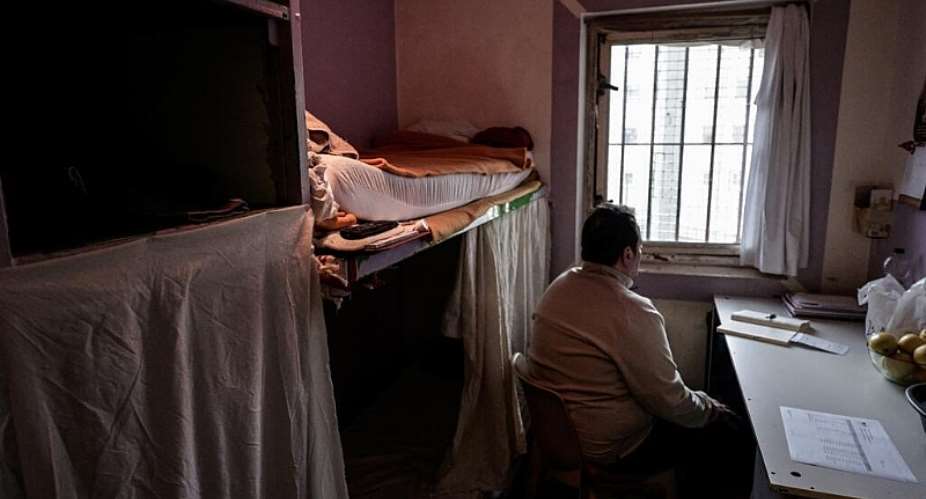
Even the highest prison walls can't keep out the heat. As temperatures rise past 40°C (104°F) across swaths of France, the heat creeps through thick concrete, slips down hollow pipes and seeps under the reinforced doors that divide the prisoners from the free.
France's prisons were not built to withstand these temperatures. Prisoners complain of scalding water spraying from the showers; prison guards, of centuries-old walls that hold the day's heat through to the early light of dawn.
André Ferragne, the secretary-general of France's Inspector General of Places of Deprivation of Liberty, said that just about everything about how France's prisons were set up made them deeply unsuited to the heatwaves that sweep the country with increasing intensity each summer.
“Firstly, prison buildings are often run-down, poorly maintained and, of course, very, very poorly insulated,” he said. “So they offer absolutely no protection against the heat, or indeed against the cold.”
On the other side of the bars, sweating through their stab vests, the guards tasked with overseeing the detainees aren't spared either. Wilfried Fonck, the secretary-general of the UFAP-UNSa Justice correctional workers union, said that prison staff were also struggling with the sweltering conditions.
“Prisons are completely overwhelmed by this heatwave,” he said. “One of my colleagues told me, 'Right now, I feel like I'm working in a kettle' – and that image says a lot. Yesterday, temperatures reached 37 degrees inside some detention centres, particularly in eastern France.”
France's prisons are among the most overcrowded in Europe – only Cyprus and Slovenia rank worse. Official figures showed that the country's carceral system held a record-breaking 88,654 detainees as of May 1, an increase of almost 5,000 people over the past year. Just 750 places were created across France's detention centres over the same period. Detainees are pictured in their prison cell at the Hauts-de-Seine remand centre, in Nanterre, suburbs of Paris, on January 15, 2026.
Overall, France's prisons have an overcrowding rate of 140 percent. That figure rises sharply to more than 172 percent for the country's remand centres, built to hold people awaiting trial – and therefore presumed innocent – and people sentenced to fewer than two years behind bars.
Under these conditions, Ferragne said, multiple prisoners are often crammed into stifling cells built to hold a single occupant. As of the start of May, official figures show that some 7,693 people were forced to sleep on mattresses laid out on the cell floors due to the lack of beds for the rising number of detainees.
“The standard is nine square metres per person, plus three square metres for each additional person,” he said. “So when you have overcrowded prisons, you end up with two people, sometimes even three, in nine square metres – and because you have to put mattresses on the floor next to the beds, there's absolutely no room to move.”
Watch more French prisons: A ticking time bomb
Unlike prisons in many parts of the world, French detention centres don't have communal canteens. Instead, inmates eat in their cells, often having to re-heat the platters that slide through the doors themselves.
On top of that, Ferragne said, many cells have toilets partially open to the rest of the space. Combined with a chronic lack of ventilation due to the reinforced windows, the atmosphere can quickly become suffocating.
“You can have multiple heat sources, overcrowding, the inability to air out the space – and a very, very long time spent in the cell,” he said.
Detainees in France's overcrowded remand centres can spend up to 22 hours a day in their cells, with two short turns around the exercise yard a day often their only reprieve from the monotony. A detainee is pictured in his prison cell at the Hauts-de-Seine remand centre, in Nanterre, suburbs of Paris, on January 15, 2026.
Fonck said that inmates' tempers often ran high as the temperature rose, stoking the risk of violence between detainees or towards prison staff.
“When you have cells that are meant for one person and you put two, three or four people in them, things inevitably take on a completely different tone,” he said.
“The tension that's already there only gets worse. As soon as people start to feel a bit too hot, even the slightest annoyance is bound to take on much greater proportions.”
Read more France's overcrowded prison population reaches all-time high – for months on end
France's chronic overcrowding has come under heavy criticism from international bodies tasked with preventing people in detention from being subjected to inhumane or degrading treatment. Following a week-long visit to 18 places of detention across the country, a UN Subcommittee on Prevention of Torture delegation's assessment was damning.
“Prison overcrowding is one of the most pressing challenges observed during this visit. It directly undermines the fundamental rights of prisoners, and its consequences extend far beyond the prison environment,” delegation head Suzanne Jabbour said in a statement. “In some of the facilities visited, the conditions observed may constitute inhuman or degrading treatment under international law.”
A Council of Europe delegation warned that the ram-packed prisons risked turning into “human warehouses”.
Alternatives to prison
Fonck said that understaffing and overcrowding were making it harder and harder for correctional officers to carry out their work safely.
“The projections we're being given for the end of this year or early 2027 are for 100,000 inmates with the same number of prison places as now,” he said.
“We can't push the walls back. We need to find effective solutions. Not only do we need more staff to work in decent conditions and, above all, in conditions of optimum safety, but it's also a matter of considering how we can either prevent certain incarcerations – that is, thinking about all possible alternatives to imprisonment – and also exploring all possible options for adjusting sentences so that prisoners can be released within a framework that is somewhat safer than an unconditional release.” Correctional staff take part in a day of strike, blocking off access at the entrance of the prison of Beziers, southern France, on April 27, 2026. The CGT and UFAP-UNSa unions called for a day of strikes to protest chronic understaffing and overcrowding.
Shifting away from a system of mass incarceration has struggled to find popular support in France, where politicians campaigning on law-and-order platforms continue to push for stricter penalties for criminals.
And while the country has signed into law clear alternatives to imprisonment, including daily fines, community service and work-release programmes, Ferragne said that these measures had done little to stem the number of people being put behind bars.
“The result is that these systems have grown in scale while the incarceration rate has continued to climb,” he said. “So in reality, what we have done is not to create alternatives to incarceration, but simply to widen the scope of the criminal justice system.”
Ferragne said that France's dilapidated prison infrastructure needs widespread renovations to better prepare them for the worsening weather extremes of coming years.
“I think the first thing to do is ensure the construction quality of prisons, because right now the prisons aren't adapted to heatwaves – or to any other kind of weather,” he said. “The heat makes the conditions in which detainees are housed worse, but really it's just exacerbating conditions that are already bad the rest of the year.”
But he added that the structural problems in France's bloated prison system went well beyond concrete and foam cladding.
“The prison system, overburdened as it is, means that movement within prisons is virtually impossible – impossible to manage, impossible to organise,” he said. “The idea, therefore, is that by both reducing the prison population and reviewing the internal prison regulations, we could make it easier for prisoners to actually leave their cells.”

 Highly influential people sponsoring Ghana Jollof TikTok activities – CID
 'Ghana Jollof' case: Bawumia's condemnation of nurse's arrest is hypocritical – ...
 Ahafo Ano South West MP involved in road accident
 Constitutional Review alone will not solve Ghana’s problems – Kwesi Pratt Jnr.
 East Legon Football Academy applauds NPA Boss for supporting youth football
 Gov't didn't show NPP enough respect in constitutional review process – Martin K...
 September 18: Cedi sells at GHS12.15 on forex market, GHS11.53 on BoG interbank
 Lawyer challenges two-week remand of Salomey over connection to wanted 'Ghana Jo...
 Minority calls for NSA boss Ampofo Ankrah, others to be dismissed over alleged 2...
 ‘You gave us GH¢60,000 to run 66 offices nationwide and expect us to function?’ ...


