




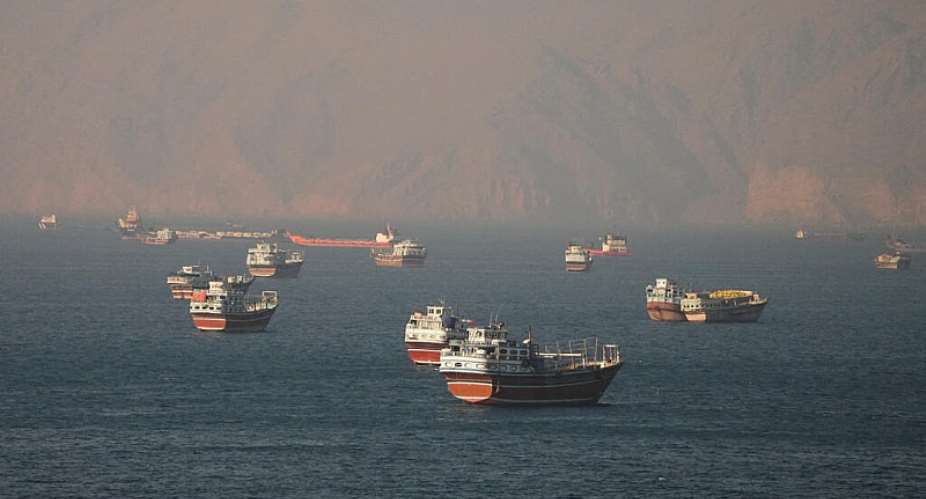
There is no independent confirmation that Iran has mined the waterway, but maritime authorities have warned of suspected and confirmed mines in the area and vessels have reported seeing floating objects.
Around one-fifth of the world's oil passes through the Strait of Hormuz. Under the US-Iran memorandum of understanding signed on 17 June, Iran is expected to lead any de-mining operation, although France and the United Kingdom have offered to contribute to an international coalition.
While commercial traffic has resumed, it remains well below pre-war levels. The question now is whether shipowners, crews and insurers can be confident the passage is safe.
Lavault explains how naval mines are laid and why clearing the strait could take anything from days to months.
RFI: Access to, management of and control over the Strait of Hormuz remain at the centre of tensions. Even on Thursday morning, Iran's Revolutionary Guard warned that no vessel should cross the strait without its permission. How do you secure this strategically vital waterway, and do we know for certain whether it has been mined?
Admiral Éric Lavault: I honestly couldn't tell you. I don't know whether the Strait of Hormuz has been mined. There have been reports here and there of ships spotting floating objects in the Gulf or in the strait itself. But at this stage, nothing proves it. Even if we can't rule it out, we have to make sure it hasn't been mined. That means carrying out a verification operation.
RFI: That is one of the characteristics of mine warfare, isn't it? There is a psychological dimension. The mere idea that the area might be mined is enough to have an effect.
ÉL: Absolutely. That is exactly what mine warfare is about. It is a low-cost weapon with a major strategic impact. The psychological effect is collective and quickly affects international markets, shipping insurance premiums and transport costs. It can drive huge inflation.
No lifting of UN sanctions on Iran without France's approval, FM says
RFI: In a way, Iran has already achieved part of its objective. De-mining is your speciality, but before we examine that, how do you actually mine a strait?
ÉL: Iran is believed to have a fairly large arsenal of naval mines. Let's start with bottom mines. As the name suggests, they sit on the seabed. They contain sensors that measure a ship's magnetic and acoustic signatures. They can also be programmed to count passing ships and explode only when a specific type of vessel passes overhead – a container ship, an oil tanker or an aircraft carrier.
RFI: So the mine can effectively listen and sense vibrations, allowing it to identify what kind of vessel is passing overhead?
ÉL: Exactly. The second is the one most people picture – it is attached to the seabed by a chain and floats below the surface, around the waterline of passing ships. It has contact horns and explodes when a vessel hits it. The third is a variation of that, you cut the chain and allow the mine to drift freely.
RFI: So it comes to the surface?
ÉL: Yes. That may well be the type some sailors have reported seeing. It is also the kind we have seen in the Black Sea.
Then there is a fourth method. It is a little more unusual, but one the Revolutionary Guard is particularly fond of. Fast boats quietly approach a passing vessel from behind and attach limpet mines to the hull at the waterline. The explosives are then detonated, blowing a hole in the ship.
RFI: That is a specialised operation – almost a commando raid against a ship.
ÉL: It's certainly more unconventional, but it's an approach they favour.
RFI: Are some mines more dangerous than others?
ÉL: The most destructive is the bottom mine. Its effect is similar to that of a torpedo. It breaks the ship's keel – the vessel's backbone – causing it to sink very quickly. The effect is comparable to that of an Iranian naval vessel sunk by an American submarine a few months ago.
Inside Iran's new two-tier internet access, as blackout drags on
RFI: If Iran's Revolutionary Guard laid the mines, they would know exactly where they are.
ÉL: Normally, yes. If the operation has been carried out properly, every minefield is carefully mapped.
RFI: Under the agreement reached after the conflict, Iran is expected to take responsibility for clearing any mines. France and the UK have proposed an international coalition to help secure the Strait of Hormuz. What could the French Navy contribute to an operation like this?
ÉL: Europe, and France in particular, has a great deal of expertise in this field. For decades, we have been clearing unexploded ordnance left over from the Second World War. As part of France's maritime safety operations, around 40 tonnes of explosive devices are neutralised every year.
RFI: So every year, French teams still recover around 40 tonnes of wartime explosives from our coasts. That gives the French Navy particular expertise.
ÉL: Exactly. Our Belgian and Dutch partners have the same experience, as do the Baltic countries, because they face the same challenge in the Baltic Sea. A European mine warfare force could carry out this mission, although it certainly could not happen without Iran's agreement.
RFI: Operationally speaking, how does a mine clearance operation work? What are the different stages?
ÉL: You have to think of the Gulf and the Strait of Hormuz as a motorway with designated shipping lanes. Those lanes have been surveyed for years. The seabed has already been mapped, so we have a baseline picture of what it normally looks like. The first step is to compare today's seabed with that reference.
RFI: Can you then immediately tell whether an object is a mine?
ÉL: Not immediately. First, you detect an object. We use sound rather than ordinary cameras. By studying the shadow an object creates on the seabed, experienced operators can judge whether it might be a mine. Some modern mines are even designed to look like rocks, which makes the job more difficult.
Kharg Island, the fragile oil lifeline behind Iran's war economy
RFI: So first you map the seabed, then you detect suspicious objects...
ÉL: Then you classify them. And after that you identify them to confirm that they really are mines, and then you neutralise them. Traditionally, minesweepers deploy either self-propelled underwater vehicles – the predecessors of today's underwater robots and drones, which European navies have used reliably for decades – or bomb disposal divers.
RFI: And you were one of those divers?
ÉL: Yes.
RFI: So you're sending a person right up to the mine?
ÉL: Right up to it. But in every operation I'm aware of, no bomb disposal diver has ever been killed by a mine during a clearance mission. These are highly trained, highly qualified specialists. The risks exist, but they are understood, managed and carefully controlled.
RFI: So there is still risk?
ÉL: Of course there is risk. But it is a controlled risk, one that is accepted and managed through training and procedures.
RFI: Drones could also become a major asset, both for mapping the seabed and for detecting and neutralising mines.
ÉL: First, we need to make sure those systems are fully operational, which is not necessarily the case everywhere.
There is also the cost question. I would compare it to Rafale fighter jets shooting down Shahed drones with Mica missiles. A Mica missile costs around €3 million, while a Shahed drone costs around €50,000. If you use equipment costing tens of thousands of euros to destroy a mine, you have to ask whether the response makes economic sense.
RFI: How long could it take to clear the Strait of Hormuz?
ÉL: It depends entirely on how many mines there are.
RFI: If there are very few?
ÉL: If there are none, or only a handful, it could be completed in a matter of days. If there is a genuine minefield then you're probably looking at months.
This interview has been adapted from an audio version in French and lightly edited for clarity.

 Let's move from promises to action on disability rights — Dr Apaak
 Mahama confirms three Deputy Comptrollers-General for Ghana Immigration Service
 GoldBod to purchase 30% of gold output from large-scale mining companies effecti...
 ECOWAS Court did not rule on constitutionality of Torkonoo's removal — Kwesi Bot...
 Collins Adomako Mensah demands explanation for fresh electricity tariff hike
 Ghana pushes for high-integrity carbon markets at London Climate Week
 Ghana's judges need to update their jurisprudence - CDD boss on Larry Dogbe's 7-...
 Teenage pregnancy cases surge in Upper East, hit 2,205 in five months
 Oliver Barker questions legality of jail sentence for Larry Dogbe in Okyere cont...
 Awutu Senya East MCE allegedly storms Obaatanpa Radio for discussing NDC interna...


