




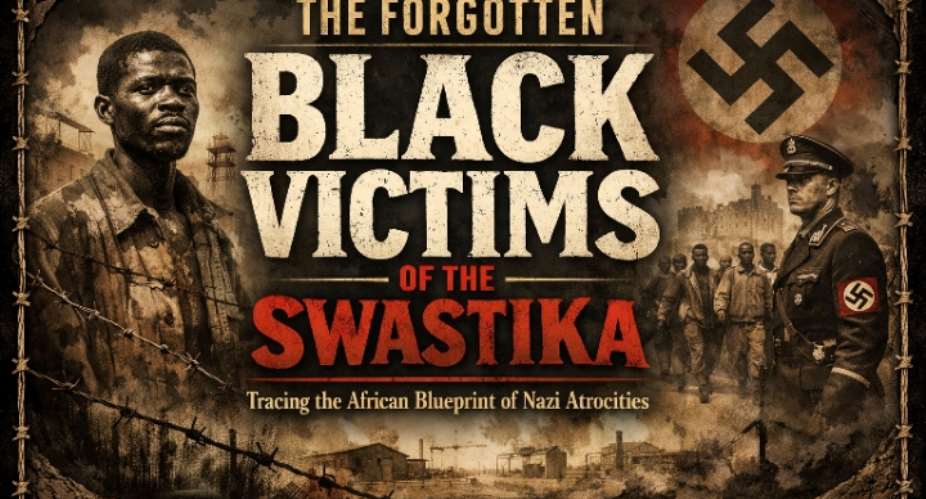
Unmasking a Stolen History
When West Africans think of the horrors of World War II and Adolf Hitler, the narrative often feels distant—a tragic, European war detached from African soil. For decades, global history curricula have pushed the experiences of Black individuals under the Nazi regime into the shadows. However, history tells a far more sinister truth that every Ghanaian, African, and person of Black descent must know: the ideological and technical framework of the Holocaust was not born in Berlin. It was engineered, tested, and weaponized against Black African bodies decades prior. Understanding Nazi Germany is not merely a lesson in European history; it is a critical confrontation with the global mechanics of military brutality, white supremacy, and anti-Black racism. This article serves to shatter this historical amnesia, unmasking the direct line from colonial African genocides to the targeted erasure of Black lives during the Third Reich.
1. The African Proving Ground: The Namibian Genocide (1904–1908)
Long before the construction of European death camps, Imperial Germany executed the first genocide of the 20th century in German South West Africa (modern-day Namibia). This horrific event laid the literal infrastructure for Nazi methodologies.
- The Extermination Order: In 1904, following an indigenous uprising against colonial land theft, German General Lothar von Trotha issued a written Vernichtungsbefehl (Extermination Order), declaring that every Herero man, woman, and child within German borders would be shot.
- Death by Attrition: German troops sealed off the Omaheke Desert, forcing tens of thousands of Herero people into the arid wasteland and poisoning water holes to ensure systematic starvation.
- Shark Island Concentration Camp: Survivors were forced into death camps where prisoners were worked to exhaustion. Herero women were forced to use glass shards to scrape the flesh off the decapitated skulls of their dead relatives so the bones could be sent to Germany for racial testing.
- The Genetic Blueprint: Dr. Eugen Fischer conducted horrific medical pseudo-science on these African prisoners. Fischer later became a prominent Nazi scientist, co-authored a textbook on racial purity that Adolf Hitler heavily integrated into Mein Kampf, and eventually helped draft the infamous Nazi Nuremberg Laws.
2. Generational Erasure: The Persecution of Afro-Germans
Within Nazi Germany, Black individuals were labeled Untermenschen (sub-humans) under the Nuremberg Laws. Because their numbers were relatively small, the regime sought their destruction not through immediate mass execution camps, but through systematic social and physical erasure.
- Forced Sterilizations: Children born to white German women and African colonial soldiers during World War I were derogatorily dubbed the "Rhineland Bastards." In 1937, the Gestapo rounded up hundreds of these multiracial children, forcibly sterilizing them without anesthesia to permanently stop the continuation of Black lineages.
- The Horror of Human Zoos: Afro-German citizens, such as survivor Theodor Wonja Michael, were stripped of citizenship and forced to perform in traveling Völkerschauen (human zoos). White audiences paid to touch their skin and hair, reinforcing state-sponsored colonial propaganda.
- Survival Through Movie Propaganda: Barred from higher education and traditional jobs, some Afro-Germans only survived by working as background actors in Nazi propaganda films. The Third Reich paradoxically needed Black actors to portray "loyal subjects" in films glorifying Germany’s lost African colonies.
3. Battlefield Brutality: The West African Massacres (1940)
The terror of Nazi Germany directly spilled over into the lives of West African soldiers fighting on the frontlines of Europe, exposing the lethal danger of racist military doctrines.
- The Massacre of the Tirailleurs Sénégalais: During the 1940 invasion of France, the German Wehrmacht captured thousands of West African colonial troops (including men from Senegal, Mali, Guinea, and Burkina Faso).
- Racial Executions: Driven by unyielding anti-Black Nazi ideology, German soldiers systematically separated Black soldiers from their white French counterparts. The African soldiers were marched into open fields and immediately slaughtered en masse using machine guns and tanks. An estimated 1,500 to 3,000 African soldiers were murdered on the spot.
A Call to Global Black Vigilance
The atrocities of Nazi Germany prove that anti-Black racism, when married to state power, moves seamlessly from geographical containment to global catastrophe. The historical continuum from the sands of the Namibian desert to the forced sterilization clinics of Berlin shows that African suffering has frequently served as a laboratory for global tyranny. For Ghanaians and Black people everywhere, honoring this history is an act of geopolitical survival. We must fiercely reject historical narratives that minimize our collective traumas or separate African history from global history. True emancipation requires that we document, teach, and remember every drop of Black blood spilled under the banner of racial supremacy, ensuring that "Never Again" truly applies to all of humanity.
Recommendations for Academic, Civic, and Military Engagement
1. For Lecture Halls of Military Training Institutions (KAIPTC, MATS, and Academies)
- KAIPTC Strategic Inclusion: The Kofi Annan International Peacekeeping Training Centre (KAIPTC) should integrate the study of the Namibian Genocide and the 1940 Wehrmacht massacres into its specialized courses on regional security, conflict prevention, and international humanitarian law (IHL).
- Commissioned Officers Curriculum: In the lecture halls of military academies, training for commissioned officers must analyze the 1940 French campaign to study how racialized political ideologies can corrupt professional military ethics, leading to state-sanctioned war crimes and the illegal execution of prisoners of war (POWs).
- NCO Professional Development: Non-Commissioned Officers (NCOs) should be taught these historical precedents in tactical ethics classes, emphasizing the vital role of NCOs in enforcing the Geneva Convention on the ground and resisting illegal, inhumane operational orders.
2. For Political Science and History Students in Universities
- Comparative Genocide Studies: University students should actively pioneer research comparing early German colonial administrative strategies in Africa (such as Vernichtungsbefehl) with the bureaucratic policies of the Nazi Third Reich.
- The Legacies of Eugenics: Investigate how early 20th-century "race science" conducted on Black bodies in Africa directly influenced international legal, medical, and scientific norms prior to World War II.
- Dissertation Focus: Explore the historical roles, experiences, and subsequent abandonment of West African troops (including the Royal West African Frontier Force) during major European theaters of war.
3. For Senior High Schools (SHS) and Educational Policymakers
- Curriculum Reform: The Ministry of Education and the Ghana Education Service (GES) should formally integrate the history of the Herero and Nama Genocide, alongside the experiences of Black people during the Holocaust, into the Senior High School (SHS) history and social studies curricula.
- Institutional Archiving: African educational institutions should collaborate with global entities like the United States Holocaust Memorial Museum (USHMM) to build localized digital repositories of African testimonies from the colonial era and World War II.
- Public Memorialization: Establish annual public discourse forums, lecture series, and cultural exchanges centered on Pan-African solidarity, exploring how these colonial historical intersections shape contemporary European-African diplomatic relations.
✍️ Retired Senior Citizen
For and on behalf of all Senior Citizens of the Republic of Ghana 🇬🇭
Teshie‑Nungua
[email protected]

 Let's move from promises to action on disability rights — Dr Apaak
 Mahama confirms three Deputy Comptrollers-General for Ghana Immigration Service
 GoldBod to purchase 30% of gold output from large-scale mining companies effecti...
 ECOWAS Court did not rule on constitutionality of Torkonoo's removal — Kwesi Bot...
 Collins Adomako Mensah demands explanation for fresh electricity tariff hike
 Ghana pushes for high-integrity carbon markets at London Climate Week
 Ghana's judges need to update their jurisprudence - CDD boss on Larry Dogbe's 7-...
 Teenage pregnancy cases surge in Upper East, hit 2,205 in five months
 Oliver Barker questions legality of jail sentence for Larry Dogbe in Okyere cont...
 Awutu Senya East MCE allegedly storms Obaatanpa Radio for discussing NDC interna...


