




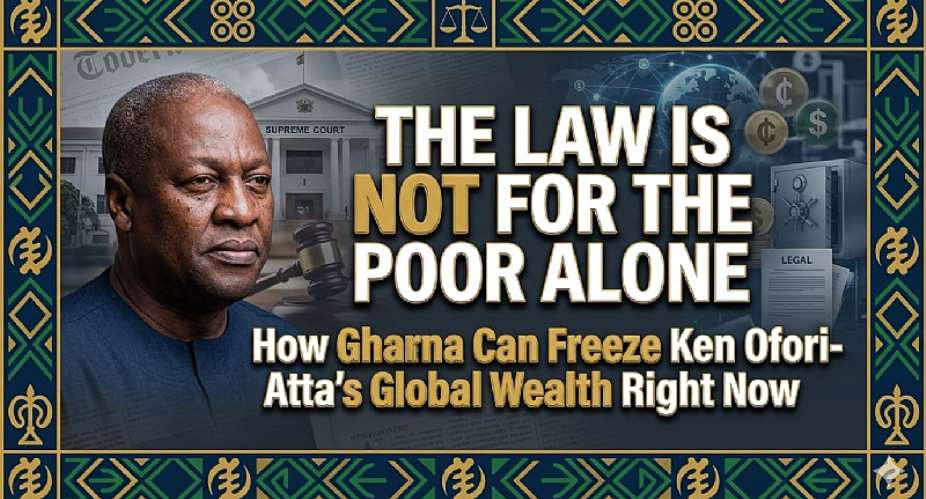
A Defining Moment for Ghanaian Justice
For years, ordinary Ghanaians have been told to tighten their belts, pay higher taxes, and endure harsh economic times. Meanwhile, those who managed the country's money are accused of living in luxury. Right now, former Finance Minister Ken Ofori-Atta faces 78 counts of corruption-related offences brought by the Office of the Special Prosecutor (OSP). These serious charges involve the controversial SML revenue scandal and the National Cathedral project.
Yet, instead of standing in an Accra court to defend his name, Ken Ofori-Atta is far away in the United States. He has managed to secure a U.S. Green Card, using medical treatments and foreign immigration laws to stay out of the reach of Ghanaian judges. If a rich and powerful politician can simply board a plane, fly abroad, and keep his wealth safe while ordinary citizens suffer, then our laws mean nothing. Under the firm leadership of H.E. President John Dramani Mahama, Ghana must stop this delay. We must use a powerful legal weapon called a Worldwide Mareva Injunction to freeze his wealth everywhere in the world and prove that no one is above the law.
What is a "Worldwide Mareva Injunction" in Plain Language?
To the man on the street, legal terms can sound like confusing jargon. Here is exactly what Order 25 of Ghana’s High Court Rules (C.I. 47) means for the average citizen:
- The Ultimate Bank Account Lock: Think of a Mareva Injunction as a universal remote control that locks a person's financial life. It is a court order that commands an accused person: "Do not touch, move, hide, or spend your money anywhere on earth until your trial is finished."
- It Attacks the Money, Not Just the Person: While Ghana is fighting a slow political battle to bring Ofori-Atta back physically through extradition, this law goes straight after his pockets. It stops him from transferring his wealth to offshore tax havens, foreign banks, or secret companies.
- Stopping the "Empty Theater": Ghanaian judges use this rule to make sure that if a court finds an official guilty of stealing state funds, the money is still there to be collected. Without it, a trial is just an "empty theater"—a long show that ends with the state winning on paper but getting zero Pesewas back.
How this Relates to Ken Ofori-Atta’s Escape from Justice
The criminal trial in Accra is currently stuck in a mud of legal technicalities. This is why a global asset freeze is urgently needed:
- The U.S. Green Card Distraction: Ofori-Atta’s lawyers successfully convinced a U.S. immigration judge to give him permanent residency by claiming his prosecution in Ghana is just political.
- The Extradition Waiting Game: Bringing him back physically requires a lengthy legal process through the U.S. Department of Justice. This can take years, giving him plenty of time to scatter and hide his wealth.
- Our Institutional Fights: Back home, the OSP and the Attorney General have been arguing in court over who has the right to prosecute high-profile cases. This internal fighting has paralyzed the trial.
- The Safe Haven Risk: While these local and international delays drag on, Ofori-Atta's vast financial footprint—including assets tied to Databank and foreign investments—remains completely active and unprotected.
Action Plan: Immediate Steps for President Mahama and Stakeholders
We cannot sit down and fold our arms while our national wealth sits unprotected in foreign countries. Here is what must happen immediately:
- President John Dramani Mahama Must Lead: The President must directly instruct the Attorney General and the Foreign Ministry to put heavy diplomatic pressure on the United States. Washington must know that Ghana expects full cooperation in tracking state assets.
- Apply for the Global Freeze Now: The OSP and the Attorney General must stop waiting for the criminal trial to restart. They must walk into a Ghanaian High Court tomorrow under Order 25 of C.I. 47 and get an order freezing Ofori-Atta’s global assets.
- Send "Mirror Orders" Abroad: Once the Ghanaian judge grants the freeze, our lawyers must take that order straight to courts in the U.S., the UK, and offshore banks to force foreign institutions to lock his accounts.
- The Judiciary Must Hurry: The Supreme Court of Ghana must stop allowing defense lawyers to use endless appeals to delay justice. High-profile corruption cases must be fast-tracked.
- Citizens Must Demand Accountability: Everyday Ghanaians, civil society groups, and the media must keep speaking up. We must ensure that public funds are returned to fix our schools, hospitals, and roads.
A Diplomatic Appeal to Leadership, Conscience, and Legacy
While the legal machinery of the state grinds through complex international channels, the pursuit of justice cannot rely on court orders alone. True leadership requires a moral compass that points toward accountability, even when the legal rules do not strictly demand it. To this end, a profound appeal is made to the conscience of the leadership of the New Patriotic Party (NPP), its National Communications Director Richard Ahiagbah, and former President Nana Addo Dankwa Akufo-Addo.
- To Richard Ahiagbah and the NPP Leadership: While it is legally accurate that a political party has no statutory mandate to enforce arrests or execute extraditions, a ruling party is the moral custodian of public trust. Standing on legal technicalities to distance the party from the actions of its most prominent appointees erodes the very faith citizens place in political institutions. The party leadership possesses immense social leverage. Making a formal, public appeal to Ken Ofori-Atta to voluntarily return and clear his name in an Accra High Court would be a historic demonstration of political maturity. It would signal to everyday Ghanaians that the party values institutional integrity over partisan protectionism.
- To Former President Nana Addo Dankwa Akufo-Addo: As the appointing authority who entrusted the management of Ghana’s economy to Ken Ofori-Atta for nearly eight years, your legacy is inextricably linked to the accountability of your administration. Throughout your distinguished career as a human rights lawyer and statesman, you championed the rule of law and the independence of state institutions. A quiet, statesmanlike intervention—appealing directly to your former minister to respect the judicial processes of the Republic—would protect your enduring legacy. It would reaffirm your lifelong commitment to ensuring that no individual, regardless of stature or proximity to power, is insulated from answering to the citizens of Ghana.
The Law Must Work for Everyone
The legal stalemate surrounding Ken Ofori-Atta is a test for our entire nation. If a poor man steals a goat in a village, he is jailed within days. If a powerful politician is accused of mismanaging billions of state funds, he should not be allowed to live comfortably in America while our local courts stall.
Justice is sweetest when it is pursued with dignity. By rising above partisan defense mechanisms and appealing to the conscience of the accused, the leadership that appointed and supported him can help heal the national psyche. They can demonstrate that in Ghana, the defense of the public purse is a shared moral duty that transcends party lines.
As President John Dramani Mahama drives his national agenda to reset Ghana's broken institutions, the state must act with speed and smart legal strategies. By using the Worldwide Mareva Injunction under Order 25 of C.I. 47, we can bypass the international red tape. We will freeze the wealth where it sits, protect the Ghanaian taxpayer, and send a clear message to all public officials: you can run, but your wealth cannot hide from the scales of Ghanaian justice.
✍️ Retired Senior Citizen
For and on behalf of all Senior Citizens of the Republic of Ghana 🇬🇭
Teshie‑Nungua
[email protected]

 Let's move from promises to action on disability rights — Dr Apaak
 Mahama confirms three Deputy Comptrollers-General for Ghana Immigration Service
 GoldBod to purchase 30% of gold output from large-scale mining companies effecti...
 ECOWAS Court did not rule on constitutionality of Torkonoo's removal — Kwesi Bot...
 Collins Adomako Mensah demands explanation for fresh electricity tariff hike
 Ghana pushes for high-integrity carbon markets at London Climate Week
 Ghana's judges need to update their jurisprudence - CDD boss on Larry Dogbe's 7-...
 Teenage pregnancy cases surge in Upper East, hit 2,205 in five months
 Oliver Barker questions legality of jail sentence for Larry Dogbe in Okyere cont...
 Awutu Senya East MCE allegedly storms Obaatanpa Radio for discussing NDC interna...


