




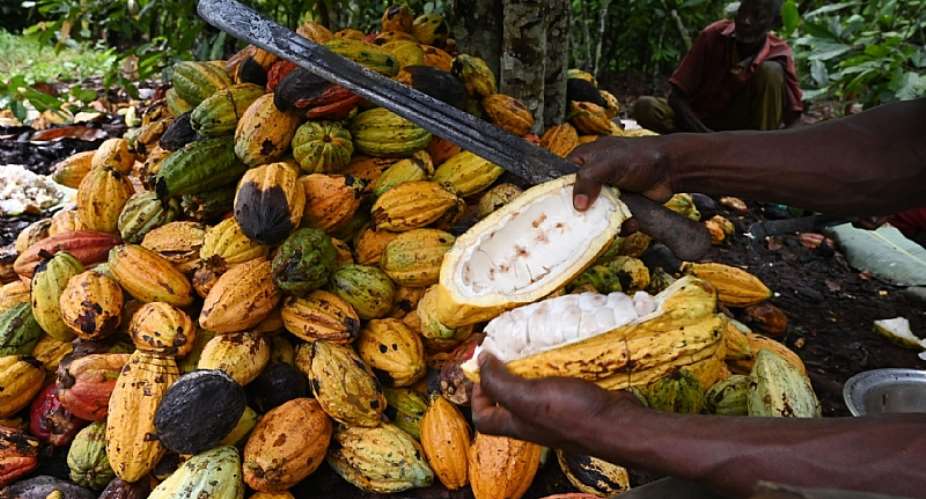
For decades, policymakers, industry actors, researchers and development partners have focused on a familiar challenge: how to protect cocoa trees and increase cocoa production. Significant investments have been made in mass spraying, disease control, rehabilitation programmes, improved planting materials, artificial pollination, extension services and, more recently, efforts to improve farmer incomes through initiatives such as the Living Income Differential (LID).
Yet despite these interventions, Ghana's cocoa sector continues to face mounting difficulties. National production has fallen from historical averages of around 800,000 tonnes to approximately 600,000 tonnes in recent years. Farmers continue to report declining yields, increasing production costs, labour shortages, and growing uncertainty about the future of cocoa farming. The question is obvious: why does vulnerability remain so high despite substantial investments?
New research conducted in Ghana and Côte d'Ivoire suggests that we may be asking the wrong question. Climate change is no longer only a threat to cocoa production; it is increasingly becoming a threat to cocoa producers themselves.
Across cocoa-growing communities, farmers consistently report rising temperatures, prolonged droughts, erratic rainfall, physical exhaustion, reduced working hours and increasing anxiety about their livelihoods. Many struggle to implement adaptation measures because they lack the necessary financial resources. Others are questioning whether cocoa farming remains a viable livelihood under increasingly unpredictable climatic conditions.
The implications are profound. If cocoa producers become less healthy, less productive and less able to adapt, then no amount of investment in cocoa trees alone will secure the future of the sector. What Ghana needs is a fundamental shift from a yield-centred climate policy to a producer-centred climate policy. Such a shift does not mean abandoning productivity goals. Rather, it recognizes a simple reality: a climate-resilient cocoa sector requires climate-resilient cocoa producers.
Eight priorities should guide this transition.
First, we must move from a narrow focus on yields to a broader focus on producer resilience. Success should not be measured solely by tonnes of cocoa produced but also by whether farmers are becoming healthier, more adaptive and better able to withstand climate shocks.
Second, climate adaptation must complement price and income interventions. Higher farmgate prices remain essential, but prices alone cannot offset climate-related production losses. Living incomes increasingly depend on living resilience.
Third, Ghana must invest more aggressively in climate-smart water management. Water harvesting systems, community reservoirs, moisture conservation measures and carefully targeted irrigation pilots can help farmers cope with prolonged dry spells and increasing rainfall variability.
Fourth, adaptation should be treated as an investment challenge rather than simply an information challenge. Farmers often know what needs to be done but lack the financial means to implement adaptation measures. Climate adaptation financing should therefore become a central pillar of cocoa policy.
Fifth, greater attention must be given to farmer health and labour productivity. Heat stress, physical exhaustion and declining work capacity are emerging risks that directly affect production. Climate adaptation should include occupational health measures, labour-saving technologies and interventions that reduce the physical burden of cocoa farming.
Sixth, adaptation support must move beyond information delivery towards practical implementation support. Training is important, but knowledge alone cannot overcome financial barriers, labour shortages or infrastructure deficits.
Seventh, farmers must have a stronger voice in cocoa governance. Too often, policies are designed for farmers rather than with farmers. Meaningful participation in policy design, implementation and monitoring can improve both legitimacy and effectiveness.
Finally, cocoa resilience should be viewed as a national economic resilience issue. Cocoa remains one of Ghana's most important export commodities and a major source of rural livelihoods. Strengthening producer resilience is therefore not merely an agricultural objective; it is an economic and development imperative.
Some may argue that the answer lies simply in increasing cocoa prices. Higher prices are indeed important and should remain part of the solution. However, climate change is increasingly reducing the volume of cocoa that farmers are able to produce and sell. A farmer who harvests fewer bags because of drought or heat stress cannot fully benefit from higher prices. This is why income policies and adaptation policies must work together rather than compete for attention.
The future of Ghana's cocoa sector will not be determined solely by the health of cocoa trees. It will also be determined by the health, wellbeing, productivity and resilience of the farmers who cultivate them.
The sustainability debate must therefore evolve. We can no longer focus exclusively on protecting cocoa production. We must also protect cocoa producers. The evidence is becoming increasingly clear: Ghana's cocoa future depends not only on climate-resilient farms, but on climate-resilient farmers. The sooner our policies reflect this reality, the better positioned the country will be to secure the future of one of its most important sectors.
Dr Albert Arhin is a Development Consultant, Sustainability Researcher and Research Fellow of the Institute for Rural Development and Innovation Studies (IRDIS), Kwame Nkrumah University of Science and Technology, Ghana. His email address is: [email protected]. Richard Tetteh is a Research Consultant and an Associate at the Institute for Rural Development and Innovation Studies (IRDIS), Kwame Nkrumah University of Science and Technology, Ghana.
 NDC is a useless govt – Miracles Aboagye fumes
 66-year-old woman remanded over death of toddler in her care after alleged hot w...
 Ghana suspends all gun licences over public safety concerns
 Govt eyes 1,012km rail corridor to boost trade, transform cargo transport from T...
 Rent Control Task Force begins nationwide crackdown on illegal rent charges
 Mahama’s delay in appointing Environment Minister shows lack of seriousness on c...
 Late Victor Gbeho's contributions to Ghana's foreign policy will never be forgot...
 June 23: Cedi sells at GHS12.35 on forex market, GHS11.22 on BoG interbank
 SHS graduation was never part of the GES calendar – Kwadwo Poku
 World Cup 2026: We know how England play, and we know how to control them – Ghan...


