




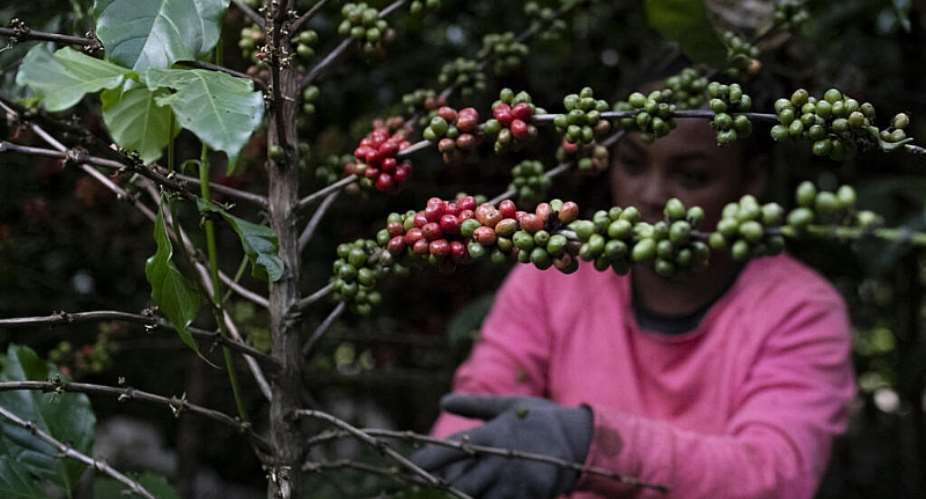
The report's authors say the biggest concern is not what ends up in consumers' cups, but the health and environmental damage linked to intensive coffee farming.
"Poison in Your Coffee", was compiled by Coffee Watch, an NGO, and draws on several hundred scientific studies examining the health and environmental impacts of intensive coffee farming.
"Our report is our effort to sound the alarm," Etelle Higonnet, one of the report's authors, told RFI.
"There are traces of pesticide residues in one in five cups of coffee that consumers drink. But the real catastrophe is that workers are being poisoned."
Coffee is one of the world's most pesticide-intensive crops, the report said. In Kenya, for example, coffee farming accounts for nearly one-quarter of all pesticides used even though it covers only about 1 percent of agricultural land.
How Brazil's booming coffee industry is driving deforestation
Banned substances
Researchers identified 159 active substances approved for coffee production in the main countries studied. Among them are pesticides classified as probable carcinogens, neurotoxic substances or chemicals that can harm reproduction.
"What is even more striking is that 59 to 60 percent of pesticides used in coffee are banned in Europe because they are considered too dangerous," Higonnet said.
The report cites chlorpyrifos, banned in the European Union since 2020 because of concerns about its effects on children's neurological development, and imidacloprid, a neonicotinoid insecticide whose impact on pollinators has been widely documented.
The report also examines pesticide residues found in coffee sold on international markets. Between 2020 and 2024, pesticides were the most frequently reported risk for coffee in the European Union's rapid food alert system.
Data analysed by PAN Europe, the Pesticide Action Network, found that 23 percent of coffee samples tested in Europe contained pesticides banned in the EU.
"When residues are found in coffee, they are often a cocktail of pesticides rather than a single substance," Higonnet said.
The combined effects of these mixtures remain poorly understood, she said.
Tanzanian farmers in the shadow of Mount Kilimanjaro struggle to cope with climate change
Workers bear burden
Coffee Watch said the report's main concern is agricultural workers.
Around 25 million producers and 100 million workers worldwide depend on the coffee sector, yet access to protective equipment remains limited in many producing regions.
In the Dominican Republic, 87 percent of producers surveyed said they do not wear gloves or masks when applying pesticides. In India, two thirds of workers reported using no specific protection.
"Most farmers and workers have absolutely no access to training or protective equipment," Higonnet said.
Immediate effects of pesticide exposure include nausea, vomiting, dizziness, skin irritation and breathing problems, the report says. The authors say long-term exposure also carries serious health risks.
Some 14 percent of pesticides used in coffee production are classified as probable or confirmed carcinogens, the report found, while almost two thirds may be toxic to reproduction.
The report also points to links between some substances and neurodegenerative diseases such as Parkinson's, as well as effects on fertility and on the development of children exposed before birth.
"Cancers, fertility problems, reproductive disorders and cases of Parkinson's disease are being observed. These are not minor consequences," Higonnet said.
France recognises role in pesticide harm across Caribbean islands
Labels under scrutiny
Coffee brands increasingly promote labels and certifications that claim to meet environmental and social standards. But the report questions how effective those schemes are.
"When you drink certified coffee, it does not necessarily mean it is free of pesticides," Higonnet said.
Certification standards vary widely, making them difficult for consumers to compare.
No certification currently guarantees a decent income for all producers and workers in the coffee sector, Higonnet said.
The report said proven alternatives already exist. It points to agroforestry systems and agroecological farming methods that can greatly reduce dependence on pesticides while protecting biodiversity.
"We know perfectly well how to produce coffee that respects nature. Organic coffee exists. The solutions exist too. The question now is whether the coffee industry is ready to adopt them more widely," Higonnet said.
This article was adapted from the original version in French by Simon Rozé


 GoldBod’s gains must be weighed against full cost to Ghana – Prof. Bokpin
 ‘Afenyo-Markin’s smear campaign against me is about extortion’ – Sammy Gyamfi
 August 22: Cedi sells at GHS12.30 on forex market, GHS11.13 on BoG interbank
 There is a deliberate smear campaign against GoldBod from Minority – Sammy Gyamf...
 ‘If GoldBod wants credit, it must accept blame for losses’ – Dr Owusu Sarkodie
 Akosombo control system to be restored next month – Energy Minister
 ‘Temporary Akosombo system not very robust’ – Energy Minister on recent power ou...
 Mike Ocquaye Jr reacts to Adwoa Safo’s reported return to NPP Dome-Kwabenya race
 Foreign Affairs Ministry urges Tijjaniya pilgrims to Senegal to travel by air ov...
 Bono Police Arrest 36‑Year‑Old in GH¢1.1M Fake Gold Deal; Hunt for Three Others ...

