




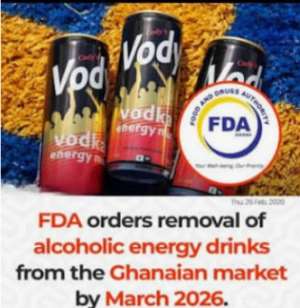
On February 25, 2026, the Food and Drugs Authority issued one of its most consequential public health directives in recent years, ordering every importer, manufacturer and distributor of mixed alcoholic energy drinks to clear such products from the Ghanaian market by the end of March 2026.
The notice, signed under Sections 81 and 82(a) of the Public Health Act, 2012 (Act 851), targeted beverages that fuse alcohol, a depressant, with stimulants such as caffeine, taurine, inositol, glucuronolactone, ginseng and guarana, a combination the Authority and public health advocates describe as one of the more dangerous packaging innovations to reach Ghanaian shelves in years. Four months on, the law on paper is unambiguous.
The landscape on the ground, particularly along the major arteries of Accra and Kumasi, tells a different story. Billboards advertising these very products, or visually indistinguishable successors to them, continue to loom over commuters on some of the busiest roads in the two cities, a quiet but visible signal that a directive meant to protect young and unsuspecting drinkers has yet to translate into enforcement where it is most seen.
The Ban and the Science Behind It
The FDA's directive did not emerge from nowhere. It followed what the Authority described as an exhaustive post-registration review of products combining alcohol with stimulants, an exercise that weighed both international regulatory precedent and emerging scientific evidence. The Authority concluded that several other countries had already restricted, suspended or outright prohibited the category, and that growing evidence pointed to serious health risks and harmful psychosocial behavior, particularly among young people and unsuspecting consumers.
The underlying danger is well documented by global health bodies. The Centers for Disease Control and Prevention has long warned that combining a stimulant with a depressant masks the physical signs of intoxication, so that a drinker feels more alert and in control than their blood alcohol level would suggest.
The result, as the Vision for Accelerated Sustainable Development Ghana noted in commending the ban, is overconsumption, riskier behavior on roads and in public spaces, and a wider exposure to liver disease, cardiovascular conditions and other non-communicable illnesses tied to heavy drinking. Internationally, the precedent cited by the FDA includes Sweden's restrictions following alcohol-related deaths and Lebanon's outright prohibition on the production, importation and marketing of the category.
Manufacturers caught in the directive were not asked to shut down operations outright. They were instructed to reformulate, separating alcoholic beverages and energy drinks into distinct, independently regulated product lines, with the end of March 2026 set as the date beyond which non-compliant products would attract sanctions including withdrawal from the market.
Enforcement on Paper, Absence on the Ground
What has followed the deadline is instructive. In late April, the FDA's Western North Regional office reported seizing more than two thousand one hundred units of banned alcoholic energy drinks, including well known brands sold under vodka and carbonated mix labels, in an operation explicitly framed as a check on whether the directive was being respected outside the capital.
That a dedicated regional enforcement sweep was needed a full month after the deadline suggests the Authority itself recognized that voluntary compliance could not be assumed. The operation, useful as it was, was also narrow in scope, confined to one region, and there is little public evidence of comparable, sustained sweeps targeting outdoor advertising in Accra and Kumasi, where the bulk of the country's beverage marketing spend and billboard inventory is concentrated.
This is where the gap becomes most visible to the ordinary commuter. Major corridors such as the Spintex Road stretch between Accra Mall and the eastern suburbs, sections of the Tema Motorway approach, and the principal routes linking Kumasi's central business district to its outskirts, are among the densest outdoor advertising corridors in the country.
The Advertising Association of Ghana has itself complained publicly this year about the state of that space, citing a thirteen kilometer stretch from Accra Mall through Spintex Road alone as an example of the clutter and non-compliance that audits, including one conducted with the National Road Safety Authority in 2024, found alarming. Against that backdrop, a directive ordering products off shop and bar shelves does little if the same products, or their rebranded equivalents, remain visible to hundreds of thousands of road users daily on billboards that were never required to come down.
This would not be the first time Ghana's outdoor advertising space has lagged behind its own regulatory text. A legal commentary on the FDA's advertising guidelines for energy drinks has previously observed, with some irony, that despite a clear requirement for energy drink adverts to carry health warnings about excessive consumption and restrictions for minors, pregnant women and caffeine-sensitive persons, such warnings are rarely if ever seen on the billboards and television adverts that actually run.
If a standing, long known requirement for health warnings on legal energy drink advertising has gone largely unenforced, there is little reason for confidence that a newer, more sweeping ban on an entire mixed product category will fare differently without a dedicated outdoor advertising enforcement push.
Why the Billboard Gap Matters
The FDA's own rationale for the ban rested heavily on protecting the young and the unsuspecting. Billboards are, by design, the advertising format with the least filtering. A shop shelf can be cleared by a single inspection visit. A billboard standing over a junction in Spintex, Achimota and Ring road or along the Angloga junction,Kumasi-Accra road is seen by every driver, trotro passenger, student and pedestrian who passes beneath it, repeatedly, for as long as it remains mounted.
Civil society groups such as VAST-Ghana have already pressed the FDA to go further and publish a public list of affected brands so that consumers are not left guessing which products remain illegal. The same logic applies, arguably with greater urgency, to outdoor advertising. A product can be quietly pulled from a back-street provision shop while its brand identity continues to be reinforced daily on a highway billboard, which keeps demand alive and signals to both consumers and retailers that the ban is more rhetorical than real.
There is also a parliamentary dimension worth noting. Ghana's government introduced the Alcohol Control Regulations Bill in February 2026, intended to give the FDA clearer authority over how alcohol is promoted, including broadcast timing and sponsorships reaching vulnerable groups, a move driven partly by data showing a significant share of school-age Ghanaians already drinking.
Until that bill is passed and its outdoor advertising provisions tested, the FDA's existing authority over billboard content for already-banned products remains the only available lever, and it is one that appears, at least along the Accra-Kumasi corridor, to be under-used.
Closing the Gap
None of this is an argument against the ban itself. The science cited by the FDA and reinforced by the CDC's warnings on masked intoxication is sound, and the public health case for separating alcohol from stimulant marketing is not in serious dispute. The argument here is narrower and more practical.
A market withdrawal order that stops at the shop counter while leaving brand advertising standing on the country's busiest roads is only half a policy. The FDA has the legal authority under Act 851 to compel the same compliance from advertisers and outdoor media owners that it has demanded from importers and distributors.
Until billboards in Accra and Kumasi reflect the same regulatory reality as the shelves they tower above, the ban on mixed alcohol and energy drinks will remain, for the ordinary road user, more a press statement than a lived fact.
Mustapha Bature Sallama.
Medical/ Science Communicator,
Private Investigator, Criminal investigation and Intelligence Analysis.
International Conflict Management and Peace Building.USIP
[email protected]
+233-555-275-880
References
Food and Drugs Authority directive, reported in Citinewsroom, "FDA orders removal of alcoholic energy drinks from Ghanaian market," February 25, 2026. https://citinewsroom.com/2026/02/fda-orders-removal-of-alcoholic-energy-drinks-from-ghanaian-market/
Graphic Online, "Mixed drinks combining alcohol and stimulants must vanish by April - FDA," February 26, 2026. https://www.graphic.com.gh/news/general-news/mixed-drinks-combining-alcohol-and-stimulants-must-vanish-by-april-fda.html
MyJoyOnline, "FDA orders removal of alcoholic energy drinks from Ghanaian market by March 2026," February 26, 2026. https://www.myjoyonline.com/fda-orders-removal-of-alcoholic-energy-drinks-from-ghanaian-market-by-march-2026/
Ghana News Agency, "VAST-Ghana commends FDA for ban on mixed alcoholic energy drinks," March 3, 2026. https://gna.org.gh/2026/03/vast-ghana-commends-fda-for-ban-on-mixed-alcoholic-energy-drinks/
MyJoyOnline, "FDA bans mixed alcoholic energy drinks: VAST-Ghana demands 'Name and Shame' list for public safety," March 3, 2026. https://www.myjoyonline.com/fda-bans-mixed-alcoholic-energy-drinks-vast-ghana-demands-name-and-shame-list-for-public-safety/
GhanaWeb, "FDA seizes over 2,100 banned alcoholic energy drinks," April 30, 2026. https://mobile.ghanaweb.com/GhanaHomePage/business/FDA-seizes-over-2-100-banned-alcoholic-energy-drinks-2032250
Food Business Middle East & Africa, "Ghana FDA orders withdrawal of alcoholic energy drinks from market by March 2026," February 28, 2026. https://www.foodbusinessmea.com/ghana-fda-orders-withdrawal-of-alcoholic-energy-drinks-from-ghanaian-market/
Graphic Online, "AAG demands clarity over billboard demolition exercise," February 18, 2026. https://www.graphic.com.gh/news/general-news/ghana-news-aag-demands-clarity-over-billboard-demolition-exercise.html
Trendtype Africa and Middle East, "Ghana aims to tighten rules on the advertisement and marketing of alcohol," February 5, 2026. https://trendtype.com/news/ghana-aims-to-tighten-rules-on-the-advertisement-and-marketing-of-alcohol/
Ghana Law Hub, "This Advertisement has been Vetted and Approved by the FDA," July 24, 2025. https://ghanalawhub.com/this-advertisement-has-been-vetted-and-approved-by-the-fda-2/
Chambers and Partners, "Advertising & Marketing 2025 - Ghana," Global Practice Guides, October 14, 2025. https://practiceguides.chambers.com/practice-guides/advertising-marketing-2025/ghana


 PMMC audits were initiated in 2024, not 2025 – Former MD replies Sammy Gyamfi
 Fire at GRIDCo’s Mallam Substation disrupts power supply to parts of Accra
 Chairman Wontumi’s lawyer says plea-bargaining talks with state ended over unfav...
 University Administrators demands 114% market premium before calling off strike
 We need your support in fight against illegal mining - Mahama appeals to chiefs
 Haruna Iddrisu orders suspension of Obuasi SHTS headmaster over alleged sexual m...
 World Cup visas: Hold TRIBE Culture Fest liable for defrauding applicants – Kofi...
 Police arrest farmer seen in viral video assaulting wife in Agona Nkwanta
 NDC appoints Julius Kwame Anthony as Deputy Communications Director
 French counter-terrorism body to investigate 14-year-old behind school shooting


