




Introduction
When the COVID‑19 pandemic forced schools worldwide to close, educators and learners in both urban London and rural Ghana discovered how fragile remote education can be when connectivity is unreliable. The shock exposed a persistent digital divide: while digital platforms promised equitable access, the physical networks connecting learners were uneven and often absent. In Ghana, gaps remain stark; only 19% of rural households have internet access, compared with 63% in urban ones. Limited incomes and weak infrastructure keep many families offline, yet mobile phones dominate connectivity about 68% of Ghanaian internet users connect via smartphones revealing both an opportunity and a constraint. To deliver effective remote learning, Ghana needs resilient, adaptive information architectures that leverage artificial intelligence (AI) and edge computing to personalise instruction and keep education accessible, even when bandwidth is low or intermittent.
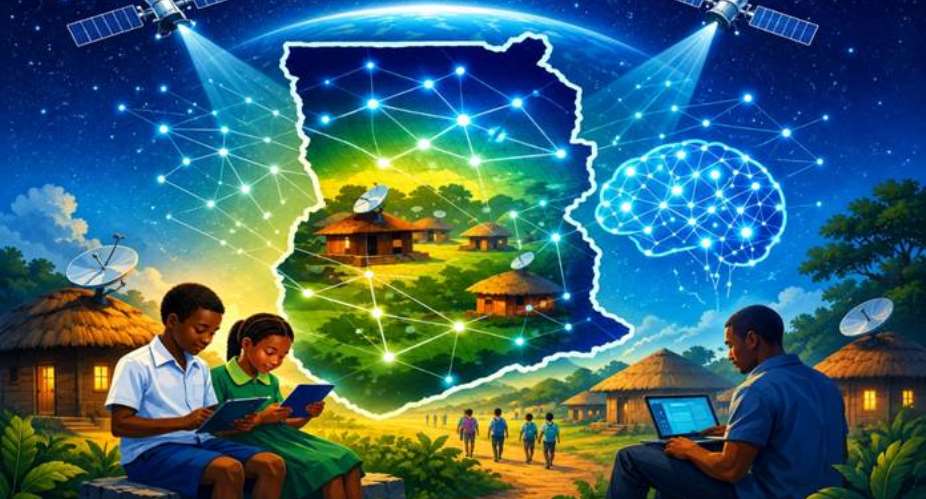
This article proposes a blueprint for AI‑driven adaptive information architectures tailored to Ghana’s remote learning landscape. Drawing on research in AI, network engineering and human–computer interaction, alongside recent initiatives in Ghana, it outlines a solution combining satellite connectivity, AI‑powered content adaptation, local caching and resilient network design, turning the digital divide into a digital bridge so rural learners can access education alongside their urban peers.
The Scope of the Connectivity Gap
Ghana has made measurable progress in expanding internet access, but deep inequalities persist. Between 2010 and 2021, national uptake rose from 8% to 69%, yet a pronounced rural–urban divide remains: 80% adoption in urban areas versus 54% in rural ones. Low household incomes, averaging 400 Ghana Cedis a month, make data prohibitive for many families, while frequent power outages and weak broadband further limit access. These disparities translate directly into educational inequity: rural students often cannot join online lessons, submit assignments or access digital libraries.
The divide is also visible in Africa’s broader infrastructure. The continent holds nearly 19% of the world’s population but less than 1% of global data‑centre capacity, with cloud capability concentrated in Southern and West Africa. Investments such as the 2Africa subsea cable, expected to triple the continent’s international internet capacity, will ease some constraints, but infrastructure alone will not guarantee equitable access.
Satellite Connectivity as an Immediate Bridge
Recent initiatives show how satellite technology can rapidly extend connectivity to underserved schools. In September 2025, the education platform Learning Upgrade partnered with the Our Future Prize, Starlink for Good, local NGO Friends of Adaklu and Ghana’s Ministry of Education to launch the Connecting the Unconnected programme. In just six days, the team deployed 52 Starlink kits across four regions - Volta, Oti, Eastern and Central, bringing high‑speed satellite internet to 52 rural schools. Each installation included one year of connectivity, teacher training and integration of the Learning Upgrade platform. At Akatsi Demonstration School, the intervention connected 214 students (including deaf learners) and 19 teachers for the first time, enabling sign‑language dictionaries, visual learning tools and virtual field trips.
Such initiatives show the potential of space‑based connectivity to leapfrog terrestrial infrastructure. Yet satellite bandwidth is finite and expensive, and connectivity alone does not ensure meaningful learning; the next challenge is to adapt content and delivery to variable network conditions and learner needs.
AI‑Driven Adaptive Learning and Offline Tools
Artificial intelligence offers two key capabilities for remote education: personalisation and adaptation to bandwidth constraints. AI‑driven adaptive learning platforms can analyse learner performance in real time and adjust the difficulty, format and pace of lessons. Algorithms based on reinforcement learning and predictive modelling can dynamically compress videos, switch to audio or text when bandwidth drops, or recommend alternative activities, helping maintain engagement when networks falter.
Importantly, AI tools do not require constant cloud connectivity. AI‑powered, offline‑compatible devices such as Mavis Talking Books demonstrate that even schools without reliable internet can benefit from advanced learning technologies. These solar‑powered audio devices come preloaded with stories and lessons in local languages; they can be updated periodically when connectivity is available and then operate offline. Similarly, Ghana’s partnership with Google, announced in January 2026, will deploy data‑free educational tools in local languages, Twi, Ewe, Dagbani and Hausa, offering curriculum‑aligned content without data charges.
AI also supports system‑level decision‑making, helping leaders monitor where learning deficits persist, flag at‑risk students and design targeted interventions. Evidence is promising: schools in Future Seeds Foundation programmes recorded a 32% rise in science performance and a 45% boost in students’ confidence with digital tools.
Edge Computing and Resilient Architectures
For AI‑enhanced platforms to perform under intermittent connectivity, edge computing and resilient network design are essential. Edge computing brings computation and storage closer to users, on local servers, smartphones or micro‑data centres, reducing latency and reliance on the cloud. When connectivity deteriorates, the system switches to offline or low‑bandwidth modes; once it is restored, data synchronises with cloud servers, updating analytics and learning progress.
The proposed adaptive architecture comprises three layers:
- Cloud Layer: Central servers host curriculum content, AI models and analytics dashboards, coordinating with edge nodes to update materials and aggregate learning data.
- Edge Layer: Local servers in schools or community centres cache content and host lightweight AI models that compress and adapt lessons in real time. In Ghana, where smartphones are widespread, mobile devices can act as micro‑edge nodes.
- Peer‑to‑Peer Layer: When connectivity is disrupted, devices form a mesh network to share resources and synchronise progress with nearby peers, ensuring continuous learning even in isolated settings.
These architectures align with Ghana’s Artificial Intelligence Practitioners’ Guide, which calls for deploying low‑bandwidth AI tools and public Wi‑Fi zones to achieve digital inclusion.
Implementation and Local Capacity
While the technical blueprint is critical, successful adoption depends on community engagement, capacity building and governance. The Starlink initiative underscores the value of a train‑the‑trainer model, in which local champions and support teams ensure that schools can maintain and expand their systems. Partnerships between NGOs, government and private providers are essential, and teacher training matters just as much: Future Seeds Foundation reports that many teachers initially lacked the skills to navigate e‑learning platforms, but after targeted training, participating schools showed marked improvements in performance and confidence.
Challenges and Risks
Implementing AI‑driven architectures in Ghana is not without challenges. Satellite service and edge equipment require upfront investment, so sustainable funding and public–private partnerships are necessary. Ongoing subscription fees can be prohibitive, and subsidies or universal service funds may be needed to avoid excluding low‑income households. AI systems also collect sensitive learning data, so robust governance is essential to protect student privacy. Content must support local languages and cultural contexts, and Ghana must expand AI training to address skill shortages and the risk of brain drain.
Conclusion: Toward an Equitable Digital Future
Bridging Ghana’s digital divide requires more than laying fibre‑optic cables; it demands intelligent, adaptive systems that respond to local conditions and empower learners regardless of location. By combining satellite connectivity, AI‑driven adaptive learning, edge computing and resilient network design, Ghana can create remote learning environments that are robust to bandwidth fluctuations and tailored to individual needs. The Starlink pilot, the promise of offline tools such as Mavis Talking Books and the commitment of government and partners to data‑free education all show that solutions are within reach.
Ultimately, AI will not replace teachers or students; it will augment them. As one expert observed, “Artificial Intelligence will not replace people, but people and nations that use AI will replace those that don’t.” Ghana has an opportunity to lead in using AI and satellite technology so that every child, whether in the heart of Accra or in a remote village, can access quality education. By investing in adaptive architectures, nurturing local talent and prioritising inclusive design, Ghana can turn its digital divide into a springboard for educational excellence and social equity.
Author
Joseph Borketey | AI Automation | Agentic AI | Member, IIPGH
For more info, contact: +44 7984754579 & email: [email protected]
 Wontumi's Samreboi case: Atta Akyea will try to delay judgement beyond July 3 — ...
 Uncovering challenges of NDC's Isaac Adongo’s grinding mill projects
 ECOWAS launches regional fortnight to empower women cross-border traders
 June 19: Cedi sells at GHS12.25 on forex market, GHS11.18 on BoG interbank
 Celebrate your WASSCE completion in a law-abiding manner — NUGS to 2026 candidat...
 Gender Ministry congratulates Ghana’s Dr Sylvia Ama Adusu on election as first A...
 Reparatory justice must restore humanity, not just compensate for its loss — Wol...
 ‘I believe our fasting and prayers will work’ — Prophet Uche’s words before Blac...
 Iran peace talks put on hold after Vance scraps Swiss visit
 No vaccine, conflict, mistrust: Ebola's return to DR Congo


