




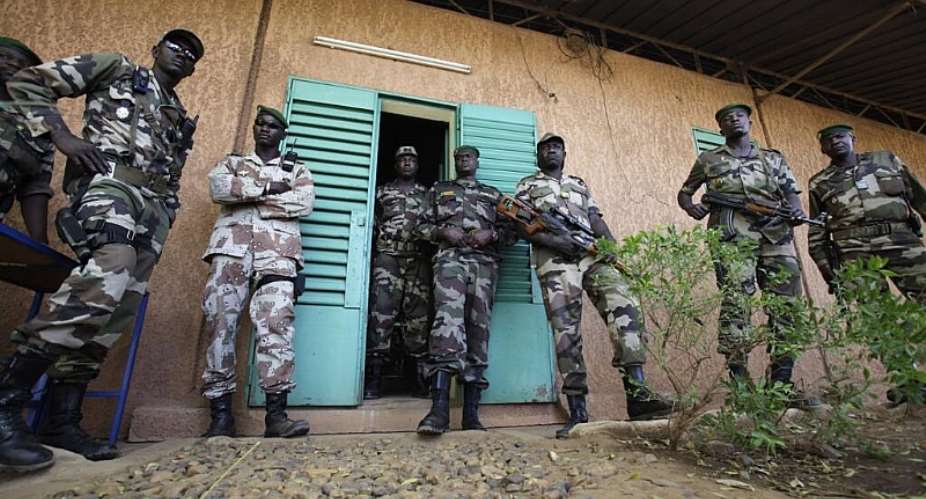
The attack began early on Thursday and lasted for several hours. Niger's defence minister said security forces repelled the assault, killing 22 attackers and arresting about 20 suspects.
In a statement the minister said "13 martyrs – including 11 members of the defence and security forces – and two civilians had died in the "treacherous attempted incursion". Four others were wounded.
The ministry added that a “large-scale operation” by the army was underway at the international airport, which remained fully secured and open to air traffic.
A separate statement from Niger's civil aviation agency said normal operations at the airport had resumed.
In a brief statement published Thursday evening on its propaganda channel, Az-Zallaqa, the Group for the Support of Islam and Muslims (JNIM), Al-Qaeda's branch in the Sahel region, claimed to have carried out “a suicide attack on Diori Hamani International Airport and the neighbouring military base”.
The Fulani women living under the control of JNIM jihadists in the Sahel
Strategic site
The African Union Commission to the European Union delegation in Niger, via Algeria – expressed its “deep indignation", while Benin assured its neighbour of its "full solidarity" following Thursday's attack, the second on the airport complex this year.
On 29 January, an assault claimed by Islamic State in the Sahel (ISSP) left four soldiers injured and caused extensive damage.
Niger's armed forces and their Russian partners killed 20 combattants.
Junta leader General Abdourahamane Tiani accused France of being behind the attack as part of orchestrating destabilisation efforts – claims President Macron roundly rejected.
Diori Hamani International Airport and its adjacent 101st Air Force Base is one of the most sensitive and strategically critical sites in Niger.
It hosts advanced drone infrastructure and the joint military headquarters for Niger, Burkina Faso and Mali (Alliance of Sahel States) to combat jihadist groups.
It also stores a large shipment of uranium from northern Niger – stranded while awaiting export amid disputes with French firm Orano.
How a disinformation network is destabilising the Alliance of Sahel States
Rival jihadist groups
Niger, like neighbouring Mali and Burkina Faso, has faced years of attacks by jihadist groups linked to both al-Qaeda and the Islamic State.
JNIM and ISSP have increasingly competed for influence in the region. The two groups clashed in Niger for the first time in April.
"The attack points to the parallel expansion of JNIM and ISSP," said Heni Nsaibia, senior West Africa analyst for the Armed Conflict Location & Event Data conflict-monitoring group.
"Longstanding rivalry and competition for regional dominance are likely driving increasingly frequent high-impact attacks against strategic and symbolic targets", he added.
(with newswires)

 Celebrate your WASSCE completion in a law-abiding manner — NUGS to 2026 candidat...
 Gender Ministry congratulates Ghana’s Dr Sylvia Ama Adusu on election as first A...
 Reparatory justice must restore humanity, not just compensate for its loss — Wol...
 ‘I believe our fasting and prayers will work’ — Prophet Uche’s words before Blac...
 Iran peace talks put on hold after Vance scraps Swiss visit
 No vaccine, conflict, mistrust: Ebola's return to DR Congo
 Obama opens Chicago presidential center, urges Americans to defend democracy
 US forces lift Iran ports blockade as uncertainty clouds planned Switzerland tal...
 Fire destroys five-bedroom house; family, tenants rendered homeless
 Timber Millers accuse, demand arrest of trade association members behind attack ...


