




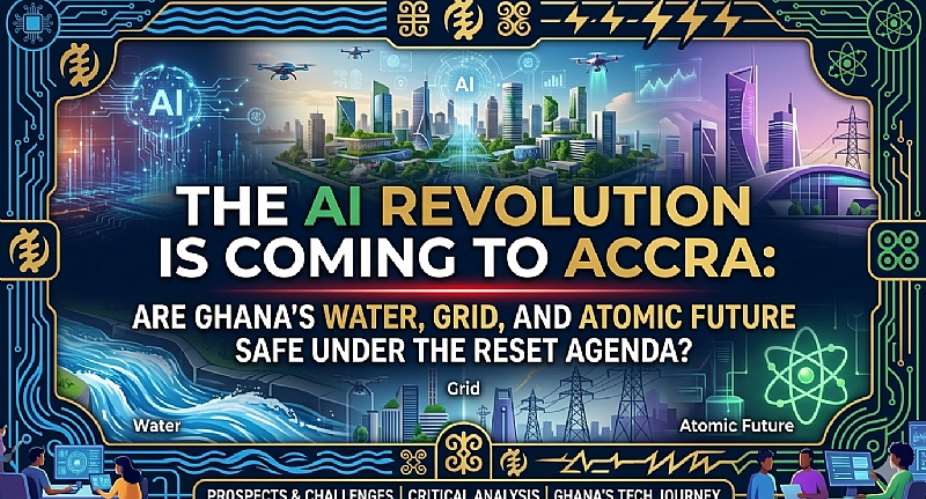
Artificial Intelligence is no longer just a digital talking point on our phones; it is an incoming physical infrastructure wave rewriting the global economy. As Ghana accelerates its digital transformation—highlighted by the launch of Digital Realty’s state-of-the-art 1.7-megawatt ACR2 Data Centre in Accra and new hubs in Kumasi—we must look beyond corporate public relations. While major tech companies make bold sustainability pledges, the massive infrastructure required to power and cool these AI servers relies heavily on resource extraction and fossil fuels.
Globally, data centers are driving the restart of obsolete coal plants, draining critical river basins, and relying on minerals tied to child labor. Because AI models require continuous communication across hardware, chips are grouped into dense networks that multiply power demand at both the chip and server rack level. As our Ministry of Energy pushes to integrate nuclear power into our grid, Ghanaians must ask the hard questions now before these energy-hungry machines outpace our national capacity and swallow our public resources.
The Global Warning Sign: Supply Chains and Resource Strains
To understand the risk to Ghana, we must look at the hidden reality of global AI data center supply chains and resource extraction networks:
- Fossil Fuel Lifelines: The sudden, immense electrical demand from AI has driven global utilities to keep aging fossil-fuel facilities online. In the United States, plants like Georgia Power's Plant Bowen and Plant Scherer delayed planned closures to sustain data center growth.
- Severe Human Exploitation: Rechargeable batteries and tech infrastructure utilize cobalt, over half of which is sourced from the Democratic Republic of Congo. Global human rights organizations like Save the Children and Amnesty International have documented toxic chemical exposure, forced evictions, and thousands of children working in unregulated, hazardous artisanal mines to supply global tech hardware.
- The Regulatory Shift: To combat this, frameworks like the EU's Corporate Sustainability Due Diligence Directive (CSDDD) now mandate that massive corporations audit global value chains to identify and eliminate child labor. Tech companies are scrambling to use blockchain systems like the ReISource Initiative (piloted by mining giants Glencore and CMOC) to log zero-child-labor certifications via tamper-proof ledgers before minerals blend with uncertified materials.
Regional Realities: The West African Data Hub Pressure
As the tech sector builds out data infrastructure across West Africa, neighboring countries are already grappling with intense grid and resource conflicts:
- Nigeria's Grid and Water Strain: In tech hubs like Lagos, over 60% of residents lack consistent access to potable municipal water. Sprawling data center installations in Ikoyi and Victoria Island are facing severe pushback because a single 1-megawatt facility can consume up to 25.5 million liters of water annually for cooling. The Nigerian Electricity Regulatory Commission (NERC) is actively tightening captive power generation mandates, forcing tech hubs to deploy off-grid gas or solar infrastructure to protect an already fragile national grid.
- The West African Power Pool (WAPP) Vulnerability: West African nations are tightly interconnected via the WAPP grid network. If one nation allows hyper-dense AI data server farms to over-allocate local generation capacity, the resulting supply deficit can trigger cascading blackout risks across interconnected national boundaries—directly affecting cross-border partners like Togo, Benin, and Burkina Faso.
The Hard Numbers: Ghana’s Current Grid Reality
- A Thin Safety Margin: According to recent Energy Commission and GRIDCo Power Outlooks, Ghana’s available dependable generation capacity hovers around 5,016 MW to 5,060 MW, while historic peak system demand has climbed to 4,168 MW.
- The Impending Deficit: GRIDCo has explicitly warned that the national power network faces an active capacity deficit because the grid falls short of the vital 18% planning reserve margin required to prevent operational failures and systemic load shedding.
- The AI Power Spike: Traditional cloud racks pull a predictable 5 to 15 kW of power. Next-generation AI racks draw an astronomical 40 kW to 100+ kW per single rack. State-of-the-art NVIDIA H100 GPUs pull 700W, while newer Blackwell B200 chips demand up to 1,000W each. A single 8-GPU server node draws 7 to 8 kW instantly for computing processors alone. Without immediate intervention, integrating massive AI computing hubs will rapidly wipe out Ghana's remaining reserve margin and trigger massive domestic grid stress.
- The Local Water Crisis: Standard data centers utilize ambient air cooling optimized for racks under 20 kW. Because dense AI configurations exceed 40 kW per rack, air cooling fails completely, forcing infrastructure teams to rely heavily on water evaporation for cooling. With global experts warning that data center water footprints could soon equal the domestic water needs of Sub-Saharan Africa, allowing foreign tech firms to draw millions of liters daily from local watersheds poses an immediate threat to our ecological security.
A Direct Call to the Flagstaff House: A Message to President John Dramani Mahama
Mr. President, your flagship 24-Hour Economy Programme and Accelerated Export Development Agenda (24H+) have laid a bold, transformative roadmap designed to transition Ghana into a 24/7 industrial production powerhouse. This technology-driven strategy is exactly what our youth need to unlock 1.7 million quality jobs.
However, you must not rest on your oars. A 24-hour economy requires an unyielding, resilient, and bulletproof electricity grid. You cannot build a 24/7 digital manufacturing and logistics empire if high-density data hubs are permitted to step in and swallow our baseline electricity reserve, leading back to the dark days of dumsor.
The "Reset Agenda" must actively include a strict regulatory reset for the tech sector. True economic sovereignty means ensuring that global tech corporations build out their own clean energy generation infrastructure rather than cannibalizing the public power grid intended to fuel domestic Ghanaian factories and local industries.
Key Recommendations and Strategic Suggestions
- Enact Strict Local Water Restrictions: The Environmental Protection Agency (EPA) and the Energy Commission must ban traditional evaporative, water-consuming cooling systems for all newly proposed data facilities. Tech operators must be legally mandated to deploy water-free, closed-loop liquid cooling setups or advanced two-phase immersion cooling systems where server nodes are fully submerged in non-conductive dielectric fluid.
- Implement Mandatory "Grid-First" Tax Policies: Ghana should learn from US states like Virginia, Illinois, and North Carolina that are currently revoking or pausing data center tax breaks due to severe grid anxiety and surging power costs. We must pass laws forcing data center developers to build or fund their own dedicated solar, wind, small modular nuclear reactors (SMRs), or battery storage networks so they do not pass infrastructure upgrade costs down to ordinary Ghanaian households.
- Enforce Digital Asset and Hardware Traceability: In alignment with international value-chain regulations, Ghana’s Ministry of Communications and Digitalization must require data hub providers to utilize verifiable blockchain tracking to prove all computing components entering our borders are entirely free from human rights exploitation or child labor in the mineral supply chain.
- Leverage Climate Realignment: If tech companies want to set up shop in Ghana, they must follow the path of global alternative hubs like the Nordic region (Norway, Sweden, Iceland) which absorb massive workloads strictly because they offer abundant, dedicated, baseload green energy like hydro and geothermal power.
The Billion-Dollar Question to Our Scientific Community
As our leaders step up the National Nuclear Power Programme with backing from the International Atomic Energy Agency (IAEA), our attention turns directly to the Ghana Atomic Energy Commission (GAEC) and our local energy regulators.
"With data centers rapidly expanding across West Africa, we are looking at a future where computing infrastructure will demand massive, continuous baseline electricity. Our scientific community is aggressively promoting nuclear energy as our clean power savior—but what is the true roadmap? Are our regulatory safeguards, waste strategies, and grid distribution systems genuinely prepared to handle this massive load safely, or are we rushing into an atomic expansion just to keep global tech servers running at the expense of our local environment? What is the plan, and are we safe?"
Ghana stands at a historic digital crossroads. Embracing technological sovereignty and building regional data hubs is an exceptional strategy for our economic future, but we cannot afford to blindside our public infrastructure. If we allow global tech companies to deploy resource-heavy infrastructure without strict, unyielding local regulations, we risk trading our water security and grid stability for corporate promises. True innovation means setting firm boundaries. Our policymakers, engineers, and scientists must collaborate immediately to ensure the digital future we build protects Ghanaian citizens first.
✍️By A Concerned Retired Senior Citizen
For and on behalf of all Senior Citizens of the Republic of Ghana 🇬🇭
Teshie-Nungua
[email protected]


 Claim I have ignored EOCO's invitation is false – Manhyia South MP
 'This is a retrogression’ – Martin Kpebu condemns EOCO's attempted arrest of MP
 EOCO must follow lawful procedure in dealing with Baffour Awuah – Dafeamekpor
 8% transport fare hike is not justified – Kwame Owusu Danso
 We'll take action against two individuals who helped Manhyia South MP escape arr...
 'Baffuor Awuah ignored two invitations since February' – EOCO explains attempted...
 'EOCO wanted to abuse his rights' – Minority Leader on attempted arrest of Manhy...
 'I feared I was being kidnapped' – Manhyia South MP explains clash with EOCO off...
 Tension at Accra High Court as EOCO officials reportedly attempt to arrest Manhy...
 Gender Ministry commiserates with family of child killed in Cantonments fire


