




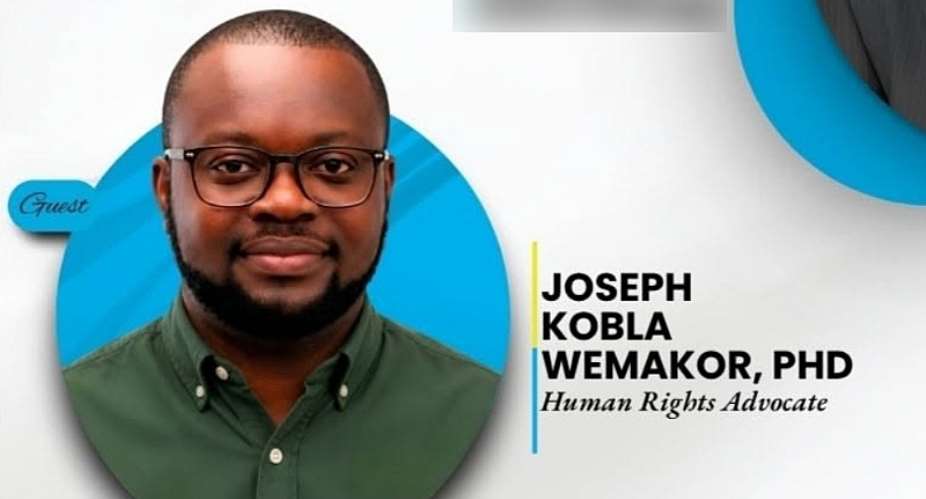
Ghanaian human rights advocate, peace ambassador, journalist, and development communicator, Dr. Joseph Kobla Wemakor, has called for sustained investments and deliberate policies to strengthen women's economic empowerment in Ghana, emphasizing that empowering women economically is essential to building resilient communities and a prosperous Africa.
Dr. Wemakor made these remarks during an interview on Africa In Perspective, a programme aired on Radio Now 95.3 FM, a Lagos-based radio station in Nigeria.
The interview, hosted by Abiodun Adelowore, focused on the theme: "Breaking Barriers: Women's Economic Empowerment in Ghana."
According to Dr. Wemakor, women's economic empowerment goes beyond income generation and encompasses creating equal opportunities for women to participate meaningfully in the economy.
"Women's economic empowerment means ensuring that women have equal opportunities, resources, and the freedom to participate meaningfully in Ghana's economy. It means having access to education, finance, land, markets, technology, leadership opportunities, and the ability to make decisions that affect one's economic future," he explained.
Reflecting on Ghana's progress over the past decade, Dr. Wemakor acknowledged significant gains, noting that more women are pursuing higher education, establishing businesses, and assuming leadership positions across sectors. He also highlighted the role of government interventions, private sector initiatives, and digital technologies such as mobile money in expanding financial inclusion for women.
However, he cautioned that considerable barriers persist.
"Women continue to dominate the informal sector, where earnings are often unstable and social protection is limited. Access to finance remains unequal, and many women still face cultural expectations that restrict their economic choices," he stated.
Dr. Wemakor who is also the Executive Director of Human Rights Reporters Ghana (HRRG) further observed that women in rural communities encounter more severe obstacles compared to their urban counterparts.
He explained that limited access to financial institutions, markets, business training opportunities, internet connectivity, and transportation infrastructure often hinders the economic advancement of women in rural areas. While women in major cities such as Accra and Kumasi may have relatively better access to services, they still contend with financing constraints and societal expectations.
Addressing the issue of access to credit, Dr. Wemakor noted that although microfinance schemes and digital lending platforms have broadened financing options, many women entrepreneurs continue to struggle with expensive loan conditions and inadequate funding.
"Some loan products carry high interest rates, while others provide only short-term support. Many women-led enterprises operate informally and may lack the documentation and collateral required by financial institutions," he said.
On the types of support women entrepreneurs increasingly seek, Dr. Wemakor identified financial literacy, business management, bookkeeping, digital marketing, customer service, negotiation, and leadership training as critical areas for capacity building.
He also underscored the transformative potential of technology in advancing women's economic participation.
According to him, mobile money services have enabled women to save, receive payments, and conduct transactions more conveniently, while e-commerce platforms have opened new markets beyond local communities. He added that emerging technologies, including artificial intelligence, can support business planning, marketing, content creation, and productivity.
Nevertheless, he stressed the importance of ensuring digital inclusion. "Digital inclusion efforts must ensure that women are not left behind," he noted.
Dr. Wemakor further highlighted the often-overlooked contributions of Ghanaian women across multiple sectors.
He pointed to women's growing influence in agribusiness, food processing, manufacturing, fashion, renewable energy, education, healthcare, and technology.
"Women are not merely participating in these sectors; they are transforming them through creativity and resilience," he remarked.
During the interview, Dr. Wemakor also announced his upcoming participation as an honoured guest speaker at the Women Entrepreneurship Empowerment Programme (WEEP) workshop scheduled for 20 June 2026 in Accra.
The initiative, organised by Eminence Lead International with support from stakeholders including the National Entrepreneurship and Innovation Programme (NEIP) and the Ghana Export Promotion Authority (GEPA), seeks to equip women entrepreneurs with practical skills, mentorship opportunities, financial literacy, and leadership development.
For Dr. Wemakor, such interventions demonstrate that meaningful progress requires moving beyond rhetoric to tangible action.
"Breaking barriers requires moving beyond discussion to concrete action that empowers women to succeed," he said. "Initiatives like WEEP demonstrate that stakeholders across different sectors increasingly recognise that empowering women economically requires deliberate action through mentorship, financial literacy, leadership development, and creating opportunities for women entrepreneurs to thrive."
In his concluding remarks, Dr. Wemakor called for women's economic empowerment to become a continuous national priority rather than an occasional discussion.
"When women rise economically, communities rise with them. Women's empowerment should not be an annual conversation; it should be a daily commitment translated into policies, investments, mentorship, and opportunities that help women succeed economically."
He added: "When we invest in women's enterprises, we are investing in stronger families, resilient communities, and a more prosperous Africa."
The interview reinforced the urgent need for governments, development partners, civil society organisations, and the private sector to intensify efforts aimed at dismantling barriers that limit women's full participation in economic life.
 Mysterious illness leaves children struggling to walk, hear in Mafi Kope
 ‘We’ve come back to make sure our father's ideas never die’ – Nkrumah family
 Ghana Jollof: Akosua Manu appeals to Naana Jane to use her influence to free Sal...
 Yellow fever confirmed in Sissala East after 21 mysterious deaths
 Kenyasi man allegedly attacked by prison officers and inmates over yam theft cla...
 Germany’s far-right AfD makes strong gains in two state elections
 Savannah Regional Minister, IGP Yohuno visit Gbindabuor following lynching of po...
 Jehovah's Witnesses make blood component decisions a matter of personal conscien...
 Road contractors fed on contracts for years without completing projects – Alhass...
 Ghana Jollof saga: ‘She has no right to do what she’s doing’ – Inusah Fuseini


