




The Reality of Hand-Picking a Cabinet
No, presidential hand-picking will not resolve the structural crisis. In an absolute autocracy like Equatorial Guinea, the cabinet possesses no independent executive authority. Ministers function entirely as administrative executors of the presidency.
From a political science perspective, hand-picking a new cabinet serves two main systemic functions:
- Deflecting Systemic Blame: It allows President Teodoro Obiang Nguema Mbasogo to channel public and international frustration away from his 47-year rule by treating structural economic failure as a localized management problem.
- Consolidating Dynastic Succession: By positioning Vice President "Teodorín" Nguema Obiang Mangue as the enforcer of "accountability," the regime uses the purge to build populist appeal and weed out independent power bases ahead of an upcoming father-to-son transition.
True stabilization requires deep institutional overhauls—including judicial independence to mitigate legal uncertainty, absolute transparency in oil revenues, and the removal of dynastic nepotism—none of which a rubber-stamp cabinet can provide.
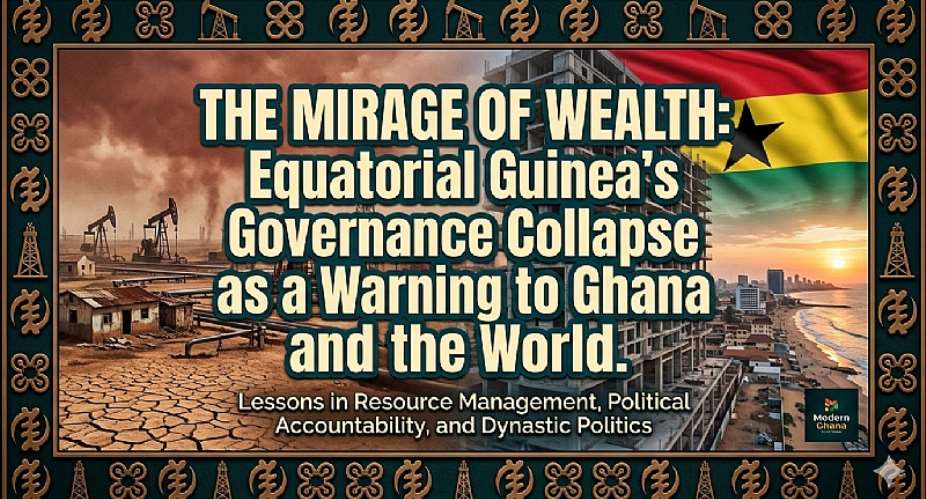
The Mirage of African Wealth: Lessons from Equatorial Guinea’s Governance Collapse
The dramatic en masse resignation of Equatorial Guinea’s entire cabinet on June 16, 2026, serves as a sobering case study in the perils of resource dependency and institutional decay. Dictated by Vice President Teodoro Nguema Obiang Mangue, the mass firing was justified by a staggering metric: the outgoing administration had achieved a mere 10% of its core socioeconomic objectives. For Ghanaians, West Africans, and international political science observers, this unprecedented executive purge unmasks a deeper structural crisis. It proves that vast natural resource wealth, when decoupled from democratic accountability, creates nothing more than a fragile illusion of development.
The Numbers Behind the Collapse: A Decade of Decline
To understand why the government crumbled, one must examine the macroeconomic metrics tracking the country's economic freefall:
- Deepening GDP Contraction: Following a tiny 0.4% bump in 2024, the nation's real GDP collapsed by 5.4% in 2025. International Monetary Fund (IMF) and World Bank forecasts project a further 2.7% contraction for 2026, trapping the country in an unyielding recession.
- Plunging Revenues: Total state revenues dropped by 15%, driven entirely by lower corporate tax collections from foreign operators as offshore oil fields dry up and lack new investment.
- Fiscal Deficit Reversal: The country’s healthy fiscal balance of a 2.3% GDP surplus quickly flipped into a persistent deficit, starving public sectors of development capital.
- The Human Toll: Despite historical paper wealth, systemic neglect has caused poverty to climb from 58.1% to 61%, with massive gaps leaving 24% of citizens without electricity and over 32% without piped water.
Political Science Analysis: Scapegoating and Dynastic Survival
- The 10% Alibi: Blaming the cabinet for a 10% performance rate serves as a tactical shield for President Obiang—the world's longest-serving non-royal ruler since 1979. Sacking the cabinet creates an illusion of accountability while keeping the regime's core power structures untouched.
- Dynastic Stage-Managing: The public announcement was strategically delivered via social media by the President’s son and Vice President. By acting as the champion of anti-corruption, he is cultivating the political capital necessary to secure a peaceful dynastic transition of power.
- The Capital Flight to Ciudad de la Paz: As the economy tanks, the regime has accelerated the administrative transfer of the national capital from coastal Malabo to the isolated, multi-billion-dollar jungle city of Ciudad de la Paz. This relocation is widely seen by analysts as an insulation strategy against potential civil unrest and maritime security vulnerabilities.
Recommendations: What to Watch in the Coming Weeks
As the international community and political analysts monitor the capital, observers should keep a close eye on several key indicators:
- Recycling vs. Reform: Watch whether the incoming cabinet features genuine technocrats or simply recirculates loyalists from the ruling Democratic Party of Equatorial Guinea (PDGE). History shows a similar 2020 mass resignation resulted in the immediate reappointment of the same key ministers.
- IMF and Regional Bailout Compliance: Track whether the new cabinet can successfully implement the World Bank Group’s structural frameworks regarding business environment safety, digital transparency, and revenue diversification.
- The Pace of Dynastic Consolidation: Monitor whether Vice President "Teodorín" leverages the upcoming cabinet appointments to place personal loyalists into key defense, finance, and hydrocarbon portfolios, effectively finalizing his grip on the state apparatus.
Equatorial Guinea’s current political paralysis offers a stark warning to resource-rich African democracies, including Ghana. True economic resilience is built through robust institutional governance, stringent fiscal discipline, and an enabled private sector—not through the volatile extraction of oil. Sacking a cabinet can temporarily absorb political heat, but it cannot replenish dry oil wells or reverse a structural recession. Until the underlying autocracy yields to transparency and the rule of law, a change of faces in the cabinet will remain an exercise in political theater, leaving the citizens to bear the heavy burden of a mismanaged state.
✍️By A Concerned Retired Senior Citizen
For and on behalf of all Senior Citizens of the Republic of Ghana 🇬🇭
Teshie-Nungua
[email protected]

 Explosions and gunfire heard at airport in Niger's capital Niamey
 Tehran and Washington sign interim peace deal to end US-Israeli war on Iran
 Why are Kenyan kids burning schools and killing their classmates?
 Yirenkyi's late flourish launches Ghana's World Cup party
 World Cup 2026: Ghana break Panama resistance with stoppage-time winner
 VIDEO: Watch the only community toilet carried away by floods
 We don’t owe Tema Motorway contractor any amount of money — Agbodza
 Swift response by Saki High Tension residents helps contain warehouse blaze in K...
 Bank of Ghana converts 147 rural and community banks into community banks
 Five fake soldiers grabbed for armed robbery at Ashanti mining community


