




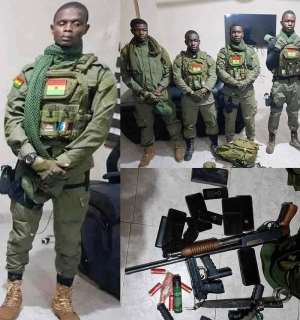
There is a particular kind of evil in impersonating a soldier. The military uniform carries with it the weight of a nation's trust the implicit promise that the person wearing it stands between the citizenry and danger. When criminals don that uniform to become the danger itself, something deeper than a robbery occurs. A sacred compact between state and citizen is desecrated. And across West Africa, from the galamsey pits of Ghana's Western Region to the highways of Lagos and the gold markets of Accra, that desecration is becoming alarmingly routine.
The phenomenon of fake military personnel criminals who wear military camouflage, carry live ammunition and assault weapons, and exploit the authority that a uniform confers to commit robbery, extortion, fraud, and worse is no longer an isolated or occasional aberration. It has become a structured feature of organized crime across the sub-region, one with roots in systemic failures of arms governance, institutional corruption, unemployment, and the proliferating illicit weapons trade that now connects West Africa's criminal underworld from the coast to the Sahel.
Ghana: A Nation Confronting Its Own Uniform
On the morning of 27 May 2026, the Ghana Police Service confirmed what many Ghanaians had long suspected but preferred not to say aloud: that serving military officers and police personnel were operating as part of a criminal robbery syndicate that had terrorized multiple cities across the country. The Ghana Police Service confirmed the arrest of seven individuals, including two military personnel and three police officers, over their alleged involvement in a robbery syndicate linked to multiple attacks across Accra, Tema, Anyinam, Kumasi, and Takoradi.
The case had begun with a deception so brazen it reads almost like a film script. An Ivorian investor, Mousa Bamba, reported that he had been lured to the Dzorwulu area of Accra under the pretext of a planned purchase of six kilograms of gold valued at US$450,000. Upon arrival, the suspects posed as officers of the Criminal Investigation Department and military personnel before robbing him at gunpoint and fleeing the scene.
Further investigations linked additional suspects to the operation, including two soldiers identified as Lance Corporals Eugene Akurugu and Emmanuel Arko, also known as "Bullet," as well as three police officers: Inspector Richmond Osei, Corporal Gideon Anor, and Lance Corporal Felix Deku Tetteyga. The officers involved have since been interdicted to allow for full investigations into their conduct. Intelligence-led operations on May 23 and 24, 2026 led to the arrest of additional suspects, including Justin Oduro, alias "Don King" and "Mafia," Clement Gyasi, and Farouk Zakari.
But this was not a one-off. Ghana has been accumulating a damning record of uniformed criminals targeting its most vulnerable economic sectors. In September 2025, Ghana's mining industry witnessed a textbook case of the phenomenon.
Two soldiers and some civilian accomplices invaded LongShine Mining Company in Prestea-Obouho in the Western Region. According to the company's Public Relations Officer, Zion Rootman, the two suspected soldiers, dressed in military uniforms and accompanied by two masked civilians, arrived at the site in a pickup truck. The company quickly alerted the Prestea Police, who arrested them at the scene.
The Ghana Armed Forces later confirmed it was investigating the incident, with its statement emphasizing that the military does not condone indiscipline or criminal behavior within its ranks and that personnel found culpable would face the law as any citizen of Ghana.
A year earlier, in March 2024, a group of four individuals dressed in military uniforms and carrying offensive weapons stormed a mining site at Nyamesom near Obuasi in the Ashanti Region. The Ghana Armed Forces stated emphatically that the 27-year-old suspect who was apprehended is not a military officer, and warned that people who use military accoutrements without authorization would be severely dealt with by the law when caught.
And in a separate case that speaks to the audacity these criminals now demonstrate, a suspect dressed in military camouflage and decorated with fake Lieutenant Colonel ranks was arrested attempting to access a military installation in Ghana. He claimed to be stationed at Northern Command Headquarters and was proceeding to the Air Force Base to book a flight to Tamale. Upon investigation, fake military identification cards, business cards, certificates, fake GAF recruitment reports bearing names of defrauded persons, additional military uniforms, and a toy pistol were all discovered at two residences he led officers to.
The Security Sector Complicity Problem
Beyond robbery-related offences, allegations of security personnel protecting illegal mining activities have persisted over the years. During the operations of Operation Vanguard a joint military-police anti-galamsey task force established in 2017 allegations emerged that some officers deployed to fight illegal mining were instead receiving money to protect operators or selectively enforce the law.In 2021, the Ghana Armed Forces confirmed that it had launched investigations into claims that some soldiers were providing protection for illegal mining activities.
This collusion between security personnel and criminal networks is not merely a disciplinary failure. It is a systemic one. In December 2002, Nigerian President Olusegun Obasanjo acknowledged that most of the ammunition circulating illegally in Nigeria had come from state security agencies such as the military and the police, with 3,000 rounds of ammunition reportedly sold in Abuja by police and in Jos by military personnel. That acknowledgement, made over two decades ago, describes a condition that has only worsened across the sub-region.
A 27-year-old suspected kidnapper arrested in Abuja, Musa Ibrahim, said criminals wear soldiers' uniforms during their operations so they can be respected by their victims, who are mostly travelers and road users. His complete uniform was handed down to him by one of their leaders, who also provided the same for over 10 members of the gang. In another case reported in April 2021, some illegal military personnel were arrested following suspected collaboration with Boko Haram, said to be helping the terrorists infiltrate the army and sabotage counter-insurgency efforts in Nigeria.
Based on the accounts of most arrested fake military personnel in Nigeria, they obtain their uniforms and weapons from friends and contacts within the military. Despite reported cases and arrests, there have been no robust proactive measures by authorities to curb this issue.
The Arsenal Behind the Camouflage: West Africa's Illicit Weapons Economy
The fake soldier phenomenon cannot be understood without understanding the wider weapons economy that supplies it. Across West Africa, the proliferation of illegal firearms has reached a scale that security analysts describe as a parallel arms market one that operates in plain sight, feeds criminal gangs and terrorist groups alike, and is sustained by state complicity at multiple levels.
All it takes to manufacture a craft firearm in Ghana is US$9. Gunsmiths produce approximately 200,000 of these illegal weapons a year, selling them for between US$90 and US$150 depending on type and technology. These weapons are used in 90% of the country's home robberies, as well as in banditry, trafficking, and reprisal attacks.
Kwesi Aning, Professor at the Kofi Annan International Peacekeeping Training Centre, has warned that if criminals can access all types of guns, including military-grade weapons, that means Ghana has created a fertile ground for the acquisition of tools for violent attacks and for the development of resupply and distribution networks.
Although local production of weapons is prohibited under Ghana's laws, the country has one of the most sophisticated craft weapons production and trafficking networks in the sub-region. Ghana's craft weapons often end up fuelling conflicts in neighboring countries some explosive devices found in Mali, Guinea, and elsewhere in the Sahel have been identified as originating in Ghana.
The problem extends far beyond craft weapons. Between 2020 and 2023, clashes with armed galamsey groups in Ghana killed more than 50 security personnel and 120 civilians. In 2022 alone, security forces confiscated approximately 1,500 illegal firearms from galamsey sites in the Ashanti and Western regions, including submachine guns and grenades. Some illegal miners are now allied with transnational crime networks, enabling them to procure military-grade weapons such as AK-47 rifles and drones, and to operate out of fortified camps with trenches, watchtowers, and armed patrols.
Smuggling hubs in Ghana particularly in the towns of Bawku, Tumu, Hamile, Sampa, and Elubo play a documented role in arms trafficking across the sub-region, with Ghana and Guinea serving as sources of arms and ammunition for small-scale traffickers, particularly hunting cartridges, hunting rifles, craft weapons, and handguns.
According to one arms smuggler operating along the Lagos-Ghana corridor, "here, anything goes you can transport guns to Ghana, Togo if you work with the right person. You have to know the police, customs, army and others if you want to do the business successfully on this route." This candid admission encapsulates the depth of the problem: not merely porous borders, but corrupted gatekeepers at every checkpoint along the route.
The Sahel Connection: When Fake Soldiers Feed Real Terrorism
The fake military phenomenon in coastal West Africa does not exist in a vacuum. It is connected, through shared supply chains of weapons and ammunition, to far more dangerous actors operating in the Sahel. Researchers believe that the primary method of arms acquisition in the Sahel occurs through looting of military or law enforcement stockpiles, with attacks on military garrisons often preceding larger attacks in which the assailants use the looted weapons.
Security officials' low wages incentivize their participation in illegal arms trafficking for supplemental income, and there are documented cases of Nigerien officials accused of selling arms and ammunition from national stockpiles to extremist actors such as Boko Haram, while Nigerian security officials have been found to "donate" or sell weapons to local ethnic conflict groups with whom they sympathize.
Galamsey Ghana's illegal small-scale mining epidemic is among the 20 illicit economies identified by the Global Initiative Against Transnational Organized Crime in West Africa, alongside drug trafficking, arms trafficking, and the illicit gold trade. Security risk consultant Liam Morrisey has warned that "the threat that galamsey poses is despicable, and Ghana needs to treat it as an emergency before these terrorists find their way here," referring to militant groups operating in the northern borderlands.
In the Sahel, shoppers in Mali's Gao, Timbuktu, and Ménaka regions can acquire AK-pattern assault rifles for $750 and cartridges for 70 cents apiece, from locally handcrafted pistols to smuggled machine guns, with a wide array of illegal weaponry available in market stalls across the region. This is the weapons economy into which Ghana's craft arms industry and its leaking security stockpiles feed an economy that ultimately puts guns in the hands of both the bandit impersonating a soldier in Prestea and the insurgent attacking a military base in Burkina Faso.
What Must Be Done
The convergence of uniformed criminality, security sector complicity, and illegal weapons proliferation across West Africa demands a response that is equally convergent one that treats the symptoms and the disease simultaneously.
First, the supply of uniforms and accoutrements must be controlled. Military uniforms and rank insignia must be treated as restricted materials subject to documented issuance and regular inventory. The ease with which complete military uniforms including rank decorations are obtained by civilians and criminals in Ghana and Nigeria is a procurement governance failure of the first order.
Second, the illegal weapons economy must be disrupted at its manufacturing base. A database of all blacksmiths in Ghana would be a first step toward identifying those engaging in illicit gun manufacturing, enabling the government to map and monitor their operations alongside those of arms dealers across the country. Acknowledging and investigating the complicity of state officials in facilitating the illegal trade especially at borders is equally critical.
Third, the security sector itself must be purged of its criminal elements through independent, well-resourced investigative mechanisms that operate outside the chain of command of the units being investigated. The pattern of security officers colluding with criminal and illegal mining networks while the official mandate is to combat those same networks represents a corrosion of institutional integrity that threatens the entire edifice of public safety.
Fourth, economic alternatives for young people must be created and delivered at scale. Due to a lack of economic opportunities, many of Ghana's unskilled young people are engaging in illegal mining as an easy way to earn money without regard for its long-term consequences. The same economic desperation drives recruitment into fake military syndicates and armed robbery gangs.
Finally, regional coordination must be deepened. The weapons, uniforms, and criminal networks that enable fake military operations do not respect national borders. An Accra-based syndicate with serving soldiers among its members, targeting an Ivorian investor with gold-purchase bait, operating across five Ghanaian cities simultaneously, is not a local policing problem. It is a transnational organized crime problem that requires ECOWAS-level response architecture, real-time intelligence sharing, and joint prosecution frameworks.
Conclusion: Restoring the Uniform's Honour
The men and women of Ghana's Armed Forces, Nigeria's military, and the security services across West Africa who serve with integrity and at genuine personal risk deserve better than to have their uniform the symbol of their sacrifice worn by criminals as camouflage for robbery. Every fake soldier who escapes prosecution emboldens the next one. Every serving officer who facilitates a robbery syndicate or provides a uniform to a criminal network corrodes the institution from within.
The Ghana Armed Forces' statement that it will not shield its personnel involved in criminal activities is the correct principle. The test of that principle is not in the words of the statement but in the consistency of its application.
When Lance Corporals rob Ivorian investors in Dzorwulu. When soldiers extort miners in Prestea. When uniformed gangs storm gold sites in Obuasi. The uniform must answer for every crime committed in its name and the institution must make unmistakably clear that donning it for robbery is not merely a disciplinary infraction but a fundamental betrayal of the nation's trust.
West Africa cannot afford the luxury of treating uniformed criminality as an embarrassment to be managed quietly. It is a security threat that must be confronted loudly, systematically, and without mercy for rank or seniority.
Mustapha Bature Sallama.
Medical/ Science Communicator,
Private Investigator, Criminal investigation and Intelligence Analysis.
International Conflict Management and Peace Building.USIP
[email protected]
+233-555-275-880
References
Ghana Police Service. (2026, May 27). Statement on arrest of robbery syndicate including military and police personnel. Retrieved from https://www.modernghana.com/news/1497158/fake-soldiers-rogue-cops-busted-in-us450000.html
Daily Post UK. (2026, May 27). Ghanaian authorities arrest 2 military personnel, 3 police officers over alleged involvement in major transnational robbery syndicate. Retrieved from https://www.dailypost-uk.com/2026/05/ghanian-authorities-arrest-2-military.html
YEN.com.gh. (2026, May). Ghana army soldiers, police officers linked to Hollywood-style gold robbery. Retrieved from https://yen.com.gh/ghana/305305-ghana-army-personnel-police-arrested-hollywood-style-gold-robbery/
GBC Ghana Online. (2025, October 3). GAF confirms arrest of two soldiers over alleged galamsey extortion. Retrieved from https://www.gbcghanaonline.com/general/gaf-confirms-arrest-of-two-soldiers-over-alleged-galamsey-extortion/2025/
DailyGuide Network. (2024, March 27). Military disowns fake soldier. Retrieved from https://dailyguidenetwork.com/military-disowns-fake-soldier/
Africanews. (2022, December 7). Fake soldier arrested in Ghana attempting to access military installation. Retrieved from https://www.africanews.com/2022/12/07/fake-soldier-arrested-in-ghana-attempting-to-access-military-installation/
Ghanaian Times. (2026, June). When the protectors become suspects: Rising concern over criminal conduct among security personnel. Retrieved from https://ghanaiantimes.com.gh/when-the-protectors-become-suspects-rising-concern-over-criminal-conduct-among-security-personnel/
HumAngle. (2022, April 4). Growing Trend of Fake Military Personnel Frustrating Nigeria's Fight Against Insecurity. Retrieved from https://humanglemedia.com/growing-trend-of-fake-military-personnel-frustrating-nigerias-fight-against-insecurity/
Africa Defense Forum. (2025, June). Ghana's Complex Illegal Mining Epidemic Grows More Dangerous. Retrieved from https://adf-magazine.com/2025/06/ghanas-complex-illegal-mining-epidemic-grows-more-dangerous/
Africa Defense Forum. (2025, November). Illegal Mining Brings Terrorists to Ghana's Doorstep. Retrieved from https://adf-magazine.com/2025/11/illegal-mining-brings-terrorists-to-ghanas-doorstep/
ENACT Africa / ISS. Ghana's Sophisticated Artisanal Firearms Trade Needs Regulating. Retrieved from https://enactafrica.org/enact-observer/ghanas-artisanal-arms-market-should-be-regulated
Institute for Security Studies / ISS Africa. Ghana's sophisticated artisanal firearms market should be regulated. Retrieved from https://issafrica.org/iss-today/ghanas-sophisticated-artisanal-firearms-trade-needs-regulating
International Alert. (2004). Small Arms Control in Ghana, Nigeria and Senegal. Retrieved from https://www.international-alert.org/app/uploads/2021/09/Security-Small-Arms-Control-W-Africa-Vol2-EN-2004.pdf
Africa at LSE / Institute for Security Studies. (2024, January). Urbanization and arms trafficking are growing hand in hand in Lagos. Retrieved from https://blogs.lse.ac.uk/africaatlse/2024/01/05/urbanisation-and-arms-trafficking-are-growing-hand-in-hand-in-lagos/
London Politica. (2023, November). Arms Trafficking in the Sahel. Retrieved from https://londonpolitica.com/africa-watch-blog-list/arms-trafficking-in-the-sahel
UNODC. (2023). Firearms Trafficking in the Sahel Transnational Organized Crime Threat Assessment. Retrieved from https://www.unodc.org/documents/data-and-analysis/tocta_sahel/TOCTA_Sahel_firearms_2023.pdf
UN News. (2023, June). Trafficking in the Sahel: Muzzling the Illicit Arms Trade. Retrieved from https://news.un.org/en/story/2023/06/1137542
Wikipedia. (2026). Operation Vanguard (Ghana). Retrieved from https://en.wikipedia.org/wiki/Operation_Vanguard
The Fourth Estate Ghana. (2025, December). Gold rush: 70% of sites in four main mining regions are illegal. Retrieved from https://thefourthestategh.com/2025/11/gold-rush-70-of-sites-in-four-main-mining-regions-are-illegal/
UNODC / Nigeria Delegation. From Arms Transfer to Firearms Trafficking: Application of Controls in Nigeria and West Africa. Retrieved from https://www.unodc.org/documents/treaties/Firearms2021/Presentations/Item_3_-_Nigeria.pdf


 GCB denies robbery attempt at Labone Branch after Police shoot two suspects
 Death toll rises to 12 in Pokuase-Achimota multi-vehicle accident
 'He's not one of us' — Hajj Office denies arrested ‘Papa Angola’ seen assaulting...
 Two gunned down as Police foil robbery attempt at GCB Bank branch in Labone
 President Mahama sets 2028 deadline for completion of Upper East Regional Airpor...
 Upper East Airport to open region to investors, boost economic activity — Mahama
 NDC will not take lessons from NPP on economy — Joyce Bawah
 Man seen assaulting suspect at police station not a member of Hajj Board — Pilgr...
 Police gun down two suspects, arrest one over Labone GCB robbery attempt
 Ofankor crash: Stop publishing graphic images, videos — Oppong Nkrumah urges med...

