




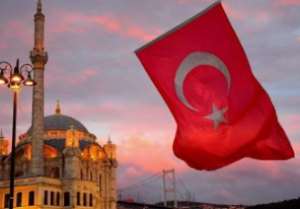
Standing at the edge of the Kanda highway in Accra, you cannot miss it. Four slender minarets rise approximately 65 meters into the West African sky. Fifty domes cascade around a central dome that sits 36 meters above the ground. The exterior is Carrara marble. The interior walls carry hand-drawn Qur'anic calligraphy in blue and gold. It is a gift from the people of Türkiye to the people of Ghana the Accra Furqan, better known as the Ghana National Mosque and its impressive series of domes and semi-domes makes it one of the most beautiful buildings in the city.
This building is, in one sense, the most visible symbol in Ghana today of the bond between West Africa and the Turkic world. But it raises a question that most Ghanaians have never paused to ask: what exactly do we mean when we say "Turkey"? What do our Hausa-speaking Muslim compatriots mean when they say "Turkiyya"? And what does Ankara mean when it insists, since 2022, that the world call it "Türkiye"? These are not interchangeable spellings of the same thing. They are three different historical journeys that converged on the same nation and understanding them transforms how Ghana, and West Africa at large, relates to this ancient crossroads of civilizations.
The Name Ankara Has Always Used
A number of news outlets reported that Turkey changed its name in 2022, but that is not really true Turks have called their country Türkiye since 1923, when Turkey became the successor state to the Ottoman Empire. The change is less like Rhodesia becoming Zimbabwe and more akin to what would happen if Germany asked the world to call it Deutschland, the way Germans have always called it.
The campaign to use "Türkiye" internationally began in December 2021 under President Recep Tayyip Erdoğan, and was formalized when the country's Foreign Minister wrote to the UN Secretary-General requesting that "Türkiye" replace "Turkey," "Turkei," and "Turquie" in all international contexts. The UN agreed to recognize the change on 26 May 2022.
The rebranding was characterized as an effort to better represent Turkish culture abroad, and to distance the country from some less-flattering associations.
Chief among those is one that Ghanaians and West Africans will appreciate with a certain wry amusement: in English, "turkey" is also the name of a large domesticated bird, and is used colloquially to mean something foolish. In the 16th century, English speakers noticed similarities between turkeys which the Aztecs had domesticated and guinea fowl, a bird imported from Africa to Europe via Ottoman trade routes. The connection, however indirect, stuck to the country's name in English for centuries. Ankara eventually decided it had had enough.
After the Ottoman Empire lost World War I and dissolved, Mustafa Kemal Atatürk established the Republic of Turkey in 1923 and respectfully adopted "Türkiye" as the official name meaning "the land of Turks" a designation that Turks had already long used to describe themselves and their homeland.
Major intergovernmental organizations of which Türkiye is a member including NATO, the WTO, the OECD, the Organization of Islamic Cooperation, and the African Union have all switched to the new name in their official documents.
Nigeria and other officially English-speaking countries around the world have made the change in their official communications. Ghana's own diplomatic correspondence has similarly shifted, reflecting the formal position enshrined in international law since May 2022.
The Arabic Road to "Turkiyya"
For the significant Hausa-speaking Muslim population across Ghana concentrated in the North but present in every Zongo community in Accra, Kumasi, Tamale, and beyond none of this diplomatic renaming was surprising, because they never used "Turkey" in the first place.
Hausa is spoken extensively among the Zango communities all across Ghana, including in the capital Accra, with especially strong communities in the north of the country. These communities maintain a living tradition of Islamic learning, and it is through that tradition not through any English colonial channel that the name "Turkiyya" entered Ghanaian Muslim vocabulary centuries before the British arrived with their atlases.
The early development of the Hausa language was most profoundly shaped by its encounter with Arabic through traders and Islamic scholars in the early medieval period. Numerous Arabic loanwords were incorporated into the language, especially in religious, legal, and administrative contexts. Most loanwords in Hausa come from Arabic, encompassing semantic fields such as religion, education, government, law, commerce, war, and horsemanship the domains through which Islamic civilization organized public life across West Africa for half a millennium.
"Turkiyya" is one such Arabic loanword. The term is the Arabic adjectival feminine form of "Turk," used for centuries in classical Islamic historical writing to describe Turkic-ruled entities. Arab scholars referenced the Mamluk Sultanate of Egypt whose ruling elite was of Turkic origin as Dawlat at-Turkiyya, the Turkish State.
When the Ottomans extended their reach across North Africa and the Middle East after 1517, the same term transferred naturally to the Ottoman world in Arabic scholarly discourse.
This was the intellectual vocabulary in which Hausa Islamic scholars were educated through the Ajami tradition of writing Hausa in Arabic script, through Qur'anic schools, and through the vast network of learning that linked Katsina and Kano to Cairo, Mecca, and Istanbul across centuries of trans-Saharan scholarship.
The Hausa tradition of long-distance commerce and pilgrimages to the holy cities of Islam carried their language to almost all major cities in West, North, Central, and Northeast Africa. Along those routes, the word "Turkiyya" travelled with the scholarship arriving in Ghana's Zango communities through an oral and written civilisational current that predates British colonialism by centuries.
Hausa has been written with an adapted version of the Arabic script called àjàmí since the early part of the 17th century, as most early Hausa literature was Islamic poetry or religious in nature. It was through this Ajami tradition that Hausa-speaking scholars absorbed and transmitted Arabic geographical and political vocabulary including "Turkiyya" across West Africa's Muslim communities.
How "Turkey" Came to Ghana
The English name "Turkey" arrived in Ghana through an entirely different channel: British colonial administration, missionary education, and the English-language press. When Ghana's schools began operating under colonial curricula, geography textbooks written in London referred to the country across the Mediterranean and beyond as "Turkey." That is the name radio broadcasters used, the name newspapers printed, and the name civil servants recorded in official correspondence.
There is nothing inherently wrong with this. Every language has its own names for foreign countries what linguists call exonyms. While French people used "Turquie" to describe the country, in Medieval Latin it was displayed as "Turchia." Even the color turquoise was named after Turkey by the French because of the color of its coastal seas. Every European colonial power thus delivered its own version of the exonym to its African territories. For Anglophone Ghana, that version was "Turkey."
But the critical insight is this: for a significant portion of Ghana's population Muslim communities whose intellectual heritage is rooted in Arabic-medium learning "Turkey" was always the foreign imposition. "Turkiyya" was the home name, carried across the Sahara not by colonial administrators but by Islamic scholars, merchants, and pilgrims who had been in dialogue with the Turkic world for centuries before European contact.
Ghana and Türkiye: A Relationship Deeper Than Nomenclature
Understanding the name correctly matters in Ghana today more than ever, because the Ghana-Türkiye relationship is one of the most consequential bilateral partnerships on the continent.
Diplomatic relations between Türkiye and Ghana were established in 1958 following Ghana's independence. The Turkish Embassy in Accra was first opened in 1964 but closed due to austerity measures in 1981 and was subsequently reopened on 1 February 2010. The Embassy of the Republic of Ghana was opened in Ankara in 2012.
The Turkish Embassy in Accra is one of the first Turkish diplomatic missions in Sub-Saharan Africa, and Türkiye-Ghana relations are built on a strong foundation that is constantly deepening and diversifying. Ghana is among the top five business partners of Türkiye in sub-Saharan Africa.
Presidential visits have anchored that deepening relationship including President Abdullah Gül's visit to Ghana in March 2011, President John Dramani Mahama's reciprocal visit to Türkiye in January 2013, and President Erdoğan's landmark visit to Ghana from 29 February to 1 March 2016, during which a business forum brought together approximately 150 Turkish businessmen with their Ghanaian counterparts.
Ghana's exports to Türkiye predominantly comprise primary goods such as gold, cocoa beans, cocoa paste, and cocoa butter, and the annual trade volume is projected to reach US$900 million by the close of 2025 and cross the US$1 billion mark by 2027.
Beyond trade, Türkiye's cultural and humanitarian footprint in Ghana is unmistakable. Turkish aid bodies have constructed primary schools in Ghana's Wa and Kumasi regions, dug wells, and distributed packages of basic goods to communities in need.
The Turkish government regularly announces scholarships for qualified Ghanaian applicants at both undergraduate and postgraduate levels through the Türkiye Scholarships programme. And then there is the mosque.
The Mosque That Speaks for Itself
The Ghana National Mosque Complex, inaugurated on 16 July 2021, is a gift from Turkish philanthropists to the Ghanaian Muslim community. The $10 million, 15,000-seater mosque was built by the Turkish Hudai Foundation in Accra with the support of the Turkish government, on a 40-acre land at Kanda. The facility encompasses not only the Grand National Mosque but also a recreational centre, a library complex, offices and residence for the Chief Imam, a research complex, a Senior High School complex, a clinic, an administration block, an auditorium, and a conference centre.
The architect Erdoğan Çetinkaya's design was influenced by the Blue Mosque the Sultan Ahmet Mosque in Istanbul, as well as the Selimiye Mosque. The structure uses 4,000 cubic meters of concrete and 700 tons of steel, and the 50 domes seem almost weightless in the Ottoman architectural tradition, with the main dome sitting at a height of 36 meters, supported by four columns at 20-metre intervals.
At the inauguration ceremony, President Nana Akufo-Addo noted that as a Christian-majority country, seeing such a symbol of Islam adorn the landscape of the capital city demonstrated the religious harmony that Ghana maintains which he described as the envy of the rest of the world.
A comprehensive analysis of Türkiye-Ghana foreign relations has observed that increased Turkish involvement in Ghana on political, economic, and cultural levels represents a convergence of corporate and governmental ambitions, with Ankara's rekindled interest in continental Africa becoming increasingly significant as it opens new markets and deepens soft-power ties. Türkiye's growing diplomatic engagement with Ghana is expected to persist and garner favorable responses from Ghanaians.
This building Ottoman in form, Ghanaian in location, funded by Turkish philanthropists, serving West African Muslims who have called its donor nation "Turkiyya" for centuries is the perfect physical metaphor for what the naming question is really about.
Three Names, One Nation, One Lesson
For Ghana, the convergence of these three names carries a specific and liberating lesson. It means that Ghana's Muslim communities through the Hausa intellectual tradition were connected to the Turkic world through Islamic civilization long before European colonialism arrived to mediate that connection through English. The Zongo elder in Nima who says "Turkiyya" is not mispronouncing "Turkey." He is speaking an older, more accurate, and historically more faithful name than any English colonial textbook ever provided.
Exonym corrections have been commonplace in postcolonial Africa. The change from Zaire a Portuguese variant of a Bantu word to the Democratic Republic of the Congo, and the change from Rhodesia named for the British colonizer Cecil Rhodes to Zimbabwe are just two examples of African nations reclaiming their names from colonial imposition. The shift to "Türkiye" belongs in that same postcolonial conversation, even if its origin is Ankara rather than Accra.
For Ghana's media, educators, and policymakers, the moment is now ripe for a deliberate transition. Official documents have already made the shift. It is time for newsrooms, schools, and public discourse to follow not merely out of diplomatic courtesy to Ankara, but out of fidelity to Ghana's own Islamic intellectual heritage, which has known the correct name all along.
When a student in Tamale says "Turkiyya," when a diplomat in Accra files a report on "Türkiye," and when a market woman in Kumasi references "Turkey," they are all, without knowing it, participants in one of the longest-running naming debates in world history. Now that the United Nations has settled the matter formally, Ghana has every reason historical, linguistic, diplomatic, and cultural to lead West Africa in saying the name right.
Mustapha Bature Sallama.
Medical/ Science Communicator,
Private Investigator, Criminal investigation and Intelligence Analysis.
International Conflict Management and Peace Building.USIP
[email protected]
+233-555-275-880
References
United Nations. (2022). Türkiye UN Member State Profile. Retrieved from https://www.un.org/en/about-us/member-states/turkiye
PolGeoNow. (2024, April). About a Bird? Your Complete Guide to Turkey's 2021-2022 Name Change. Retrieved from https://www.polgeonow.com/2024/04/turkey-name-change-to-turkiye.html
CNN. (2022, June 3). Turkey rebrands as 'Türkiye,' changing name at the United Nations. Retrieved from https://www.cnn.com/2022/06/02/europe/turkey-trkiye-united-nations-scli-intl/index.html
NPR. (2022, June 2). Turkey will now be known as Türkiye (at least at the U.N.). Retrieved from https://www.npr.org/2022/06/02/1102596510/turkey-changes-name-turkiye-united-nations
The Conversation. (2023). Why does Turkey want other countries to start spelling its name 'Türkiye'? Retrieved from https://theconversation.com/why-does-turkey-want-other-countries-to-start-spelling-its-name-turkiye-199390
Turkey Travel Planner. (2024). Turkey or Türkiye? Retrieved from https://turkeytravelplanner.com/turkey-or-turkiye/
Ghana Embassy Ankara. (2025). Ghana-Turkey Relations. Retrieved from https://ankara.mfa.gov.gh/mission/ghana-turkey-relations/
Embassy of the Republic of Türkiye in Accra. (2023). Ambassador's Message. Retrieved from https://accra-emb.mfa.gov.tr/Mission/Message
European Journal of Law and Political Science. (2025, December). Türkiye-Ghana Foreign Relations: A Comprehensive Analysis. Retrieved from https://eu-opensci.org/index.php/politics/article/view/8187
Architects Registration Council, Ghana. (2018). Ghana National Mosque Complex. Retrieved from https://www.arc.gov.gh/portfolios/ghana-national-mosque-complex/
MyJoyOnline. (2021, July 28). Ghana National Mosque Complex: Symbol of friendship between Ghana and Turkey. Retrieved from https://www.myjoyonline.com/ghana-national-mosque-complex-symbol-of-friendship-between-ghana-and-turkey/
Anadolu Agency. (2019, February 14). Turkish aid bodies inaugurate mosque, schools in Ghana. Retrieved from https://www.aa.com.tr/en/africa/turkish-aid-bodies-inaugurate-mosque-schools-in-ghana-/1393169
Anadolu Agency. (2021, July). Turkish-built mosque in Ghana opened to worshippers. Retrieved from https://www.aa.com.tr/en/africa/turkish-built-mosque-in-ghana-opened-to-worshippers/2307135
Ghana Studies (University of Wisconsin Press). (2023). Mosque, Landmark, Document. Vol. 25(1), 144. Retrieved from https://gs.uwpress.org/content/25/1/144
Wikipedia. (2026). Hausa language. Retrieved from https://en.wikipedia.org/wiki/Hausa_language
Britannica. (1998). Hausa language History, Grammar & Vocabulary. Retrieved from https://www.britannica.com/topic/Hausa-language
Global Diversity Hub. (2024, December). The Rich History and Cultural Significance of the Hausa Language. Retrieved from https://globaldiversityhub.com/the-rich-history-and-cultural-significance-of-the-hausa-language/
ScienceDirect Topics. Hausa Language. Retrieved from https://www.sciencedirect.com/topics/social-sciences/hausa
MustGo Languages. (2021). Hausa Language Structure, Writing & Alphabet.
Retrieved from https://www.mustgo.com/worldlanguages/hausa/
Ghana Scholarships Secretariat. (2020). Turkish Government Scholarships Programme. Retrieved from http://scholarships.gov.gh/?p=258

 Gunfire at airport in Niger's capital: residents
 Tehran and Washington sign interim peace deal to end US-Israeli war on Iran
 Why are Kenyan kids burning schools and killing their classmates?
 Yirenkyi's late flourish launches Ghana's World Cup party
 World Cup 2026: Ghana break Panama resistance with stoppage-time winner
 VIDEO: Watch the only community toilet carried away by floods
 We don’t owe Tema Motorway contractor any amount of money — Agbodza
 Swift response by Saki High Tension residents helps contain warehouse blaze in K...
 Bank of Ghana converts 147 rural and community banks into community banks
 Five fake soldiers grabbed for armed robbery at Ashanti mining community


