




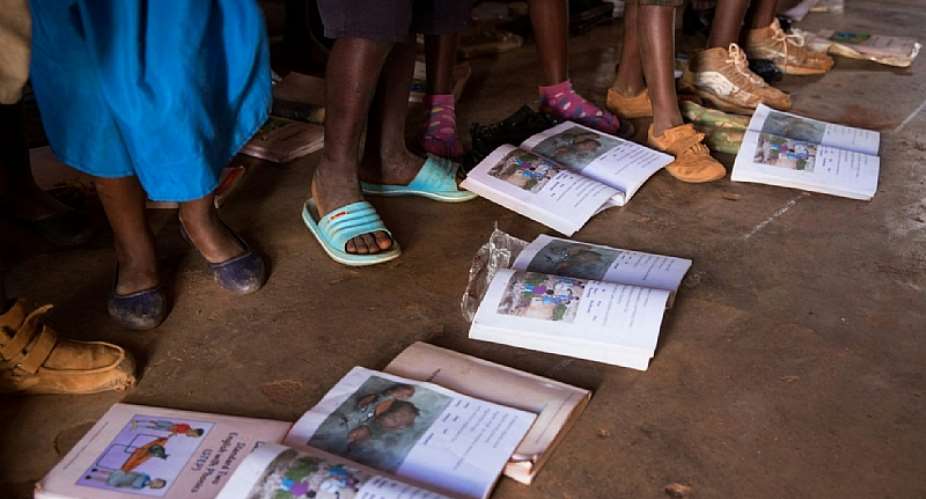
Over a year has passed since the Donald Trump administration dismantled USAID, cutting more than 5,000 programmes and slashing US$40 billion in funding worldwide.
The cuts have reduced access to HIV treatment, driven up severe malnutrition among children, and resulted in an estimated 700,000 lives lost. Medication and infrastructure to treat diseases like malaria, tuberculosis and pneumonia were withdrawn.
In education, USAID's closure has created an “unprecedented crisis”, according to a report by the European Training Foundation, an EU agency.
Aid austerity is not limited to the US. In 2025, overall official development assistance dropped by 23%, marking what the OECD described as a “historic decline in foreign aid”. Cuts came from the US, Germany, the UK, France, Canada and Japan.
As a transnational team of education scholars, we take a critical approach to development aid. While we recognise that aid can improve and even save lives, it is not an inherent good. It can reproduce inequities.
We have spent decades studying educational interventions in Malawi and have documented how, even while aid has delivered benefits to individuals, its structures sideline local organisations, serve the interests of donor countries, and mimic colonial relations.
For these reasons, we've been thinking about whether USAID's closure, while painful and damaging, might give rise to a new arrangement beyond aid.
Malawi is an ideal setting to explore this moment of change. The US alone contributed 13% of the country's overall budget and provided one-quarter of education development spending. Interested in how Malawians make sense of aid austerity and imagine alternatives, we are launching a three-year (2026-2029) qualitative study of post-USAID possibilities in Malawi's education sector. We are asking civil servants, NGO workers and aid workers how they see the future of education amid aid austerity.
To prepare for the project, we conducted a pilot study of the immediate aftermath of USAID's closure, from January to June 2025, with first-round follow-up interviews in May 2026. The 20 education experts we spoke to held very mixed opinions on the post-USAID landscape. Some saw potential to redress power imbalances; others emphasised the obstacles to self-resourcing. We pause now to reflect on these themes.
Malawi's relationship with aid
Prior to the cuts, Malawi was saturated with international development – one informant called it “a development playground”. From 2019 to 2023, foreign governments contributed 80% of funding to Malawi's education capital projects (school and classroom construction projects), according to Unicef.
In 2024, USAID allocated US$34 million to education projects that promoted early-grade literacy and higher education. In turn, USAID's portfolio buttressed US soft power while garnering opportunities for US businesses and contractors.
In our research, we've purposefully included individuals with diverse perspectives on development and aid. Some participants have been employed directly by USAID, while others hold experience with local NGOs, government, and universities.
For some, the closure of USAID was a welcome change. One former development worker called the previous status quo “more immoral than the cruel reality” of aid cuts themselves, as
it was appearing as if the right things were happening, when in actual sense, the wrong things were happening.
Comparing aid relations to “coating a bitter thing with sweet on top”, she was relieved by what felt like a break from the conditionalities and hidden agendas of US aid. She explained that, despite the rhetoric of improving Malawian education, USAID tended to funnel money to US consultants and international (rather than Malawian) NGOs. The projects ended up misaligning with Malawi's needs. Recently, political scientist Dan Banik urged Malawi to “say 'no thank you' to donors” when funding doesn't support national priorities.
Given the fickle nature of donor funding, some study participants shared stories of how their organisations had already moved towards self-resourcing models prior to USAID cuts. While one Malawian NGO had incorporated a business division with facility and vehicle rentals, another introduced a farming scheme whose profits supported the NGO's operational expenses. Both NGOs focused on community-driven, holistic and multi-generational education. Innovations like these, together with diversified funding sources, were imagined to help local organisations survive in a rapidly changing financial landscape that includes shocks of austerity.
Still, others worried that Malawi's economic realities make alternative funding arrangements and aid refusal impossible. One faculty member at the University of Malawi explained that the country's economic growth has stagnated for years. Speaking in early 2025, this scholar warned that idealistic visions of post-aid Malawi were naive at best.
Malawi's economy is in crisis, facing mounting debt borrowed from the World Bank, IMF and African Development Bank. After the 2025 aid cuts, the Malawian government increased its debt to compensate for lost funding flows. Debt payments have reached 90% of Malawi's GDP.
At the same time, respondents pointed to recent global developments that have only worsened the country's financial situation. Wars in Iran and Russia/Ukraine have led to bottlenecks in key supply chains. Fuel costs in Malawi are among the highest in the world and fertiliser shortages foreshadow food insecurity for Malawi's subsistence farming population. Opportunities for steady salaried employment in the development sector have vanished, as have the financial ripples these salaries create for the broader economy. International staff and projects, now reduced in numbers, are infusing less foreign exchange into the economy.
In the absence of cash flows, self-resourcing efforts become increasingly untenable. Instead, new forms of more nakedly transactional aid have begun to appear, for example in US-led MOUs that are “turning health aid into leverage.”
No matter what comes next for education in Malawi, it is clear that we are in a transitional space where the terms of development are being rewritten. Emerging funding mechanisms — such as self-resourcing, debt-financed investments, and transactional aid — could amplify power imbalances instead of ameliorating them. This landscape demands continued intellectual and ethical scrutiny.
Dr Steve Sharra, director of academic affairs at Malawi School of Government, contributed to this research and article.
Alyssa Morley has received funding from the Spencer Foundation, MSU African Studies Center, and MSU Center for Gender in Global Context (GenCen). Alyssa has previous experience contributing to a USAID project led by Michigan State University (2021-2023).
Rachel Silver receives funding from the Social Science and Humanities Research Council of Canada (SSHRC), the Spencer Foundation, and York University's Dadaleh Institute.
Nelson Masanche Nkhoma does not work for, consult, own shares in or receive funding from any company or organisation that would benefit from this article, and has disclosed no relevant affiliations beyond their academic appointment.
By Alyssa Morley, Assistant professor, Michigan State University And
Nelson Masanche Nkhoma, Researcher, Lilongwe University of Agriculture and Natural Resources And
Rachel Silver, Associate professor, York University, Canada

 OSP invites Patricia Appiagyei over alleged GHS70,000 vetting payment
 Avoid conduct that creates perception of judicial bias — CDD-Ghana urges Chief J...
 It may be time to end vetting if it has become an avenue for extortion – Kwaku A...
 'You have one week to shut down new Winneba Police Station or face our wrath' — ...
 NACOC arrests alleged drug dealer, wife in Weija operation
 Northern Minister orders probe into School Feeding irregularities
 Afenyo-Markin, A-Plus to lead peace mission to Gomoa and Effutu communities on S...
 NPP Chairmanship race: I have not made disparaging comments about John Boadu – B...
 Rally firmly behind Bawumia for 2028 victory – Afenyo-Markin charges NPP communi...
 FAKE: Deputy Minority Leader returns GHS70,000 received from vetting of Minister...

