




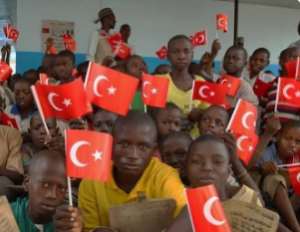
There is a striking contradiction at the heart of Turkey's Africa policy one that is becoming impossible to ignore. In Senegal, as in much of West Africa, Ankara has built an impressive presence: airports, stadiums, hospitals, schools, and mosques carry Turkish signatures. Turkish businesspeople move freely, buy property, create jobs, and are received with warmth. Yet when Africans attempt to do precisely what Turks do on their continent migrate, work, build a life they are met with shortened permits, police raids, detention centers, and deportation orders.
This is not partnership. It is a one-sided arrangement dressed up in the language of solidarity.
Turkey's African Footprint: Real, Expansive, and Strategically Deliberate
Turkey's engagement with Africa is neither accidental nor philanthropic. It is the product of a calculated foreign policy that began in earnest in 2005, when Ankara designated that year "The Year of Africa." Three years later, Turkey was formally declared a strategic partner of the African Union at the 2008 Istanbul Summit the first of three Turkey-Africa Partnership Summits, followed by Malabo in 2014 and Istanbul again in December 2021, where a Joint Action Plan for 2022–2026 was adopted.
The economic figures speak for themselves. Trade between Turkey and Africa exceeded $37 billion in 2024, with Ankara targeting $40 billion for 2025. In Senegal alone, Turkey and Senegal have agreed to raise bilateral trade to $1 billion, with an eventual goal of $3 billion announced by President Erdoğan as recently as August 2025. Earlier benchmarks tell the same story: bilateral trade stood at $540 million in 2021, up 42 percent from the previous year.
The infrastructure record is equally formidable. Turkish contractors built the Dakar Arena a 15,000-seat multisport complex the Dakar International Conference Center, and Blaise Diagne International Airport.
Turkish companies have completed over $85 billion worth of projects across Africa, from the Kigali Convention Center in Rwanda to the parliament building in Cameroon to the Niamey Airport in Niger.
Beyond bricks and mortar, Turkey deploys soft power with equal precision. The Maarif Foundation established in 2016 as the state's sole body authorized to provide educational services abroad now operates 125 schools across Africa, with 63 in the ECOWAS region, including Senegal, Mali, Niger, Sierra Leone, Côte d'Ivoire, and Gambia.
The Diyanet, Turkey's directorate of religious affairs, has built landmark mosques across the continent, including the National Mosque in Accra, modelled on Istanbul's Blue Mosque. Yunus Emre Institutes teach Turkish language and history. State scholarships have brought tens of thousands of African students to Turkish universities.
Turkey's message to Africa has been consistent: we are your partner, your brother, your investor. Africa has believed it and responded in kind.
The Reverse Journey: When Africans Go to Turkey
The logic of partnership should flow in both directions. If Turkish nationals are welcomed in Senegal and they are, with open arms it would be reasonable to expect that Senegalese nationals in Turkey might find a comparable environment. They do not.
Attracted by the image of a prosperous, accessible country and buoyed by the goodwill that Turkish institutions have cultivated, many Africans have migrated to Turkey seeking opportunity. What they have found instead is an increasingly hostile bureaucratic and physical environment.
Turkish authorities have, in recent months, progressively tightened migration policies reducing the validity of residence permits from two years to one year, and now to six months. The testimony of Boubacar Diallo, a Senegalese sales representative who has lived in Turkey for nine years, captures the human cost with precision: "Before, our documents were renewed every two years; then it was every year; and now it's every six months." He manages an online discussion group of 914 members Senegalese in Turkey navigating administrative precarity and reports that new members join daily.
The experience of Adama is starker still. After fourteen years in Turkey a life built over more than a decade his residence permit was not renewed. He spent two months in a detention centre before being released. "I know what it's like, and I suffered there," he says. His case is not exceptional. It is, by all available evidence, typical.
A System Documented to Fail Africans
This is not merely anecdote. The pattern is corroborated by authoritative institutional sources.
The Asylum Information Database of the European Council on Refugees and Exiles, in its July 2025 Turkey update, found that "migrants from Africa who held residence permits previously face difficulties renewing their permits, consequently finding themselves as undocumented migrants who cannot access basic rights and services due to fear of deportation".
Human Rights Watch, in its Turkey World Report, documented "regular reports of ill-treatment, including severe beatings and cruel, inhuman, and degrading treatment, and overcrowding in removal centers where foreign nationals including asylum seekers and migrants are subject to administrative detention pending deportation procedures" .
The United States State Department's 2023 Country Report on Human Rights Practices in Turkey noted an explicit government announcement in July 2023 to "visibly curb undocumented migrants," followed by increased reports of forced returns and deportations. It also documented cases in which Afghans and Syrians were coerced into signing "voluntary" return forms under physical duress or through conditions so intolerable that detainees submitted simply to escape them.
A 2025 investigation by the Middle East Research and Information Project (MERIP) went further, describing Turkey's deportation apparatus as neither accidental nor exceptional, but "the outcome of deliberate legal engineering, institutional centralization and transnational incentives." Interior Minister Ali Yerlikaya, the report noted, boasted in 2025 that no other country matched Turkey's biometric infrastructure or "deportation efficiency" language that reveals the pride with which Ankara approaches the removal of migrants.
Videos of forceful arrests and street-level enforcement operations targeting African and other foreign nationals have circulated widely on social media, deepening alarm within diaspora communities across Turkey.
The Sentiment That Cannot Be Suppressed
Among those affected, the sense of injustice is visceral and direct. Adama fourteen years in Turkey, then detained, then released into undocumented limbo puts the double standard plainly: "They are doing well in Senegal, well settled. They have even bought houses and nice cars, moving around freely at any time. They are free as the wind. Unlike us."
That sentence deserves to be read slowly. A man who has given fourteen years of his productive life to Turkey articulates the asymmetry with the clarity that only lived experience can provide. Turkish nationals, in Senegal, enjoy the freedoms that Turkish policy denies to Senegalese nationals in Turkey. The relationship, seen from the African end, is not reciprocal. It is extractive.
For Boubacar Diallo, the calculus has shifted. Returning home once unthinkable after nine years of building a career is now an option under active consideration. "Turkey, once seen as a land of opportunity," as the original reporting captures it, "is gradually turning into a place of uncertainty, where the Turkish dream is beginning to fade."
The Broader Architecture of Imbalance
It would be a mistake to treat this as a Senegal-specific story. Turkey's Africa policy is continental in ambition, and the asymmetry identified here is continental in scope.
Ankara maintains embassies in 42 African countries and has commercial counsellors in 26. Turkish Airlines flies to 35 African destinations more than any other carrier on the continent. The Maarif Foundation operates in over two dozen African countries. The Diyanet is active from Accra to Djibouti. Turkish defence companies sell drones to African governments. Turkey has a military base in Mogadishu and security training partnerships expanding into the Sahel including, as of 2025, Niger.
In return, African countries have opened their markets, their airspace, their contracts, and their goodwill. They have welcomed Turkish schools, Turkish mosques, Turkish corporations, and Turkish diplomatic missions. They have signed joint action plans, hosted summits, and designated Turkey a strategic partner at the continental level.
What they have not received, in return, is comparable openness for their own citizens.
A Reckoning That Must Come
Africa has, for too long, accepted asymmetric relationships in the name of development from colonial extractivism to the conditional ties of Bretton Woods institutions, to the debt-laden infrastructure deals of more recent decades. Turkey has presented itself as a different kind of partner: Muslim-majority, non-Western, post-colonial in its own framing, and invested in African development without the baggage of European guilt or Chinese opacity. That narrative has been . But narratives must be tested against outcomes.
The outcome for Boubacar Diallo nine years in Turkey, now navigating six-month permit renewals and an 800-member crisis chat group does not reflect partnership. The outcome for Adama fourteen years in Turkey, two months in detention, and now undocumented does not reflect solidarity. The outcome for thousands of African migrants navigating what the European Council on Refugees and Exiles describes as a system designed to push them into irregular status does not reflect the values that Turkey proclaims at every Africa summit.
African governments owe it to their citizens to name this contradiction publicly and to demand that the Joint Action Plan 2022–2026 which Turkey and the African Union jointly adopted include binding, enforceable commitments on the treatment of African nationals in Turkey. The language of partnership must be matched by the reality of reciprocity.
Turkey builds airports in Dakar. The least it can do is respect the people of Dakar when they arrive at Istanbul.
Mustapha Bature Sallama.
Medical/ Science Communicator,
Private Investigator, Criminal investigation and Intelligence Analysis.
International Conflict Management and Peace Building.USIP
[email protected]
+233-555-275-880
Sources and References
- African Union Press Release: Africa and Türkiye Hold the Third Ministerial Review Conference, November 2024. https://au.int/en/pressreleases/20241111/africa-and-turkiye-hold-third-ministerial-review-conference
- African Union Press Release: The 3rd Africa-Türkiye Summit Adopts Five Strategic Cooperation Areas for the Period 2022–2026, December 2021. https://au.int/en/pressreleases/20211220/3rd-africa-turkiye-summit-adopts-five-strategic-cooperation-areas-period-2022
- Asylum Information Database (AIDA) / European Council on Refugees and Exiles: Türkiye Country Report Update, July 2025. https://asylumineurope.org/reports/country/turkiye/overview-main-changes-previous-report-update/
- Daily Sabah: Turkish Firms Undertake Over $85 Billion Projects in Africa, January 2024. https://www.dailysabah.com/business/economy/turkish-firms-undertake-over-85-billion-projects-in-africa
- Energy Capital Power: Senegal, Turkey Boost Trade Ties, August 2025. https://energycapitalpower.com/senegal-turkey-boost-trade-ties/
- Foreign Policy Research Institute: Turkey's Return to Africa, March 2025. https://www.fpri.org/article/2025/03/turkeys-return-to-africa/
- France 24 Reporters: Le drone et le Coran : enquête exclusive sur la puissance turque en Afrique [The Drone and the Quran: Exclusive Investigation into Turkish Power in Africa]. https://www.france24.com/fr/reporters
- Human Rights Watch: World Report 2023: Turkey. https://www.hrw.org/world-report/2023/country-chapters/turkey
- IOM / Displacement Tracking Matrix: Türkiye Migrant Presence Monitoring, Annual Report 2024, April 2025. https://dtm.iom.int
- Maarif Foundation Ghana: Turkey's Maarif Foundation Is an Excellent Example of Turkish Aid. https://gh.maarifschool.org/news/turkeys-maarif-foundation-is-an-excellent-example-of-turkish-aid
- MERIP (Middle East Research and Information Project): Deportation as Punishment and the Everyday War on Migrants from Turkey to the United States, October 2025. https://www.merip.org/2025/06/deportation-as-punishment-2/
- Saint-Louis Info: « Nous vivons dans la peur » : L'appel des sans-papiers sénégalais d'Istanbul ["We Live in Fear": The Appeal of Undocumented Senegalese in Istanbul].
- The Africa Report: How Türkiye Built an Invisible Architecture of Power in Africa, November 2025. https://www.theafricareport.com/396552/how-turkiye-built-an-invisible-architecture-of-power-in-africa/
- Türkiye Today: From Defense to Development: How Türkiye Is Building Its Africa Strategy, April 2026. https://www.turkiyetoday.com/opinion/from-military-training-to-investment-how-turkiye-is-building-its-africa-strategy-3218144
- United States Department of State: 2023 Country Reports on Human Rights Practices: Turkey. https://2021-2025.state.gov/reports/2023-country-reports-on-human-rights-practices/turkey/


 Ayitey Powers arrested over alleged death threat against Yaw Ampofo Ankrah
 It lies with Sammy Gyamfi to prove his extortion allegation against Afenyo-Marki...
 ‘I’m ready to submit myself for investigation into Sammy Gyamfi extortion allega...
 Osahen Afenyo-Markin sues Sammy Gyamfi, others over extortion allegation
 CID yet to submit report on alleged assassination attempts on Kissi Agyebeng – M...
 NDC’s ‘love’ will soon end as Ghanaians demand results — Bryan Acheampong
 Court adjourns Tuba murder case to September 28 as Police prepare to forward doc...
 Mother seeks justice after four daughters allegedly abused by father at Gomoa Do...
 Muntaka reveals how prime suspect in 2024 Tolon election violence wins NPP const...
 'I have not landed GoldBod contract to provide platform for buying and selling g...

