




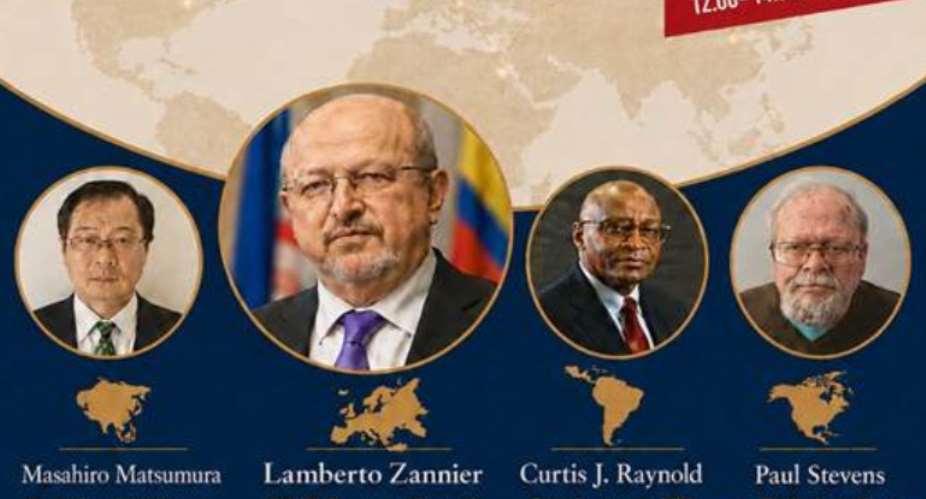
The second 2026 Energy Series event of the Global Academy for Future Governance (GAFG) brought together policymakers and top thinkers from three continents to examine the deepening intersection of energy policy and global disorder. Convened under the title Between a Hobbesian and Kantian World: Energy, Principles, and the Future, the session drew on decades of firsthand experience in conflict resolution, oil market analysis, and strategic policy to examine a world in which the institutional frameworks that once fostered cooperation are being contested.
On GAFG’s behalf, the event was opened by its Board Chair, Professor Anis H. Bajrektarevic, who situated the session within a rapidly deteriorating global context. Professor Bajrektarevic noted that the renewed escalation of conflict in the theater of West Asia (Middle East and particularly the Gulf region), the insufficiency of social responsibility on the side of numerous social media reporting on the crisis, and the broader question of whether multilateral institutions still have the capacity to act, and hence still hold globally shared credibility. He specifically pointed to the second-oldest cross-continental security arrangements – that of the Organization for Security and Cooperation in Europe (OSCE), which, after years of deadlock, finally re-approved its organization’s budget, but significantly reduced. This – by words of the GAFG Chairman – is not the signal of straightening the Kantian post-WWII order in Europe and beyond.
Moving from International Order to Global Disorder?
The keynote guest, Excellency Lamberto Zannier, former Secretary General of the OSCE, presented a diagnosis he described as “global disorder”. Drawing on a career at NATO, the UN, and the OSCE, he traced the gradual breakdown of the rules-based international system from early post-Cold War optimism of the Paris Charter to the present moment, in which power politics are preferred to agreed-upon norms.
He noted that the OSCE functioned as a dialogue space between enemies, NATO and the Warsaw Pact, and that this original logic remains intact. “The organization is there if countries want to use it,” he said. What is absent is not the instrument, but the leadership willing to engage it.
Zannier also emphasized the deeper structural forces at work: demographic and climate change, the competition for natural resources, and the rise of social media-driven polarization. These challenges, he argued, share a common feature, as they require integrated, long-term strategies of the kind that national electoral cycles are structurally ill-equipped to ensure. Here, multilateralism, though difficult to sell in the current political climate, maintains a distinct advantage: it can give political cover to leaders who need to implement unpopular but necessary policies.
However, his assessment was ultimately cautious. “We are in a phase where policies of sanctions prevail over policies of engagement,” he said. “Even engagement among enemies.”
Japan’s Energy Security Analysis and a Shifting World Order
The second contribution came from Professor Masahiro Matsumura of St. Andrew’s University in Osaka. He characterized Japan’s energy security approach as deliberately understated, as the country focuses on reducing its dependency on Middle Eastern oil through diversification, invests in mid-term efficiency gains such as advanced gas turbine combined-cycle systems, and pursues long-term technological bets on methane hydrate and nuclear fusion, neither of which will resolve near-term vulnerabilities.
Matsumura situated this strategy within a broader geopolitical framework, arguing that the current global order is in transition, which is driven by a contest between the US, Russia, and China aligned against what he termed the “globalist regime” of the UK, France, and Germany. Trump’s pressure campaign against Iran, he argued, functioned not only as a tool against Tehran but as a form of economic pressure on European energy security.
The Professor’s supplementary contribution highlighted energy stockpile vulnerabilities across East Asia. Matsumura noted that while Japan holds oil reserves for approximately 230 days, several Southeast Asian economies, including Vietnam, hold barely 30. Japan, he argued, has self-enlightened interests in regional energy stability that go well beyond its own borders.
OPEC’s Future in Energy Transitions
In the third intervention, Professor Paul Stevens of Chatham House offered the most tightly focused analysis of the session, concentrating on the Israeli-US military action against Iran and the UAE’s departure from OPEC.
The consequences, in his view, are twofold. First, energy security has returned forcefully to the topic of consumer-country policy agendas, a shift that will accelerate the energy transition and reduce long-term global demand for oil. Second, the UAE’s exit is unlikely to be the last. He identified a growing list of potential candidates, such as Venezuela, Nigeria, Kazakhstan, and even Iran and Iraq. For these countries, the pain of membership, constrained by production quotas while receiving a diminishing share of global demand, may soon outweigh the benefits.
Stevens argued that if OPEC does collapse, the result will be a return to a competitive crude market with prices potentially falling to between 20 and 50 dollars a barrel, which would be well below the average of recent years and unsustainable for most major oil-producing economies.
His assessment was complemented during the discussion by His Excellency Adnan Shihab-Eldin, former Secretary General of OPEC, who, after being the keynote speaker at the First GAFG Energy round, joined the session as a guest. Shihab-Eldin extended the Stevens’ scenario by adding that demand for oil, particularly from the Global South, may decline more slowly than anticipated, and whatever form OPEC takes in the future, some mechanism for market regulation will remain necessary. “Even if the organization is dismantled, a new, similar Organization will surely be needed,” he said.
Institutions, Leadership, and the Next Generation
The second, interactive part of the session touched upon a broad range of issues: from the practical prospects for regional security dialogue in the Gulf to the challenges young professionals are facing when seeking entry into international organizations.
On the question of possible Helsinki-style dialogue for Western Asia, Zannier was carefully encouraging. He recalled earlier regional engagements, such as multilateral discussions in Jordan on water and desertification that brought together Egypt and Israel, as evidence that interest can override political division. Furthering on the argument, he suggested that Oman, with its tradition of diplomatic neutrality, might be well placed to host an initial regional conversation, similar to the Swiss and, finally, Finland’s role in the original Helsinki process.
Regarding young professionals, Zannier was honest about the limits of optimism. He noted that international organizations are ageing, reducing their size, and increasingly filled by senior professionals accepting junior roles. “Keep trying,” he said, “but at some point, if you have to accept a compromise, you may be forced to.”
The session closed with a broader reflection on the limits to growth as we know it, and whether artificial intelligence, rather than solving structural problems, may accelerate them. “The level of noise of those who realize how fundamental these issues are had to increase“, Zannier said. “Every generation has to be bolder and make their voice heard. “
Conclusion
This, yet another successful GAFG global event, attracted diplomats, academia members, and practitioners of all branches from all five continents. Speakers’ notes and discussion afterwards clearly demonstrated that the Hobbesian and Kantian framings of the event’s title are not simply philosophical positions. They describe real and competing tendencies in today’s international system. Whether in oil markets, in arms control, or in the functioning of multilateral institutions, the mechanisms of cooperation are under pressure from forces that are structural, political, and ideological all at once.
The Global Academy for Future Governance will publish a full proceedings e-book from the second session of the Energy Series. The next event in the GAFG Energy series: New Geography of Global Trade (Ocean gateways, channels, corridors, and UNCLOS) is in the last phase of planning, and its whereabouts will soon be announced.

Maren Liedtke, of CEI, specializing in Conflict and Security Studies. She serves the global consultancy GAFG at its Information and Conference Officer.
 Ofori-Atta is still a citizen of Ghana, amenable to be extradited — OSP
 We were in power for eight years but couldn't complete Afari Military Hospital —...
 NUGS condemns alleged sexual misconduct involving teacher and student at Bole SH...
 Ken Ofori-Atta grabs U.S. permanent residency status
 2026 World Cup: Thomas Partey granted Canadian visa after court intervention
 There are efforts to help Sedina Tamakloe evade 10-year sentence — NPP alleges
 Spiritualist reveals how some pastors go for powers to fill their churches and d...
 'I didn’t say Wontumi must be jailed' – United Party Research Director
 Fuel prices drop as OMCs cut petrol, diesel prices by GH¢1.33, GH¢0.55 in June p...


