




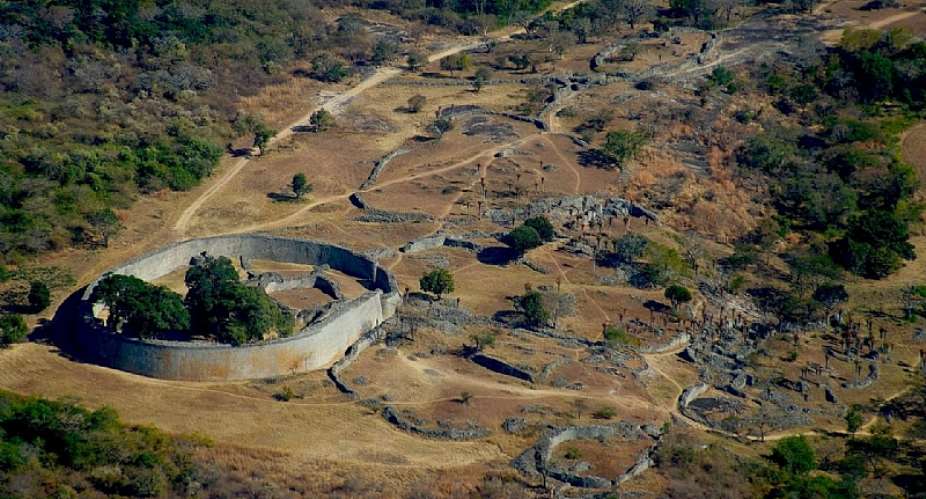
For more than a century, Great Zimbabwe has stood at the centre of a powerful story about the Zimbabwe culture. This remarkable African civilization flourished in southern Africa during the Middle Ages, constructing more than 200 dry-stone palaces, locally known as madzimbahwe (houses of stone).
These towering monuments, immense gold wealth, and an array of exotica including glass beads and glazed ceramics from distant lands, have often been interpreted as proof that southern Africa's early states were ruled by authoritarian kings. Leaders who exercised near-absolute control over their subjects.
In archaeology textbooks, museum exhibitions, and even political discourse, the image of Great Zimbabwe – rivalled in size and grandeur only by the Egyptian pyramids – has often been reduced to one of a despotic African kingdom ruled from above by divine kings.
This idea about African civilisations has often been mobilised to excuse modern forms of political despotism. But what if this story about the Zimbabwe culture is wrong – or at least incomplete?
Our new research in Mberengwa in south-central Zimbabwe is starting to challenge these long-held assumptions.
As an anthropological archaeologist, I use both excavated remains and the study of human cultures to understand how societies organised themselves. Far from revealing a rigid, centralised political system, evidence from Mberengwa suggests the opposite. Governance within the Zimbabwe culture may have been far more collective and negotiated than imagined.
Rather than monuments built solely through coercion, we may instead be looking at societies where power flowed through multiple layers of community organisation. Where ordinary households retained significant autonomy.
This challenges simplistic views. It reveals a more diverse history of governance that included consultation, negotiation and collective decision-making.
How we got here
For decades, archaeology has interpreted the Zimbabwe culture through outdated evolutionary models. These frameworks portrayed African societies as hierarchical, with kings monopolising wealth, labour and political authority.
Great Zimbabwe, Mapungubwe and Khami were viewed as capitals of centralised states in southern Africa. Rulers were assumed to have commanded vast territories, controlled mining and long-distance trade. They compelled subjects to build monumental stone architecture.
This interpretation was deeply shaped by colonial thinking. Early European historians and anthropologists often portrayed African rulers as tyrants ruling through fear, superstition and violence. The Zulu king Shaka, for example, was cast as the archetypal African despot. Similar assumptions were later projected backwards onto Iron Age civilisations like Great Zimbabwe.
Colonial scholarship like this helped to justify colonial domination.
In these narratives, monuments and massive stone walls could only have been built through forced labour directed by authoritarian elites.
Across the world, archaeology has increasingly challenged these simplistic models. Research in places like Mesoamerica, Mesopotamia and the Niger Delta now shows that complex societies were not always governed through top-down domination. Many ancient states relied on consensus-building, shared authority and cooperative systems of governance.
Southern Africa has lagged behind in this intellectual shift. Interpretations of Great Zimbabwe continue to suffer from what has been called a “neo-evolutionary hangover”. The persistent assumption that political complexity must automatically mean centralised despotism.
What Mberengwa reveals about power
Mberengwa, in Zimbabwe's mineral-rich south-central region, has long been framed as peripheral to Great Zimbabwe. Archaeologists assumed its communities fell under the control of rulers at Great Zimbabwe, over 100km away. But ongoing excavations and surveys reveal something more complicated.
Mberengwa contains numerous settlements – both walled and unwalled – some dating to the same period as Great Zimbabwe. These sites contain evidence of farming, metallurgy, mining, hunting and long-distance trade. They also reveal multiple centres of political authority rather than a single centralised state.
What's striking is how political organisation appears to have operated across several levels of society. At the grassroots were the misha (homesteads) of ordinary families. These were not politically insignificant spaces. Archaeological evidence suggests households managed their own livestock, agriculture, craft production and local affairs with considerable autonomy.
Above the homestead was the dunhu, or ward, which brought together clusters of households. Here, cooperative labour systems such as nhimbe played a central role in social life. Communities came together voluntarily to plough fields, build houses, herd cattle, and conduct hunting expeditions.
At the territorial level was the nyika, overseen by rulers known as madzimambo (kings). But even here, power appears to have been negotiated rather than absolute. Oral traditions and ethnographic evidence from precolonial Shona societies suggest that rulers governed alongside advisory councils. They worked within systems of customary law and communal expectations.
Several Shona proverbs emphasise this political ethic. “Dare haritongwi nepfumo” means a court is not governed by a spear. “Ane ziso rimwe haatongi” warns that a person with one eye cannot govern fairly. Such philosophies suggest consensus and accountability were central to governance.
Rethinking the dry-stone walls
This perspective forces us to reconsider the monuments themselves.
The dry-stone walls of Zimbabwe culture sites have often been interpreted as symbols of elite power. But architectural analysis from Mberengwa reveals something else. Many walls were built using different styles and degrees of craftsmanship, often within the same structure.
This doesn't indicate a centrally controlled labour force. It suggests multiple groups contributing collaboratively to construction over time. There's also little evidence for armies or policing systems needed to control coerced labour. In societies where people could relocate, coercion would anyway have been difficult to maintain.
Communal labour traditions offer a more plausible explanation. Just as communities gathered for agricultural work, monumental construction may also have emerged through cooperative participation. This suggests social obligation, political loyalty, and collective identity.
This doesn't mean these societies were perfectly egalitarian (democratic). There were rulers, hierarchies and inequalities. Royal residences stood above ordinary settlements, and political authority clearly mattered. But hierarchy is not the same thing as tyranny.
Archaeological discoveries from Mberengwa indicate the existence of multiple autonomous centres of power. Sites such as Chumnungwa and Mundi contained royal burials, political insignia, gold artefacts and monumental architecture. They're comparable to finds at a supposed centre like Great Zimbabwe.
The emerging picture is one of overlapping and competing polities. These were connected through trade, kinship, ritual and shared traditions.
Why this debate matters
The way we interpret the African past shapes how African political systems are understood in the present.
Unfortunately, some of those assumptions continue to echo today. By portraying despotism as historically “natural” to Africa, they normalise authoritarianism in the modern era. But archaeology tells a more complicated story.
Mberengwa suggests that political life within the Zimbabwe culture was dynamic, layered and collective.
That possibility deserves far greater attention. Not only for understanding the past, but for imagining African political futures beyond the shadow of authoritarianism.
The African Archaeology Hub at Queens College collaborates with colleagues from the National Museums of Zimbabwe, Oxford University, the Field Museum, the Midlands State University, Great Zimbabwe University, and the local communities of Mberengwa.
Robert T. Nyamushosho receives funding from the CUNY Research Foundation, Queens College Foundation, and PSC-CUNY Research Award Program. He is also a Research Associate at the University of Johannesburg.
By Robert T. Nyamushosho, Assistant Professor, Queens College, CUNY

 UN backs effort to drop Mercator map and show size of Africa more accurately
 CUTS Raises Cartel Concerns Over Cement Manufacturers’ Uniform GH¢12 Surcharge
 I have not been invited by OSP over fake GH¢70,000 memo — Patricia Appiagyei
 Vetting committee has never taken bribes or gifts from nominees — Bernard Ahiafo...
 Chief Justice Baffoe-Bonnie clarifies controversial remarks
 Dunkwa-Ayanfuri road construction to commence in 2027 – Finance Minister
 PRESEC, St. Augustine’s College and Accra Academy set for NSMQ grand finale on S...
 Appiagyei denies alleged GH¢70,000 vetting payment in memo
 Lawyer challenges GRA’s power to grant passenger baggage tax exemptions
 Agbogbloshie waste heap is as high as 10-storey building – Mahama Ayariga

