




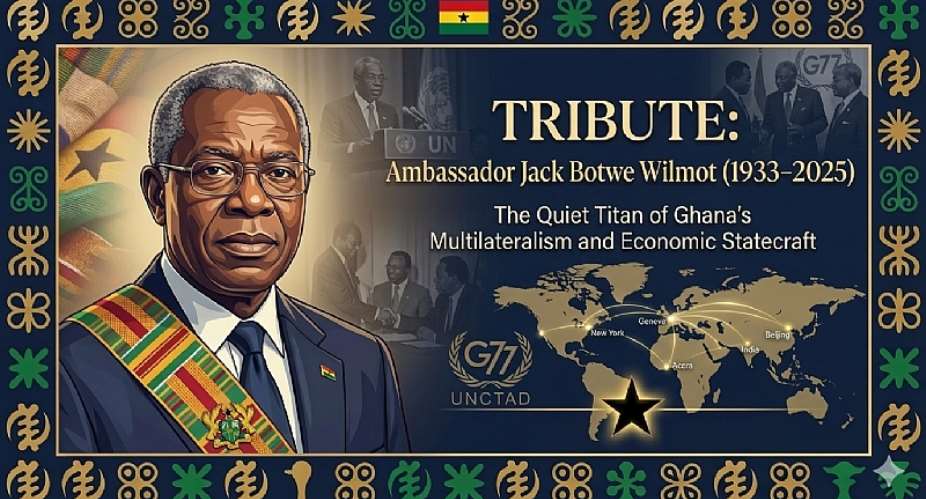
In the annals of post-independence Ghanaian history, certain names evoke immediate reverence among global policymakers. Among this elite tier of career diplomats stands Ambassador Jack Botwe Wilmot. While often operating out of the public flashlights, Wilmot’s intellectual fingerprints remain deeply embedded within Ghana's contemporary international trade frameworks and multilateral successes.
Born on February 15, 1934, Jack Botwe Wilmot belonged to the pioneering generation of Ghanaian intellectuals who came of age exactly as the country broke the shackles of colonial rule in 1957. Wilmot’s education was vast and interdisciplinary; he earned a Bachelor of Arts in Philosophy from Gray’s Inn, London, in 1959, and later added a Bachelor of Laws (LL.B) from the University of Ghana in 1971. As a solicitor of the Supreme Court of Ghana and a proud member of the Ghana Bar, he uniquely fused legal precision with international statecraft.
Constructing the Foundations of the Foreign Service
Younger generations of Ghanaians might only know Wilmot from his high-profile postings, but his foundational work behind the scenes was massive. From 1961 to 1963, right after independence, he served as the First Secretary and Head of Chancery at the Ghana High Commission in Lagos, Nigeria—structuring our earliest bilateral ties within West Africa.
He climbed every single rung of the diplomatic ladder. He served as the Director of the Economic Relations Department’s Multilateral Division (1968–1970), headed the Embassy of Ghana in Brussels as Minister-Counsellor (1970–1975), and went on to become Ghana's Ambassador to Belgium, the European Economic Community (EEC), the Netherlands, and Luxembourg from 1979 to 1985. In Europe, Wilmot was the chief negotiator protecting Ghanaian agricultural exports, securing vital trade access under the historic Lomé Conventions.
Steering the Ministry Through Global Shifts
Between 1987 and 1994, Wilmot took on the heavy role of Chief Director of the Political and Economic Relations Department at the Ministry of Foreign Affairs. During this critical phase, as the world transitioned out of the Cold War, Wilmot reorganised Ghana’s foreign policy apparatus to prioritize economic diplomacy over ideological alignment. He insisted that Ghana's embassies abroad must act as economic hubs designed to attract direct foreign investment, boost local tourism, and secure development partnerships.
The Crown Jewel: Permanent Representative to the UN (1996–1999)
The absolute pinnacle of his career came in 1996, when he was appointed by the state as Ghana’s Permanent Representative to the United Nations in New York. Serving until 1999, Wilmot’s tenure perfectly overlapped with a historic moment for our nation: fellow Ghanaian Kofi Annan taking office as the UN Secretary-General in 1997.
At the UN, Ambassador Wilmot was a masterful advocate for African unity. He fought tirelessly on the floor of the General Assembly to link global security frameworks with sustainable development, arguing that peace in West Africa could only be sustained through robust economic empowerment and poverty eradication.
A Model Public Servant for Modern Ghana
Ambassador Jack Botwe Wilmot's life teaches us that true impact does not require loudest noise. Through brilliant negotiation, legal mastery, and quiet dignity, he defended the Black Star on global stages. For every young Ghanaian aspiring to represent this nation internationally, the institutional blueprint left behind by Ambassador Wilmot is an essential guide map of excellence.
✍️By A Concerned Retired Senior Citizen
For and on behalf of all Senior Citizens of the Republic of Ghana 🇬🇭
Teshie-Nungua
[email protected]

 Atta Akyea takes over from Andy Appiah Kubi as lawyer for Wontumi’s Samreboi cas...
 Woman loses temper, fights mentally challenged lady over alleged disrespect
 WHO welcomes UK's move to ban social media access for children under 16
 June 15: Cedi appreciates, sells at GHS12.30 on forex market, GHS11.06 on BoG in...
 Samreboi case: How rejection of Appiah Kubi's withdrawal could offer Wontumi a p...
 UK to ban under-16s from social media over safety and mental health concerns
 Samreboi case: Appiah Kubi cites disappointment with court in withdrawal applica...
 ECOWAS mourns demise of former Commission President James Victor Gbeho
 Andy Appiah Kubi's application to withdraw as Lawyer for Wontumi in Samreboi ill...
 I’ll file a notice of withdrawal and leave the case—Appiah Kubi on next line of ...


