




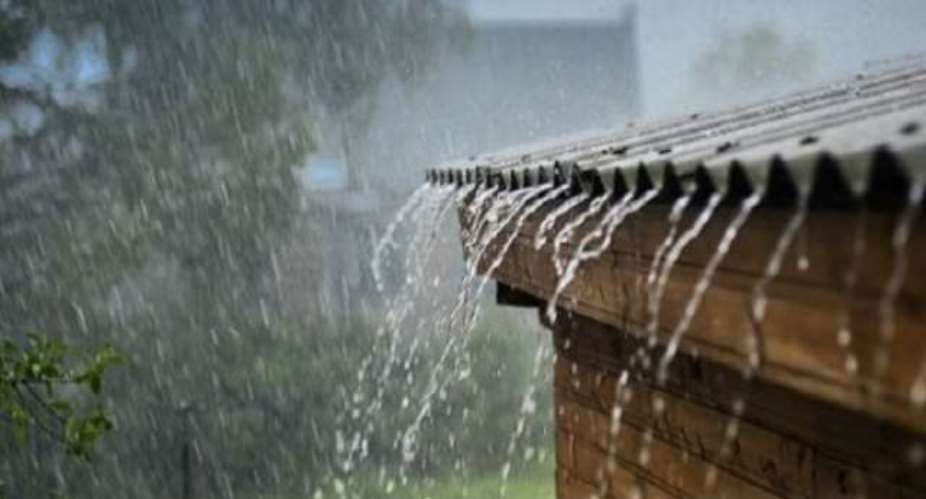
In Northern Ghana, rainfall is not merely a weather condition. It is life. It is food. It is income. It is school fees. It is market activity. It is the difference between a hopeful farming season and months of anxiety for families whose survival depends on the land.
For many communities in the north, the rainy season carries more than water. It carries expectation. Farmers prepare their lands with faith. Families wait with hope. Markets depend on harvests. Students depend on parents whose income is tied directly to farming. But in recent years, this hope has become increasingly uncertain. The rains delay, stop unexpectedly or come in destructive patterns. When this happens, the effect does not remain on the farm. It enters homes, markets, schools and national conversations on poverty, food security, youth development and economic stability.
Climate change is no longer a distant global conversation reserved for scientists, international conferences and policy documents. It is already present in our communities. It is seen in the farmer who watches the sky with uncertainty. It is felt by market women who struggle with rising food prices. It is experienced by students whose feeding, health and academic stability are indirectly affected when farming households lose their income.
This is why climate change must be treated as one of the most urgent development issues facing Northern Ghana.
The Northern Region and the wider savannah zone remain heavily dependent on rain-fed agriculture. Crops such as maize, millet, sorghum, rice, groundnut, yam and soybean are not just food crops; they are livelihood crops. They support families, provide employment, sustain local markets and contribute significantly to Ghana’s food basket. When rainfall becomes erratic, when dry spells become longer and when temperatures rise, the impact is immediate and painful.
Ghana’s own climate realities show that the country is already experiencing rising temperatures, unpredictable rainfall, droughts and floods, with serious implications for agriculture, water availability and food security. The Ministry of Food and Agriculture also reported that the 2024 dry spell significantly affected grain production and the food system, leading to reduced crop yields. By August 2024, over 430,000 farmers had reportedly been affected, with maize, rice, groundnut, soybean, sorghum, millet and yam among the most affected crops.
For Northern Ghana, this is not just an environmental crisis. It is an economic crisis. It is a welfare crisis. It is a food security crisis. It is a student welfare crisis.
When crops fail, food prices rise. When food prices rise, families struggle. When families struggle, students feel the pressure. Some students reduce the number of meals they take in a day. Some struggle to buy basic learning materials. Some lose concentration because financial pressure at home follows them to campus. Climate change, therefore, is not only about the environment; it is also about education, health, poverty, peace, migration and opportunity.
This is the part of the climate conversation we must take more seriously.
Too often, climate change is discussed in broad technical language that ordinary people do not immediately connect with. But the truth is simple: if rainfall becomes unreliable in Northern Ghana, food production suffers. If food production suffers, prices rise. If prices rise, vulnerable families suffer. If vulnerable families suffer, young people suffer too.
The response must therefore be urgent, practical and local.
First, we must strengthen climate education. Many young people hear about climate change but do not fully understand how it connects to food prices, farming, public health, water, migration and poverty. Climate education should not be limited to environmental science students or climate-related organizations. It should reach basic schools, senior high schools, tertiary institutions, farmer groups, religious bodies, traditional authorities and local communities.
Second, Ghana must invest more seriously in climate-smart agriculture, especially in the north. Farmers need access to drought-resistant seeds, irrigation support, improved storage facilities, weather information, extension services and modern farming techniques. It is not enough to tell farmers to adapt. We must provide them with the tools, information and support systems that make adaptation possible.
Third, Northern Ghana must reduce its overdependence on rainfall. Small-scale irrigation, water harvesting, dams, dugouts, boreholes and community water systems must be expanded and properly maintained. In a region where rainfall is becoming less predictable, water security must become a central part of development planning.
Fourth, local assemblies must integrate climate resilience into their development plans. Poor drainage, uncontrolled tree cutting, bush burning, weak waste management and poor land-use planning worsen climate risks. District and municipal assemblies must move climate action from speeches into budgets, infrastructure, enforcement and community-level action.
Fifth, young people must be placed at the centre of climate leadership. Youth must not only be invited to climate programs as participants. They must be trained, resourced and trusted as climate advocates, innovators, researchers, communicators and community mobilizers. Student leaders, youth groups and local organizations can play a powerful role in awareness creation, tree growing, clean-up campaigns, research, advocacy and policy engagement.
However, we must also be honest with ourselves. Climate action must go beyond ceremonial tree planting. Tree planting is important, but Northern Ghana needs more than occasional symbolic exercises. We need tree growing, environmental protection, climate-smart farming, renewable energy, water security, waste management, climate education and stronger local climate policies.
As a young leader from the north, I believe our generation has a responsibility to make climate change a central part of public discussion. We must speak about it in our schools, our communities, our student unions, our churches, our mosques, our traditional spaces and our political platforms. We must make people understand that climate change is not only about the future. It is about the price of food today. It is about the farmer’s harvest today. It is about the student’s welfare today. It is about the survival of vulnerable communities today.
The future of Northern Ghana depends on how seriously we respond now.
If the rains fail, it is not only farmers who suffer. The entire society feels the impact. Food becomes expensive. Families struggle. Students suffer. Communities become vulnerable. Development slows down.
Climate change is no longer tomorrow’s problem. It is today’s reality.
Northern Ghana must not wait until the crisis becomes unbearable before acting. The time for serious climate leadership is now. The time for youth-led climate advocacy is now. The time to protect our food systems, our communities and our future is now.
References/Further Reading
- Ghana Meteorological Agency: climate change in Ghana, including rising temperatures, unpredictable rainfall, droughts and floods https://dicf.unepgrid.ch/ghana/climate-change?utm_source=chatgpt.com
- Ministry of Food and Agriculture: 2024 dry spell update and effects on grain production and food systems https://mofa.gov.gh/site/index.php/media-centre/latest-news/item/655-dry-spell-update-government-unveils-measures-to-mitigate-effects-on-food-system-and-farmers?utm_source=chatgpt.com
- Citi Newsroom report on 2024 drought impact on farmers and affected crops https://www.citinewsroom.com/2024/08/drought-over-430k-farmers-already-affected-gh%E2%82%B53-5bn-lost/?utm_source=chatgpt.com
- FAO support programme for farmers affected by the dry spell in Northern Ghana https://www.fao.org/africa/news-stories/news-detail/eu-and-fao-to-strengthen-resilience-of-over-12-600-farmers-amid-dry-spell-in-northern-ghana/en?utm_source=chatgpt.com
- World Food Programme Ghana profile on climate-related production losses, rising food prices and food insecurity in northern Ghana https://www.wfp.org/countries/ghana?utm_source=chatgpt.com
Author Bio:
Zampiaw Isaac is a Doctor of Medical Laboratory Science student at the University for Development Studies, UDS Local NUGS President and Vice Chairman of the Climate Change Committee under the 59th National NUGS. His interests include youth leadership, student welfare, climate action, governance and sustainable development.
Contact for editorial correspondence:
Email: [email protected]
Phone: +233 54 316 5085
 Atta Akyea takes over from Andy Appiah Kubi as lawyer for Wontumi’s Samreboi cas...
 Woman loses temper, fights mentally challenged lady over alleged disrespect
 WHO welcomes UK's move to ban social media access for children under 16
 June 15: Cedi appreciates, sells at GHS12.30 on forex market, GHS11.06 on BoG in...
 Samreboi case: How rejection of Appiah Kubi's withdrawal could offer Wontumi a p...
 UK to ban under-16s from social media over safety and mental health concerns
 Samreboi case: Appiah Kubi cites disappointment with court in withdrawal applica...
 ECOWAS mourns demise of former Commission President James Victor Gbeho
 Andy Appiah Kubi's application to withdraw as Lawyer for Wontumi in Samreboi ill...
 I’ll file a notice of withdrawal and leave the case—Appiah Kubi on next line of ...


