




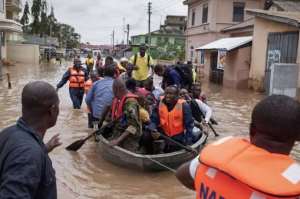
The issue of perennial flooding has dominated the media and almost every conversation in the country. This year’s flooding is a bit unprecedented compared with historical data. The problem of Accra is that the city was not engineered to withstand hours of rainfall. Whilst the topography and geology of the city can be seen as causal factors, one cannot ignore the engineering deficit as a major factor.
Along with the sensational headlines and social media hashtags for this year has been the phrase "indiscipline or engineering." Whilst this debate is new, the question: Is flooding in Accra an engineering failure or simply a consequence of residents' indiscipline, is not new.
His Excellency the President is reported to have said that the causes of the flooding in the city lean more towards indiscipline than engineering. The temptation is to choose one side of the argument. The reality is that the problem is more complex. Accra's perennial flooding is both an engineering problem and an indiscipline problem. Any attempt to address one while ignoring the other will only prolong the cycle of destruction synonymous with the rainy season.
The Engineering Deficit Cannot Be Ignored
Accra's physical infrastructure was not designed to accommodate the pace and scale of urban growth witnessed over the past three decades. Research on flood vulnerability in Accra has consistently shown that inadequate drainage systems, undersized culverts, poor urban planning, and weak enforcement of land-use regulations contribute significantly to flooding. Studies have further demonstrated that a substantial portion of the metropolis lies within naturally flood-prone zones, making effective drainage infrastructure indispensable.
Many drains across the city are either too narrow, poorly connected, or incapable of handling the runoff volume generated by increasingly intense rainfall events. Rapid urbanization has also replaced permeable surfaces with concrete and asphalt, reducing the land's natural ability to absorb water. Consequently, rainfall that would otherwise infiltrate the soil is channeled rapidly into already overstretched drainage networks.
Neighborhoods such as Kasoa, Weija, Kaneshie, Odawna, Alajo, and many parts of East Legon have repeatedly experienced flooding despite numerous dredging and desilting exercises. This suggests that the challenge goes beyond maintenance and points to deeper structural and engineering shortcomings.
Moreover, decades of fragmented urban planning have enabled development without corresponding investments in stormwater management systems. Infrastructure expansion has often lagged behind population growth, leaving many communities vulnerable.
The Culture of Indiscipline
However, engineering explanations alone do not tell the full story. It is indisputable that the city is not clean. Plastic waste, discarded household refuse, construction debris, and silt routinely find their way into drains and waterways. During rainfall, these materials accumulate at culverts and drainage intersections, obstructing water flow and causing overflow.
Residents frequently dispose of waste in open drains despite public education campaigns and sanitation by-laws. In some communities, drains are treated as refuse dumps. The result is predictable: drainage channels designed to carry stormwater become clogged long before the rains arrive.
Beyond waste disposal, encroachment on waterways remains a major concern. Buildings continue to emerge on wetlands, floodplains, and designated watercourses. Researchers studying flood vulnerability in Accra have highlighted how informal urbanization and weak enforcement of planning regulations have significantly increased flood risks.
Can engineering solutions alone succeed when citizens continue to undermine the very systems intended to protect them? The answer is clearly no. Even the most sophisticated drainage infrastructure will struggle to perform if it is routinely blocked with waste or if natural waterways are obstructed by unauthorized developments.
Why Governance Matters
The debate should not be framed as engineering versus indiscipline. Instead, attention should focus on governance.
Indiscipline thrives where regulations are weakly enforced. Illegal structures do not emerge overnight. Waste does not accumulate in drains without failures in waste management systems, monitoring, and enforcement. The city authorities have not demonstrated sufficient competence in enforcing sanity in the city, whether through unauthorized structures, the implementation of flood mitigation policies, or filthy streets and gutters. Bylaws meant to ensure compliance are not enforced.
Government agencies, metropolitan assemblies, traditional authorities, private developers, and citizens all share responsibility for the current situation. Blaming residents alone ignores systemic failures, while blaming engineers alone overlooks individual accountability.
Lessons from Other Countries
Many countries have successfully reduced urban flooding by combining infrastructure investments with behavioral change and strict enforcement.
Singapore offers a notable example. The city-state invested heavily in modern drainage systems, retention ponds and flood monitoring technologies. However, these engineering interventions were complemented by stringent environmental regulations, effective waste management and severe penalties for littering.
Similarly, the Netherlands, a country that lives with water daily, combines advanced flood engineering with strict land-use planning. Construction in flood-prone areas is carefully regulated, while citizens are actively engaged in water management initiatives.
Closer to Africa, Rwanda's capital, Kigali, has earned recognition for its cleanliness through consistent enforcement of sanitation laws and strong public participation. While Kigali faces different environmental conditions, its success demonstrates the importance of civic responsibility in maintaining urban infrastructure.
Towards a Lasting Solution
Any solution to address Accra's flooding challenge requires a dual approach. First, the government should invest in modern, climate-resilient drainage infrastructure, expand stormwater systems, restore wetlands, and enforce planning regulations without political interference.
Second, citizens must embrace responsible environmental behavior. Refuse should not end up in drains. Waterways should not become dumping grounds. Community participation in sanitation efforts must become a civic obligation rather than an occasional exercise.
Flooding in Accra is neither purely an engineering problem nor solely an indiscipline problem. It is the result of a dangerous interaction between inadequate infrastructure, poor urban governance, weak enforcement, and irresponsible human behavior.
Until we acknowledge this reality, the headlines will remain the same every rainy season: "Accra Floods Again." The city deserves better. And so do its people.
The writer is a development professional with CUTS International. For more information, email [email protected] or visit www.cuts-accra.org
 Atta Akyea takes over from Andy Appiah Kubi as lawyer for Wontumi’s Samreboi cas...
 Woman loses temper, fights mentally challenged lady over alleged disrespect
 WHO welcomes UK's move to ban social media access for children under 16
 June 15: Cedi appreciates, sells at GHS12.30 on forex market, GHS11.06 on BoG in...
 Samreboi case: How rejection of Appiah Kubi's withdrawal could offer Wontumi a p...
 UK to ban under-16s from social media over safety and mental health concerns
 Samreboi case: Appiah Kubi cites disappointment with court in withdrawal applica...
 ECOWAS mourns demise of former Commission President James Victor Gbeho
 Andy Appiah Kubi's application to withdraw as Lawyer for Wontumi in Samreboi ill...
 I’ll file a notice of withdrawal and leave the case—Appiah Kubi on next line of ...


