




An archival front page from The Ghanaian Times, dated Saturday, March 30, 1963, features a headline that reads like a cruel paradox today: "Ghana’s Town Planning Ranks With World Best". In the article, Professor Y. Hoegg, a consulting town planner from Munich, West Germany, confidently asserted that "Ghana's town planning ranks with world best," praising the country's foresight in long-term spatial development.
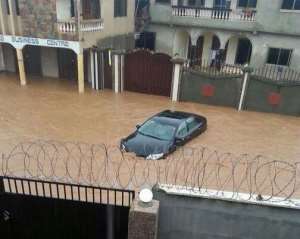
Fast forward to the present day, and the reality on the ground completely shatters that mid-century optimism. A video documentary captures a capital city completely overwhelmed by water. From historic hotspots like Circle, Kaneshie, and Odorna to newly developing areas such as East Legon Hills, Oyarifa, and the Kasoa corridor, Accra's flood crisis has expanded into a perennial disaster that halts economic life, destroys homes, and claims innocent lives.
Solving this crisis requires looking past political rhetoric, acknowledging severe engineering shortcomings, and addressing a profound crisis of civic indiscipline.
Dismantling the Rhetoric: Why It Is an Engineering Problem
During a town hall address featured in the footage, President John Dramani Mahama stated: "The flooding in Accra is not an engineering problem. It's a problem of indiscipline."
While the sentiment highlights a very real behavioral crisis, dismissing the engineering failure is fundamentally inaccurate. The flood crisis is an intersecting failure of concrete engineering, spatial planning, and behavioral science.
The data presented in video clip outlines a massive ecological and structural imbalance:
- The Loss of Natural Sponges: Between the years 2000 and 2020, Accra's woodland coverage plummeted from 10.5% to just 4%. Concurrently, built-up concrete areas surged from 40% to 65%.
- The Runoff Multiplier: Because the city has systematically paved over its green spaces, stormwater can no longer percolate into the ground. This has resulted in a staggering 3.5x increase in peak water discharge.
- Structural Deficits: Roads are routinely engineered and constructed without adequate, integrated drainage networks. Furthermore, state agencies continue to issue building permits within low-lying, flood-prone areas, physically blocking natural water channels like the Odaw catchment.
When climate-induced weather patterns dump 132 mm of rain in less than 3 hours, an infrastructure network designed for a mid-20th-century landscape simply cannot cope. To claim this is not an engineering problem ignores the basic physics of urban hydrology.
The Citizen's Burden: Indiscipline as an Infrastructure Killer
However, the political argument contains an uncomfortable truth: engineering cannot fix a system that citizens actively sabotage. The storms footage provides damning evidence of public complicity.
Even the most advanced drainage networks in the world will fail if they are treated as trash receptacles. Accra’s primary and secondary drains are consistently choked with:
- Single-use plastics and household refuse.
- Silt and uncontained construction debris.
- Commercial waste dumped directly into water channels during heavy downpours.
When citizens fill drainage channels with solid waste, they radically reduce the cross-sectional area available for water flow. This civic indiscipline acts as a physical dam, forcing stormwater out of the drains and into streets, markets, and homes. Engineering must lead the way, but citizens must shoulder a massive share of the responsibility for creating the very bottlenecks that drown their communities.
The Institutional Tangle: Overlapping Roles, Zero Accountability
A significant barrier to implementing lasting engineering or behavioral solutions is the chaotic web of state bureaucracy. As illustrated in the documentary, flood management in Ghana is paralyzed by an overwhelming number of overlapping institutions.
With authority fragmented across the National Disaster Management Organisation (NADMO), the Ghana Meteorological Agency (GMet), the Environmental Protection Agency (EPA), the Land Use and Spatial Planning Authority (LUSPA), various Metropolitan, Municipal, and District Assemblies (MMDAs), and the Hydrological Authority, there is no centralized accountability. When a neighborhood floods, the assemblies blame the developers, developers point to approved permits, and the infrastructure ministries blame public waste habits. Without a single, empowered entity to oversee urban hydrology, structural solutions remain gridlocked.
Realistic Pathways Forward
To transition Accra from a state of reactive crisis management to proactive flood resilience, a multi-tiered strategy must be deployed.
1: Ghana must establish a single, overarching Urban Hydrology and Drainage Taskforce that supercedes the fragmented jurisdictions of MMDAs, LUSPA, and the Hydrological Authority. This centralized body should have sole authority over approving major structural permits near water courses, managing drainage masterplans, and holding local assemblies accountable for maintaining clear waterways.
2: Civil Engineering Retrofits and "Sponge City" Designs
To counter the 3.5x increase in peak water discharge, the government must mandate the creation of urban retention ponds and green corridors along the Odaw basin to capture and slowly release stormwater.
Future road construction must integrate permeable pavements and mandatory, wide-bore subsurface drains rather than shallow, open gutters that double as refuse bins.
3: The state must systematically revoke building permits issued in wetlands and low-lying floodplains. Demolishing structures that block natural waterways is a politically difficult but non-negotiable step toward restoring the city's natural drainage capacity.
4: Revolutionizing Waste Management and Civic Enforcement
Citizens often dump trash into drains because municipal waste collection is irregular or prohibitively expensive. Local assemblies and government must ensure predictable, accessible household waste pickup.
Educational campaigns are no longer enough. Municipalities must deploy sanitation guards to arrest and heavily fine individuals and businesses caught dumping refuse into the drainage system.
Conclusion
The crisis in Accra is neither a pure engineering failure nor solely a product of civilian indiscipline—it is a compounding tragedy born from the collapse of both. For decades, institutional enforcement has looked the other way while concrete has replaced woodlands and garbage has replaced water flow.
If Ghana continues to treat this purely as a political talking point or a natural inevitability, the script will repeat itself with every rainy season. The rains will fall, the clogged drains will fail, lives will be upended, and the nation will be left with the recurring, painful reminder that water will always reclaim its path.


 Ms. Emelia Affi Agbenyo must honourably resign as new EC Deputy Chairperson to p...
 Why have US-Ukraine relations soured ahead of the midterms?
 Govt to meet Free Zones Authority, Trade Ministry over Customs Act concerns
 Kojo Bamba was never my driver or bodyguard — Nana B
 Ekow Assafuah petitions OSP to probe alleged World Cup visa facilitation irregul...
 Africa attracting wrong waste management solutions – GAIA report
 Summon Kofi Adams, GTA boss over 2026 World Cup visa scandal — NPP tells Parliam...
 Obuasi SHS headmaster accused of sexual abuse is NDC constituency secretary – Ma...
 Family demands answers over death of 14-year-old student at Abomosu STEM SHS
 Osahen Afenyo-Markin reflects on loneliness of public service, says survival is ...



Comments
It is unbelievable how many politicians in our country lack appreciation of technical expertise. Many technical agencies lack the resources and power to ensure that the right thing gets done. Rather than fixing that, we are no moving power away from them. Flood control falls under the jurisdiction of civil engineering, but we are handing it over to assemblies who have zero technical expertise. We seem to be becoming a jungle, so let us continue to watch as we plunge into further chaos b...