




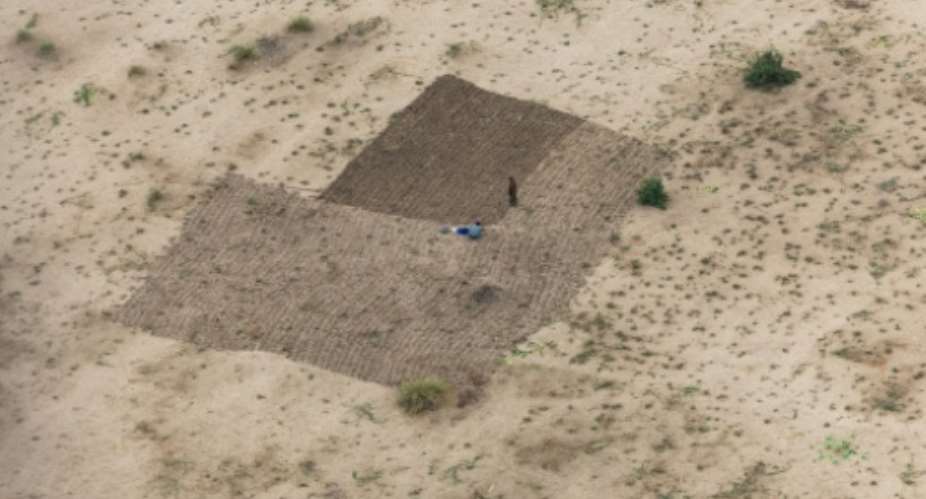
Weeks into Nigeria's crucial annual rainy season, farmers across the north are abandoning their lands due to attacks by armed groups, threatening the food supply of Africa's most populous country.
Jihadists and "bandit" gangs specialising in kidnapping for ransom and cattle rustling terrorise communities in northern and central Nigeria, where they launch deadly raids and impose levies on farmers wishing to access their own fields.
Some farmers, after paying ransoms, have no money left to pay the "taxes" to access their land. Others flee, leaving behind uncultivated fields in a country where millions go hungry each day.
"The risk of food shortage is very high due to a huge number of farmers not having access to their farms as a result of attacks by bandits and insurgents," said Ya'u Tumfafi, an official at Kano's Dawanau grain market, said to be the largest such trading centre in west Africa.
"There is bound to be a huge gap between demand and supply which will definitely drive food prices up," Ya'u said.
On Sunday, 39 elders of Magamin Didde, in Zamfara state, the epicentre of the country's banditry crisis, were kidnapped when they visited the camp of a gang kingpin to arrange a peace deal to allow the community to cultivate their farms, Sanusi Dosara, the political administrator of Maradun district, told AFP.
The bandits are demanding $92,000 to release the captives and allow the community to farm.
The violence has caught the attention of the International Monetary Fund, which warned Tuesday that "a deterioration in domestic security" could "aggravate poverty and food insecurity".
In its annual report on Nigeria's economy, it recommended that the government "strengthen security to stop oil theft and protect farmers and herders".
The north produces 70 percent of Nigeria's grains, which are both consumed locally and exported to other countries in the region.
The rainy season -- crucial for the majority of farmers, who don't have access to mechanised irrigation -- runs between June and September.
Hundreds flee their farms
While jihadists have been waging a 17-year fight against the Nigerian government to carve out a caliphate, bandits are motivated by money rather than ideology.
Both have thrived in swathes of rural territory long abandoned by the state. They've both clashed and collaborated to mete out violence.
Bandits have killed farmers across the northwest, from Zamfara to Katsina to the agricultural hub of Kebbi state.
Ado Sabon Fegi, a traditional chief in Chediya, in Zamfara's Tsafe district, said bandits would not allow his community to farm, with hundreds having fled.
Farmers in Zurmi town and surrounding communities in Zamfara have for the past week stopped going to the farm to plant, after 28 people were kidnapped and two killed in the span of two days, said resident Aliyu Musa.
In neighbouring Sokoto state, jihadists from a shadowy group known as "Lakurawa" have prevented farmers in several communities near the border with Niger from accessing their farms unless they pay up, said Garba Sodangi, director of agriculture in Tangaza district.
In northeastern Borno state, the epicentre of Nigeria's jihadist conflict, fields as close as five kilometres (three miles) from the state capital Maiduguri are off-limits unless farmers pay militants, said Abdullahi Sani, a fishermen's union official.
Despite the large contingent of troops securing the city, Nigeria's military is overstretched, with state control falling off quickly outside large urban centres.
In recent days, Boko Haram kidnapped 12 farmers from their farms in nearby Zabarmari village, Sani said.
The jihadists killed three of the farmers as a warning to the families of the other nine if they failed to pay a ransom.
'Squeezed out'
The International Committee of the Red Cross (ICRC) has warned that armed conflict from bandits, jihadists and farmers and herders clashing over land is worsening the country's already high malnutrition levels among more than six million malnourished infants in Nigeria's northwest, northeast and centre.
"The situation is projected to deteriorate significantly during the peak malnutrition season" between May and September, with the northeast being the worst hit, ICRC said in a statement to AFP.
Meanwhile, communities that have been repeatedly raising money to pay ransoms to free their kidnapped kinsmen say they no longer have enough cash to pay for access to their fields.
"We can't raise the huge levy bandits are asking us to pay to be allowed to farm," said Alka Hamidu, a resident of Bena, in Kebbi state.
"We have been squeezed out of everything, and have nothing more to offer."

 June 12: Cedi appreciates, sells at GHS12.50 on forex market, GHS11.06 on BoG in...
 'Unemployment requires deeper structural reforms, not slogans' – Stephen Amoah c...
 UE/R: Sandema flooded as heavy rains cut off major road
 Nigeria killed 13,000 'terrorists' in past year — President Tinubu
 Take the path to greatness through constitution review — Barker-Vormawor to Maha...
 Ghana evacuates over 500 citizens displaced by Abidjan demolition exercise
 Youth keep acquiring degrees with no end in sight due to lack of jobs — Sammi Aw...
 2026 World Cup: Black Stars arrive in Rhode Island for final phase of preparatio...
 Adu-Boahene trial: Prosecution witness denies claims of inter-branch fund transf...
 Sales boy captured on CCTV cameras stealing GH¢217,000 from employer jailed 36 m...


