




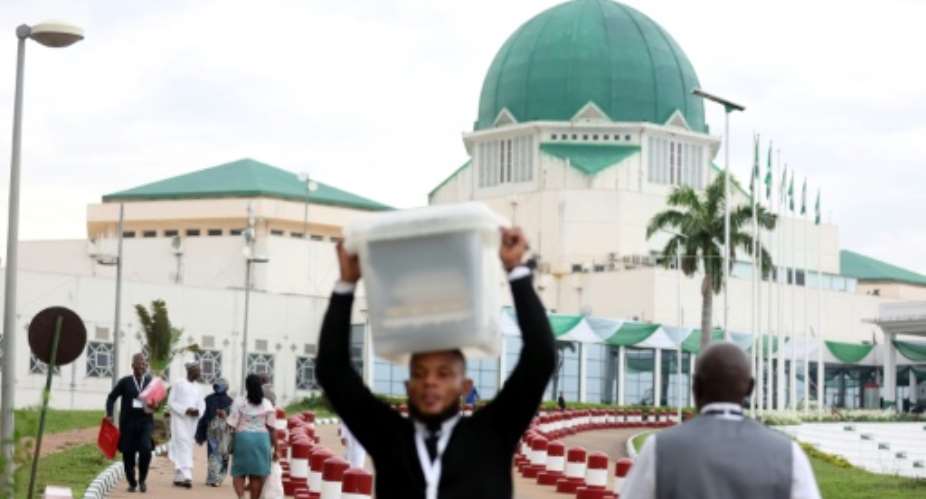
The Nigerian House of Representatives Thursday approved a bill to allow states to create their own police forces, a major security reform sought by President Bola Tinubu as overlapping crises continue to wrack the nation.
Critics of the federal police force say it has been slow to respond to incidents and cannot effectively secure the country -- concerns brought back into the spotlight in recent weeks by a spate of school abductions in the typically safer southwest.
But experts warn that putting Nigeria's 36 states in control of their own police could embolden the country's powerful governors in a nation where politics is already often violent.
To go into effect, the Senate, as well as two-thirds of Nigeria's state-level houses of assembly, must also approve the measure, which would amend the constitution.
"The current situation across our country is appalling," Representative Philip Agbese told AFP. "The security agencies are doing their best."
But "additional back-up is needed," Agbese, deputy spokesman for the chamber, said. He added this was especially the case in "ungoverned spaces that we have in the country, some of these areas strictly understood by locals".
The reform would leave the federal police intact, operating alongside state-managed forces.
Tinubu, like his predecessors, has been unable to rein in Nigeria's various armed groups during his first term. He is seeking re-election in January.
Across its north, Africa's most populous country is fighting a long-running jihadist insurgency, complicated by inroads made by militants from the Sahel, and non-ideological "bandit" gangs.
The centre of the country is the scene of farmer-herder violence, while the southeast is home to a low-level separatist conflict.
Despite the range of challenges, "Nigeria's current policing model remains one of the most centralised in the world," according to the non-partisan Policy and Legal Advocacy Centre (PLAC).
For years, states have backed locally recruited militias to plug gaps left by the military and police.
But fears that governors will deploy state police "to intimidate opposition parties, harass critics, suppress protests" and interfere with local elections "are not entirely speculative", Abuja-based PLAC warned.
Already, the federal police are known to disrupt protests with deadly force.
Critics also warn that state police could be dominated by their given region's majority ethnic group, a serious risk in the ethnically and linguistically diverse country where politicians are often accused of sectarianism.

 'Your citizens will still leave our country' — South African activist fires back...
 Anti-LGBTQ bill: 'It's not true that Parliament cannot reconsider a passed bill'...
 New NAIMOS Operations Director pledges stronger fight against galamsey
 Ghana attracting bad actors through ECOWAS free movement system — GIS laments ab...
 Court grants Abronye DC permission to travel abroad for master’s programme
 Afari Hospital Project: “They slept on a 3-year project for eight years” – Brogy...
 Chairman Wontumi seeks plea deal in GH¢30m Exim Bank fraud case
 GH¢7 million Navrongo Youth Resource Centre stalled for nearly nine years amid l...
 BECE graduate feared dead after drowning in River Osen
 Nigerian man escapes from custody during prison van transfer in London


