




Ebola is a highly infectious and often deadly viral disease spread through contact with the bodily fluids of infected people. The latest outbreak in the Democratic Republic of Congo (DRC) involves the rare Bundibugyo strain, first identified in Uganda in 2007, for which there is currently no approved vaccine.
Efforts to contain the disease are complicated – DRC borders nine countries and nearly a million people have been displaced through conflict in the region.
The DRC's health ministry says 598 cases and 115 deaths had been confirmed as of 9 June.
RFI: Hadja Lahbib, you were in Bunia last week, at the epicentre of the Ebola outbreak. What did you take away from that visit?
Hadja Lahbib: The first thing is that the European Union remains a reliable and committed partner for Africa. I wanted to demonstrate that, by travelling there myself at a time of serious health crisis. Not only to express solidarity, but also to see first-hand how we could best support the affected communities from the earliest stages of the outbreak.
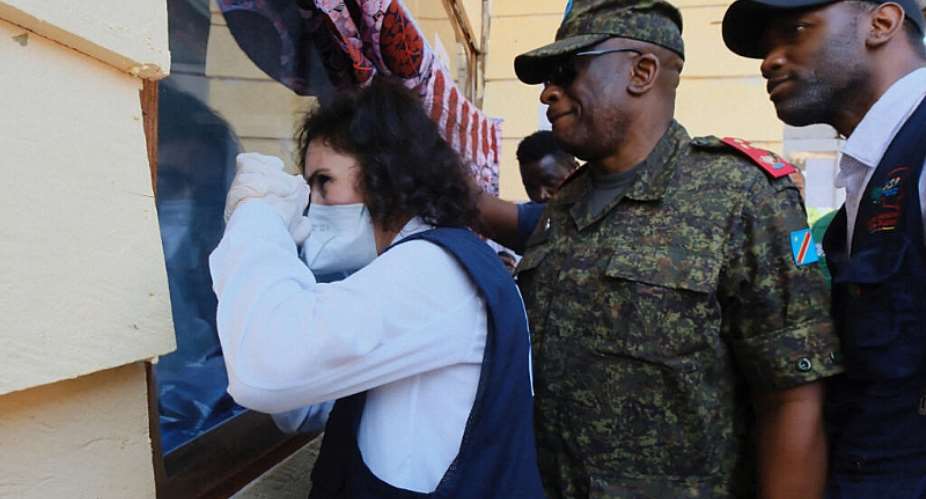
We have already sent 100 tonnes of medical supplies, including protective equipment and shelters for humanitarian workers. But being on the ground, seeing how aid is distributed and how the response is organised, is something quite different. The visit was extremely well received by local communities. A member of the EU Commissioner for Equality, Preparedness and Crisis Management delegation sanitises his feet at a treatment centre for the Ebola response set up by Alliance for International Medical Action (ALIMA) International NGO in Rwampara outside Bunia, Ituri province on 7 June, 2026.
RFI: How would you assess the delivery and management of aid on the ground?
HL: The aid has arrived, and I was able to see that for myself. I visited the warehouses where supplies are received and distributed. Humanitarian corridors remain open for now, which is crucial.
Following my visit in April, the Bukavu-Uvira corridor [a busy road axis in South Kivu, eastern DRC, near the borders with Rwanda and Burundi] has remained operational, and a humanitarian air link to Bunia has been established. For communities affected by Ebola, these logistical routes are absolutely vital. They allow assistance to reach people quickly and effectively. They are, quite literally, a lifeline.
Communication is equally important. Being present on the ground means being transparent. I visited the treatment facilities and saw how they operate. That matters because misinformation has fuelled fear and, in some cases, violence. Medical tents have been burned and hospitals attacked because of rumours that bodies were being taken away for organ harvesting.
These fears are not unique to Africa – we saw similar conspiracy theories in Europe during Covid. What matters is creating transparent systems that allow families to remain in contact with loved ones who are suspected or confirmed cases. That transparency helps dispel rumours and rebuild trust.
I also met the provincial governor and traditional leaders, who are playing a key role in countering misinformation and reassuring communities. Increasingly, people are accepting the treatments available. Ultimately, African solutions to African challenges are essential, with support from partners such as the European Union. But none of this works without trust between communities, healthcare workers and humanitarian organisations.
Radio station in DR Congo seeks to stop misinformation amid spread of Ebola
RFi: Last week, the Congolese doctor and Nobel Peace Prize laureate Denis Mukwege wrote in Le Monde that this could become the deadliest Ebola outbreak ever recorded in the DRC, partly because the Bundibugyo strain is so rare. Having seen the situation yourself, do you share that concern?
HL: The previous Ebola outbreak ended only five months ago, even if it attracted little attention in Europe. That underlines the need for a long-term response.
What we have built so far is not sustainable. Years of conflict in Ituri, around Goma and elsewhere have left the healthcare system exhausted. Across the region there are around 3 million displaced people. In South Kivu, North Kivu and Ituri alone, nearly a million people have been forced from their homes.
I visited camps housing tens of thousands of people, often far beyond their intended capacity, in extremely poor sanitary conditions. It is as though we are sitting on a volcano that could erupt at any moment.
One lesson from Covid-19 is that viruses do not respect borders. They do not care about conflicts, politics or national rivalries. In many cases they kill faster than bullets.
That is why we need a durable approach – strengthening local healthcare systems, supporting communities directly and securing a ceasefire respected by all parties. We must also address uncontrolled deforestation and the exploitation of critical mineral resources, which push wildlife into closer contact with human populations. Ebola is a zoonotic disease, transmitted from animals to humans, and environmental degradation plays a significant role.
DR Congo ceasefire a 'health emergency' given Ebola outbreak: EU
RFI: You are the only senior European official to have met with the M23 movement [a rebel group operating in eastern DRC] in Goma. Given the conflict, and the existence of parallel administrations beyond Kinshasa's control, how can Ebola be contained?
HL: That is precisely the challenge. Tracing cases is essential in responding to Ebola. When parallel administrations do not share information with the central government, it becomes extremely difficult to obtain accurate data.
That is why humanitarian access is so important. The air bridge to Bunia and the Bukavu-Uvira corridor are helping us deliver aid, but what we urgently need is visibility and traceability. At present, that remains limited.
Ultimately, there can be no lasting solution without a political settlement. Dialogue must resume. We know there is at least one case linked to the Bundibugyo strain in Goma. We also know the outbreak almost certainly began before it was officially declared on 15 May – probably as early as March.
Because of insecurity, population movements and restricted access, the scientific data available today may not fully reflect the reality on the ground. An Ebola patient is seen through a glass window inside a treatment centre for the Ebola response set up by Alliance for International Medical Action (ALIMA) International NGO outside Bunia, Ituri province, DRC on 7 June, 2026.
RFI: The European Union has pledged around €80 million for the Ebola response and a further €90 million for humanitarian assistance. Is that enough to offset the sharp reduction in US aid, which Dr Mukwege says has fallen by 68 per cent?
HL: European humanitarian assistance is there, and we increased it as soon as the outbreak was declared. We have also stepped up scientific research aimed at developing treatments and a vaccine.
Through European funding programmes, we helped identify the Bundibugyo strain. We are doing a great deal, but the European Union cannot replace the United States on its own.
In 2024, USAID provided more than $500 million to the region. In 2025, that figure fell to around $80 million. That leaves a very significant funding gap which the wider international community must help fill.
Everyone has a responsibility to act. Nobody is safe until everybody is safe.
RFI: The US is backing a controversial Ebola reception centre in Kenya, even though the country has not been affected by the virus. We also understand Washington is pressing Belgium to stop accepting Congolese nationals. How is Europe responding to American pressure over border policy?
HL: Europe's approach is based on scientific expertise. Following Covid-19, we established a dedicated authority for health emergency preparedness and response. We monitor circulating viruses, invest heavily in research and work through our disease control structures.
We also work very closely with the Africa Centres for Disease Control and Prevention. That is the basis of our approach, and we intend to maintain it.
The United States has chosen a different path, one guided by an "America First" philosophy. Our priority is to support an African-led response to an African emergency – one which also has international implications.
US Ebola facility in Kenya fuels anger in a country with no cases
RFI: Are you concerned that Washington's pressure could divide EU member states?
HL: We held an informal meeting of EU health ministers last Friday, just before my departure for Bunia. The position was unanimous. We want to maintain an open approach grounded in science.
At the same time, we remain vigilant. Following my visit, we developed a joint action plan with our African partners, including stronger departure screening measures. QR-code systems are already being used at airports in Kinshasa, Addis Ababa and Entebbe.
The next step is to ensure a coordinated system across the region. We will discuss this with the World Health Organization, Africa CDC, health ministers and foreign ministers in the coming days.
The objective is clear: a coordinated, united European response. That was the view expressed by the overwhelming majority of member states.
Deadly DR Congo Ebola outbreak spreads to rebel-held South Kivu
RFI: Is the European Union actively working on a vaccine for this rare strain, and if so, how soon could one become available?
HL: Not only are we working on it now, we were already doing so before this outbreak emerged. The Bundibugyo strain had been identified as a priority.
We currently have two promising vaccine candidates and we intend to accelerate their development so that they can move into the clinical trial phase. Only once those trials begin will we have a clearer idea of the timetable.
RFI: Can you give us any indication of when a vaccine might be ready?
HL: We hope to have a clearer answer in the coming weeks. But clinical trials must come first, and the results must be convincing. Only then will we know how quickly a vaccine can be deployed.
Race to find vaccines, treatments for Ebola strain behind outbreak
This interview was adapted from the original version in French by Sidy Yansané and has been lightly edited for clarity.

 GNFS saves marble-laden truck after fire outbreak on Cape Coast–Takoradi Road
 'Publish OMCs' annual profits to inform fuel pricing debate' — StarOil CEO urges...
 NDC to resume appearances on Oman FM from August 10 - Ako Gunn
 'We did not give Akufo-Addo grace on galamsey, so we won't give Mahama' — Ama Da...
 August 7: Cedi sells at GHS12.40 on forex market, GHS11.76 on BoG interbank
 'Democracy Under Attack' protests: No developed country jails citizens for what ...
 NUGS proposes social media ban for children under 15 to tackle indiscipline
 Nobody is going to have time to read NPP's Democracy Under Attack demo petition ...
 President Mahama unveils Cenotaph in honour of late Defence Minister Omane Boama...
 You will lose your position if you tamper with postings — Health minister warns ...

