




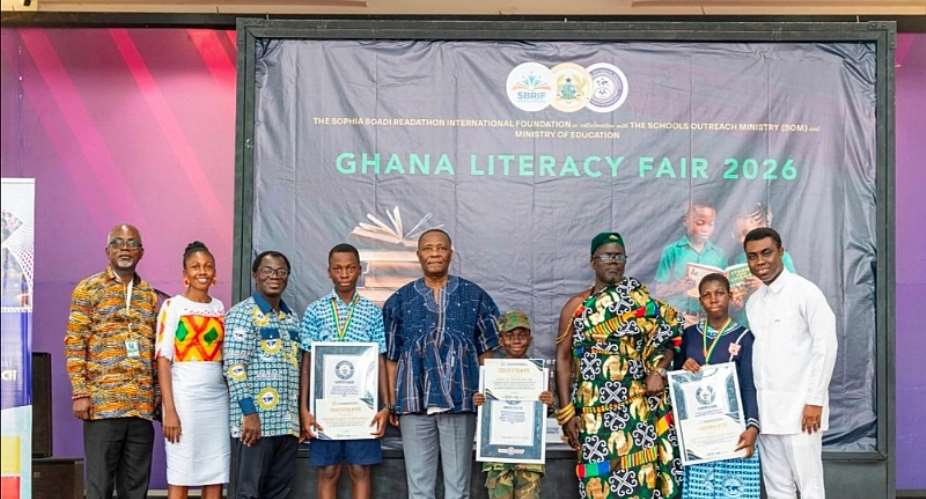
Education stakeholders have called for urgent and coordinated national efforts to tackle Ghana's literacy challenges, as the maiden edition of the Ghana Literacy Fair 2026 brought together more than 1,000 school children, educators, policymakers, development partners, and civil society actors in Accra.
Held at the Pentecost International Worship Centre (PIWC)-Atomic under the theme, "Unleashing the Power of Reading to Transform Ghanaian Students and Youth," the event featured activities including a students' reading marathon, speech marathon, storytelling sessions, choreography performances, and mentorship engagements aimed at reigniting a culture of reading among young people.
Delivering a keynote address on behalf of the Minister of Education, Haruna Iddrisu, Prof. George K. T. Oduro described reading as the foundation upon which all learning is built.
"Reading is not just a school subject. It is the gateway for everything in school," he said. "Without reading, you cannot do mathematics, science, social studies, or religious studies."
He expressed concern over the country's declining reading culture, citing national and international assessments indicating that many Ghanaian children fail to acquire foundational literacy skills in the early years of schooling.
According to figures presented during the event, only about 8 percent of children in Grades Two and Three demonstrate foundational literacy skills, while international estimates suggest that more than 60 percent of children in Ghana do not attain minimum proficiency in literacy by the end of primary school.
Prof. Oduro warned that children who fail to read proficiently by Grade Three are more likely to struggle academically, drop out of school, and face difficulties transitioning into the labour market.
"The cost of inaction is high," he noted.
He outlined measures being implemented by the Ministry of Education to reverse the trend, including curriculum reforms, teacher training, promotion of phonics-based instruction, and the use of Ghanaian languages as mediums of instruction from Kindergarten to Primary Three.
"Our commitment is to make reading a national movement, not just a school activity," he stated.
The Executive Director of the Sophia Boadi Readathon International Foundation, Sophia Boadi, described literacy as a "national emergency" requiring support beyond individual efforts.
"We cannot industrialise without thinkers. We cannot lead Africa if our children only read for exams," she said.
She announced the launch of a National Readathon Challenge, an ambitious initiative expected to engage 500,000 students across all 16 regions of Ghana over the next 12 months.
The programme aims to train 5,000 teachers, establish 100 libraries, and nurture future cohorts of young achievers inspired by the success of the "Kasoa 4" — four Ghanaian children trained under the foundation who reportedly achieved international recognition through educational and innovation-related accomplishments.
Boadi appealed to government institutions and corporate organisations to support literacy promotion initiatives.
"We need more than presence; we need policy," she said, urging the Ministry of Education to integrate the Ghana Literacy Fair and National Readathon Challenge into the official educational calendar.
Representing the Pan-African Writers Association, Secretary-General Dr. Wale Okediran encouraged students to embrace reading and creative writing regardless of their academic disciplines.
"You can be a science student and also write," he told participants. "The world today offers many opportunities, but you have to start by reading and passing your examinations."
He further urged young people to preserve Africa's cultural identity by taking interest in indigenous languages and literature.
Also addressing the gathering, Pastor Frank Mensah Tandoh, National Director of the Schools Outreach Ministry of the Church of Pentecost, underscored the importance of nurturing children's moral values alongside academic excellence.
He explained that the ministry partners with schools and like-minded organisations to provide mentorship, character development programmes, educational resources, and support systems for vulnerable learners.
In a solidarity message, Dr. Joseph Kobla Wemakor, Executive Director of Human Rights Reporters Ghana, described literacy as a critical human rights and development issue.
"Reading is power. Reading is liberation. Reading is transformation," he said.
"A child who can read can better understand their rights. A young person who reads is less vulnerable to manipulation, misinformation, crime, and exploitation."
Dr. Wemakor who doubles as the Convener of the Youth sub-platform of the Ghana CSOs Platform on SDGs called on stakeholders to invest in school libraries, digital learning opportunities, and literacy-focused interventions to empower the next generation.
The Ghana Literacy Fair 2026 was organized by the Sophia Boadi Readathon International Foundation in partnership with the Pan-African Writers Association, Schools Outreach Ministry, and other stakeholders committed to promoting literacy and youth development.
As the event drew to a close, organizers expressed optimism that the fair would mark the beginning of a sustained national movement to inspire a lifelong culture of reading among Ghanaian children and youth.
 GMET forecasts widespread rain, thunderstorms across Ghana today
 How angry mob vandalised Forestry Commission timber checkpoint housing structure...
 Ghanaians rate President Mahama higher on handling of economy, infrastructure — ...
 Unlicensed persons can no longer practice HR in Ghana – CIHRM
 'We become obsessed with keeping power while our country go down' — Fifi Kwetey ...
 June 11: Cedi sells at GHS12.55 on forex market, GHS11.51 on BoG interbank
 Taiwan says Chinese vessels entered disputed waters in South China Sea
 Constituency election nominations to open June 22, forms to be purchased online ...
 Ghana Card registration for children aged 6-14 begins in Northern Region - NIA
 'Your nation is waiting to embrace you' — Nigeria to welcome evacuees from South...


