




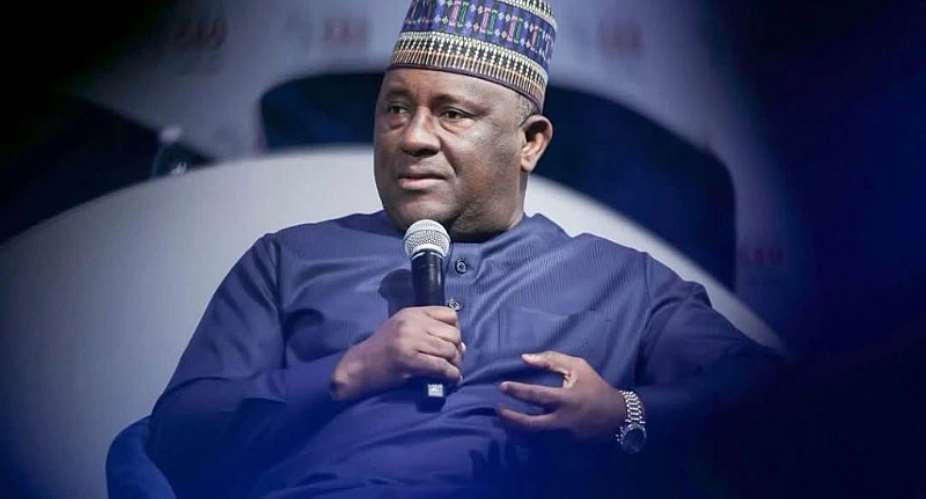
Let me start with a number that will make your eyes water. Eighty-one million dollars. That is what Abdul Samad Rabiu, chairman of BUA Group and Africa's second-richest man, just spent on a Bombardier Global 8000 private jet. That is approximately 110 billion naira. It is the fastest civilian aircraft since the Concorde. It can fly at Mach 0.95, nearly the speed of sound. It has an 8,000-nautical-mile range, meaning it can fly from Lagos to New York non-stop, or from Accra to London and back without refuelling. It can carry up to 19 passengers in luxury that most of us cannot even imagine. And Rabiu posted about it on Instagram. That is not a humblebrag. That is a statement.
Let me break down what this purchase means, not just for Rabiu, but for African business, wealth, and the economy.
The deal was reportedly signed on 4 December 2025 at BUA's Dubai office after weeks of discreet negotiations. Rabiu is one of the early African owners of the ultra-long-range business jet, which can cost up to 85 to 95 million dollars when fitted with bespoke interiors. The aircraft will join BUA's corporate fleet, which already includes a Challenger 350 and a Global 6500. That gives the conglomerate one of the most advanced private aviation fleets owned by any African business group.
The timing is notable. Rabiu's net worth surged to $11.2 billion by 2026, a 120 percent increase from the previous year. That is the largest wealth gain in Africa. He added $6.1 billion in a single year. That is not growth. That is a rocket ship. At the time the Bombardier deal was signed in December 2025, Rabiu had already overtaken both Mike Adenuga and Nassef Sawiris to move into fourth place among Africa's richest individuals. By 2026, he was solidly in second place behind Aliko Dangote.
What drove this staggering wealth increase? Rabiu oversees a diversified conglomerate with interests in cement, sugar refining, agriculture, and real estate. His flagship asset, BUA Cement, has been a key driver. Shares rose 135 percent over the past year, outperforming the Nigerian stock market, which gained 81 percent amid strong corporate earnings and increased pension fund participation in equities. BUA Foods has also delivered strong performance despite macroeconomic pressures. The company's unaudited first-quarter 2026 results showed earnings after tax of 142.32 billion naira, up from 125.28 billion naira in the same period last year. That is resilience. Despite an 11 percent decline in revenue to 394.6 billion naira, driven by moderated pricing, easing inflation, and a more stable foreign exchange environment, profitability remained strong.
Now, let me address the elephant in the room. An $81 million private jet while Nigeria and Ghana are struggling with poverty, unemployment, and crumbling infrastructure. The optics are not great. Critics will say that Rabiu should have donated the money to charity, or invested it in building more factories, or used it to pay better wages. Those are valid points. Extreme wealth inequality is a problem. And when the super-rich spend lavishly, it can feel like a slap in the face to those who cannot afford three meals a day.
But let me also give you the other side of the argument. Rabiu's wealth is not sitting in a vault. It is invested in cement factories, sugar refineries, and food processing plants. Those assets employ thousands of Nigerians. They produce goods that the country needs. They pay taxes that fund roads, schools, and hospitals. The $81 million jet is a fraction of his net worth. And it is a business asset. A businessman who travels constantly across continents needs efficient transportation. Time is money. A private jet allows Rabiu to be in Lagos in the morning, Abuja in the afternoon, and London by evening. That is not just luxury. That is productivity.
The Bombardier Global 8000 is also a symbol. It signals that African business has arrived. For decades, African businessmen were seen as small players, dependent on foreign capital and foreign expertise. Rabiu's purchase of the world's most advanced private jet says something different. It says that African wealth can compete with global wealth. It says that African businessmen can afford the same tools as their American, European, and Middle Eastern counterparts. That is not just ego. That is a statement of capability.
Rabiu's wealth surge also reflects a broader trend. African stock markets are growing. Pension funds are investing in equities. Companies like BUA are delivering strong returns. The continent's billionaire class is expanding. That is not something to apologise for. It is something to study. How did Rabiu build his wealth? What policies enabled that growth? How can other African entrepreneurs follow a similar path?
The answers are not simple. But they include a stable macroeconomic environment, access to capital, rule of law, and infrastructure. Nigeria's stock market gained 81 percent over the past year. That is not an accident. It is the result of reforms, investor confidence, and strong corporate earnings. BUA's share price rose 135 percent. That is not luck. It is execution.
Rabiu's net worth is now $11.2 billion. That is more than the GDP of several African countries. It is a staggering concentration of wealth. But that wealth is not static. It is invested in productive assets. It is creating value. And it is generating returns for shareholders, many of whom are ordinary Nigerians through pension funds and mutual funds.
The $81 million jet is a milestone. It is a reminder that African wealth has reached a new level. But it is also a reminder that wealth inequality is a problem that must be addressed. The same economy that produced Rabiu's billions also produces poverty. The challenge for African governments is to ensure that the benefits of growth are shared more broadly. That is not socialism. That is smart economics. A society with extreme inequality is unstable. Unstable societies do not produce billionaires. They produce refugees.
Rabiu's jet is fast. It is luxurious. It is a marvel of engineering. But it is not the story. The story is how he earned the money to buy it. That story involves hard work, smart investments, and a bit of luck. It also involves a country, Nigeria, that despite its many problems, still offers opportunities for those who can navigate its complexities. That is not a justification for inequality. It is a reality check.
The $81 million jet will fly. Rabiu will use it. And the rest of us will scroll past his Instagram post. But let us not just envy or criticise. Let us learn. How did he do it? What can we apply to our own businesses and careers? That is the question. The jet is just the answer. And the answer is not for everyone. But the question is. And that is where the real value lies.
.

 South Africa xenophobia: Business allegedly declines after ownership shift from ...
 Kpone Traditional Council announces death of paramount chief after 37 years of r...
 Middle East live: Iran says will target any vessel traffic in Strait of Hormuz
 Bill Gates calls Epstein meetings a ‘grave error’ while defending actions in hou...
 Infantino defends World Cup ticket prices, dismisses referee US entry dispute
 Rainstorms from Nigeria, Benin to trigger thunderstorms in Ghana — GMet warns
 Accra floods: 70 seized excavators to be deployed to NADMO for desilting — Munta...
 Kasseh Market executives stop sale of food near toilet facility
 Three arrested over theft of critical equipment at Komenda Sugar Factory
 Nearly half of Ghanaians say military rule can be justified if governments fail ...


