




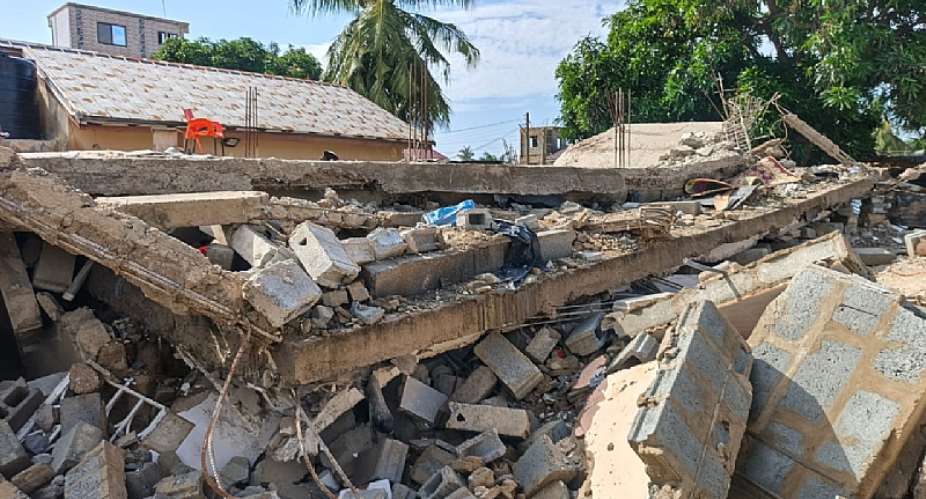
A Joint Technical Investigative Committee made up of structural engineering experts and statutory bodies has completed its preliminary assessment into the building collapse within the La Nkwantanang Madina Municipal Assembly (LaNMMA).
The team comprised the Structural Subdivision of the Ghana Institution of Engineering (GhIE), the Institution of Engineering and Technology, Ghana (IET-Gh), and the Architecture Registration Council (ARC).
A statement issued by Prince Kas-Avortri, Executive Secretary of the Structural Sub-division of GhIE, noted that the Committee has extended condolences to the family of the deceased and wished a speedy recovery to the five injured persons receiving treatment.
According to the Committee, preliminary findings point to a combination of regulatory breaches, structural deficiencies and unsafe construction practices as the cause of the collapse.
It indicated that the project was executed without the required statutory approvals, including approved architectural and structural drawings, building permits and other mandatory technical documentation.
The statement further revealed that stop-work directives issued by the Municipal Assembly were ignored, with construction continuing despite regulatory intervention.
It also established that an additional floor was under construction at the time of the incident, placing extra load on a structure that had not been designed or assessed to carry such weight.
The Committee noted that occupants were present in parts of the building while construction work was still ongoing.
A preliminary engineering assessment identified serious structural weaknesses, including discontinuous load-bearing columns, inadequate structural support systems, poor-quality concrete and improperly detailed reinforcement. These defects, it said, severely compromised the building’s ability to safely transfer loads to its foundation.
The pattern of failure observed was described as consistent with a progressive or “pancake” collapse, where the failure of key structural elements leads to the sequential collapse of multiple floors.
To support further investigations, samples of concrete and reinforcement steel have been collected for laboratory testing to determine compliance with engineering standards.
The Committee also recommended that the National Disaster Management Organisation (NADMO) secure the site and maintain a perimeter while unstable sections of the structure are carefully dismantled to ensure public safety and allow further investigations.
It stressed that the incident underscores the importance of strict adherence to building regulations, professional supervision and compliance with approved engineering and architectural standards.
The Ghana Institution of Engineering, IET-Gh and the Architecture Registration Council reaffirmed their commitment to supporting authorities to establish accountability, strengthen enforcement systems and promote safer construction practices nationwide.
The Committee is expected to release a comprehensive final report after laboratory analyses and further technical investigations are completed.

 FIFA vows to proceed with private investor plan consultation as opposition sprea...
 Almost 50,000 migrants crossed Morocco-Ceuta border over past 24 hours
 What we know about the Hamas disarmament deal announced by Trump
 AI safety scare: Anthropic says Claude models accessed outside systems during te...
 Pakistan says US-Iran talks still alive despite fresh wave of US strikes
 Bekwai residents give Chinese quarry company one week ultimatum to address envir...
 Sedina Tamakloe’s acquittal sets a dangerous precedent in Ghana — Former Deputy ...
 Blows in CLOGSAG over disqualification of Oti regional chairmanship aspirant
 Government approves taxation of President’s salary and allowances but rejects ta...
 Attorney-General seeks stay of Court of Appeal ruling acquitting Sedina Tamakloe

