




The Danger of Fake Folklore in an Era of Declining Glory
In recent weeks, an AI-generated sports documentary poster titled "The Barefoot Kings" has spread rapidly across Ghanaian WhatsApp groups. It claims that in 1950, the Gold Coast national team delivered a shocking 2-1 defeat to England while playing completely barefoot. While this romanticized narrative stirs intense patriotic sentiment, it is entirely historical fiction.
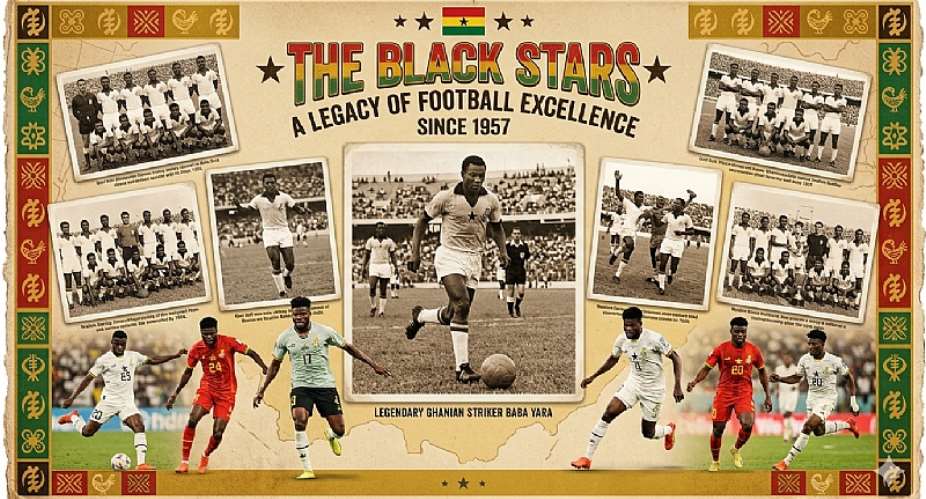
Living on manufactured nostalgia will not rescue our current sporting decline. Ghana’s true football history is far more spectacular than any digital fabrication. It is a history forged in the flames of anti-colonial resistance, pan-African pride, and tactical genius that once made the Black Stars the undisputed kings of the continent.
To build a sustainable future for Ghanaian sports, stakeholders and leadership must stop chasing ghosts and instead look at the concrete structural blueprints that built our legacy.
Debunking the Myth: What Actually Happened in 1950?
To understand where we are going, we must precisely separate fact from viral fiction:
- The Fictional 1950 England Match: The senior England national team never played the Gold Coast in 1950. During that exact period, England was playing in their first-ever FIFA World Cup in Brazil.
- The Real 1949 Barefoot Tours: The rumor stems from a conflation of two separate historical events. In August 1949, the Gold Coast national team did tour the United Kingdom and experimented with playing barefoot ("on ten toes"), though they lost their opening match 5-2 to a Northern Irish Amateur XI. Concurrently, a Nigerian selection known as the "UK Tourists" also played barefoot in England, defeating an amateur club named Marine FC 5-2.
The Real Genesis: The Origins of the Black Stars
The true architectural foundation of Ghanaian football was systemic, deliberate, and fiercely patriotic:
- Foundation and Evolution: The Gold Coast Football Association was formally established in 1920. Following independence, the iconic "Black Stars" moniker was adopted, taking inspiration from the black star on the national flag—a symbol derived from Marcus Garvey’s Black Star Line shipping company.
- The Architectural Visionary: The golden era of Ghanaian football was not accidental. It was engineered by Ohene Djan, the country's first Director of Sports. Under the backing of Dr. Kwame Nkrumah, Djan transformed football into a formalized state apparatus to project national unity and African capability.
The Real Giants: Early Lineups and the Historic 7-0 Destruction of Nigeria
While accurate historical match sheets from individual friendly fixtures in the pre-independence era are scarce, the record books reflect an absolute dominance over our regional rivals long before modern tournaments existed:
- The True International Debut (1950): Ghana and Nigeria played their first recognized international match on October 16, 1950, in Accra. The Gold Coast emerged victorious with a 1-0 win. Early squad rosters from that specific 1950 era reveal the emergence of legends like Charles Kumi Gyamfi (C.K. Gyamfi), who anchored the team's early identity.
- The Historic 7-0 Demolition (1955): On June 1, 1955, the Gold Coast squad hosted Nigeria in Accra for a Jalco Cup match and handed them their largest defeat in football history—a staggering 7-0 victory.
- The Goalscoring Legends: The demolition was executed by a legendary frontline: C.K. Gyamfi scored a masterful hat-trick, "The King of Wingers" Baba Yara scored twice, while Asante Gespar and A.R. Adjei added one goal each to seal the victory.
The Zenith of Dominance: The First AFCON Title (1963)
The structural work of the 1950s culminated in absolute continental supremacy in the early post-independence era:
- The Tournament: Ghana hosted the 4th edition of the Africa Cup of Nations (AFCON) for the first time in 1963.
- The Grand Finale: On December 1, 1963, at the Accra Sports Stadium, the Black Stars systematically dismantled Sudan 3-0 to lift their first continental trophy.
- The Architects of Glory: Head coach C.K. Gyamfi orchestrated the tactics from the touchline, while national icons Aggrey-Fynn (via a penalty) and Edward Acquah (scoring a brace) executed the victory on the pitch.
Strategic Blueprint: Recommendations for the Ministry of Youth and Sports
Our history proves that Ghana wins when there is a deliberate, state-supported structure. The current decline in our sports sector demands urgent, structural transformation. The Ministry, the Ghana Football Association (GFA), and corporate stakeholders must implement these actionable reforms:
- Revitalize Grassroots Infrastructure and School Sports: Ohene Djan’s model succeeded because it relied on a robust pipeline from schools to clubs. The state must re-establish structured national school sports festivals and build municipal sports complexes across all regions to halt the ongoing encroachment on public playing fields.
- Establish a National Coaching Philosophy and Invest in Local Talent: Ghana won its earliest AFCON titles under a local coaching icon, C.K. Gyamfi. We must establish a standard national football curriculum and heavily invest in top-tier, fully funded licensing courses for local coaches.
- Modernize Sports Governance and Promote Financial Transparency: Move away from reactive, tournament-to-tournament crisis management. The Ministry should implement multi-year strategic plans, robust public-private partnership (PPP) frameworks for corporate funding, and strict financial auditing to ensure capital reaches athlete development rather than administrative overhead.
Honoring the Past by Rebuilding the Future
We do not need to invent fake victories against England to prove the greatness of Ghanaian football. Our true heritage—highlighted by a historic 7-0 demolition of Nigeria and becoming the first nation to permanently keep an AFCON trophy—presents a legacy that requires no embellishment.
However, pride in our history is useless if it is not paired with a dedication to structural development. The Ministry of Youth and Sports and current football administrators must look back at the calculated, institutional groundwork laid down in the 1950s and 1960s. Only by restoring rigorous grassroots scouting, empowering local technical expertise, and enforcing transparent governance can we pull the Black Stars out of modern mediocrity and return Ghana to its rightful place as the powerhouse of African sports.
✍️By A Concerned Senior Citizen
Retired Senior Citizen
For and on behalf of all Senior Citizens of the Republic of Ghana 🇬🇭
Teshie-Nungua
[email protected]


 I have not been invited by OSP over fake GH¢70,000 memo — Patricia Appiagyei
 Vetting committee has never taken bribes or gifts from nominees — Bernard Ahiafo...
 Chief Justice Baffoe-Bonnie clarifies controversial remarks
 Dunkwa-Ayanfuri road construction to commence in 2027 – Finance Minister
 PRESEC, St. Augustine’s College and Accra Academy set for NSMQ grand finale on S...
 Appiagyei denies alleged GH¢70,000 vetting payment in memo
 Lawyer challenges GRA’s power to grant passenger baggage tax exemptions
 Agbogbloshie waste heap is as high as 10-storey building – Mahama Ayariga
 'How did we get here, to be told to go to Rwanda to learn cleanliness?' – Mahama...
 'After getting the gold, you will get thirsty' – Kwaku Bonsam explains why galam...

