




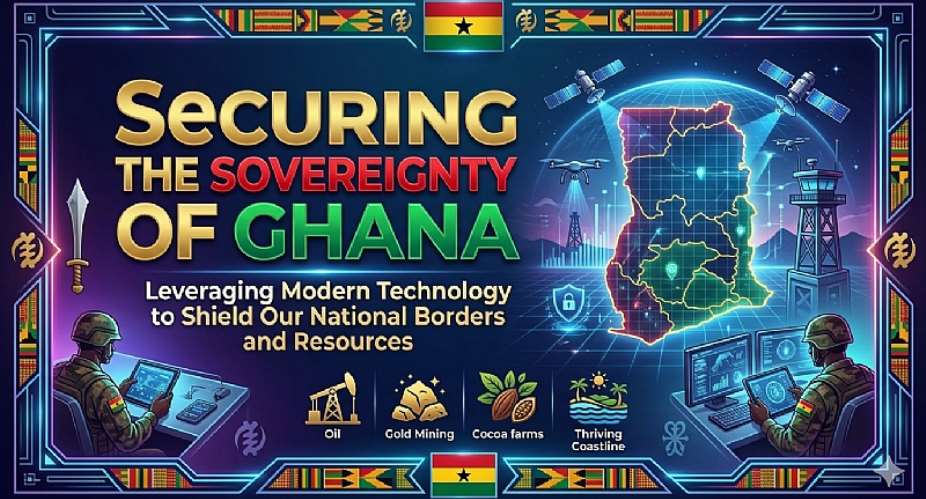
As a sovereign nation, Ghana stands at a critical geopolitical crossroads. The global scramble for mineral wealth and deep-sea hydrocarbons means our international frontiers are no longer just lines on a colonial map—they are the literal walls of our national treasury. With the ongoing economic and industrial resets under the administration of President John Dramani Mahama, Ghana has shown immense resolve in reshaping its technological trajectory, particularly with the recent launch of the National Artificial Intelligence (AI) Strategy. However, economic sovereignty and digital leadership cannot exist without strict territorial certainty. History teaches us that the discovery of natural resources in ill-defined border zones can instantly transform peaceful neighbors into bitter adversaries. For Ghana to safeguard its wealth, maintain regional stability, and fulfill its commitments under continental frameworks, we must transition from passive border monitoring to aggressive, technology-driven boundary permanence.
The Reality of Our Borders: Land and Sea Dynamics
The Ghana Boundary Commission (GhBC) is currently managing unique, complex challenges across our three major frontiers:
- The Western Frontier (Côte d’Ivoire): While land boundary reaffirmation exercises continue on the ground to preserve the integrity of our physical markers, our offshore assets stand as a testament to the power of international law. The 2017 ITLOS maritime case permanently secured Ghana’s sovereignty over multi-billion-dollar oil fields, serving as our definitive blueprint for handling maritime border friction.
- The Eastern Frontier (Togo): Decades of baseline ambiguities and failed bilateral talks led Ghana to officially file for compulsory binding arbitration under the United Nations Convention on the Law of the Sea (UNCLOS). Drawing a definitive legal line in the Gulf of Guinea is vital to securing offshore resource blocks and preventing volatile naval standoffs. On land, multiple colonial markers across the 1,098km border are broken, defaced, or lost to environmental erosion.
- The Northern Frontier (Burkina Faso): Spanning 556 kilometers, this land boundary is heavily exposed to the threat of illicit trans-border migration, informal gold mining (galamsey), and regional instability. Securing this line requires a delicate balance of ironclad physical security, joint border validation, and community-focused infrastructure.
CASE STUDY: The 2017 ITLOS Judgment (Ghana v. Côte d'Ivoire)
The dispute over the western maritime boundary arose when Côte d'Ivoire claimed that Ghana’s offshore oil exploration blocks—specifically parts of the lucrative Jubilee, TEN (Tweneboa, Enyenra, Ntomme), and Mahogany-Teak fields—encroached upon its territory.
┌────────────────────────────────────────────────────────────────────────┐ │ THE 2017 ITLOS VERDICT & IMPLICATIONS │ ├───────────────────────────────────┬────────────────────────────────────┤ │ ⚖️ The Legal Standard Adopted │ The Special Chamber rejected Côte │ │ │ d'Ivoire's bisector method, using │ │ │ an equidistance line instead. │ ├───────────────────────────────────┼────────────────────────────────────┤ │ 🛢️ Protection of Oil Fields │ Existing Ghanaian oil wells were │ │ │ confirmed safe within Ghana's EEZ. │ ├───────────────────────────────────┼────────────────────────────────────┤ │ 🌍 Precedent for Togo (UNCLOS) │ Proves that definitive legal lines │ │ │ prevent costly offshore conflicts. │ └───────────────────────────────────┴────────────────────────────────────┘
This landmark case proved that precise mathematical and geographical data, backed by a firm international legal strategy, is the only way to permanently insulate vital national resources from foreign claims. Ghana is now applying this identical strategic resolve to the UNCLOS maritime dispute with Togo.
Redefining Border Security Through Modern Technology
The traditional approach of concrete pillars and physical foot patrols is insufficient for thousands of kilometers of porous terrain. Aligning with President Mahama's national push to build, govern, and apply advanced technologies to solve national problems, Ghana must institutionalize an advanced, multi-layered technological framework:
- Smart Pillars with RFID and GPS Instrumentation: Every newly constructed physical border marker must be embedded with weather-resistant Radio Frequency Identification (RFID) chips and satellite-linked GPS transponders. If a pillar is destroyed or covertly shifted by encroaching actors, an automated distress signal should immediately alert the nearest Ghana Immigration Service (GIS) and Ghana Armed Forces (GAF) sector commands.
- Continuous Operating Reference Stations (CORS): Ghana must deploy a dedicated network of GNSS (Global Navigation Satellite System) CORS stations along all land borders. This provides real-time, millimeter-accurate geodetic positioning data, leaving absolutely zero room for mathematical manipulation or baseline disputes during cross-border surveys.
- LiDAR-Equipped Drone Surveillance & Digital Twins: High-end drones outfitted with Light Detection and Ranging (LiDAR) sensors can penetrate dense jungle canopies to create a highly accurate, 3D "Digital Twin" of our topography. These drones can run automated patrol routes, using thermal imaging to detect unauthorized illegal crossings, smuggling tracks, and illegal mining camps in real time.
- Satellite-Generated Baselines: Leveraging hyperspectral satellite imagery allows the state to monitor maritime activities, changes in coastal baselines, and illegal deep-sea vessel movements within our Exclusive Economic Zone (EEZ) before diplomatic rows can manifest.
The Golden Formula: Preventing Resource Disputes
The discovery of gold, lithium, or oil along an unmapped border often sparks conflict. To ensure resource discoveries bring prosperity rather than war, Ghana must champion two main protocols:
- The Compulsory "Unitization" Framework: If a newly discovered natural resource pool or oil field straddles the boundary line between Ghana and a neighboring state, the reservoir must be legally declared a single, non-divisible unit. Under a pre-negotiated Unitization Agreement, a single operator is selected to extract the resource, and production revenues are split equitably based on the percentage of the geological formation located within each country’s territory. This eliminates competitive "drill-off" or aggressive unilateral extraction.
- Transparent Data-Sharing Portals: Joint boundary committees must utilize synchronized, blockchain-secured databases where geological, hydrographic, and seismic data are co-uploaded. Transparency prevents corporations or states from exploiting informational asymmetries to hoard trans-boundary assets.
Funding and Project Costs: A Strategic Investment
True sovereignty requires substantial capital. Financing this technological shift must look beyond traditional, overstretched state coffers:
- The Petroleum Holding Fund (PHF) Leverage: A dedicated percentage of Ghana's existing oil revenues from the Heritage or Stabilization Funds should be legally funneled into a sovereign "National Border Infrastructure and Security Fund."
- Mineral Royalty Diversion: Royalties generated from gold and lithium concessions situated in border administrative districts must be reinvested locally to build modern border checkpoints and fund advanced surveillance equipment.
- International Strategic Grants: Ghana must aggressively tap into the African Union Border Programme (AUBP) and Germany's GIZ funding pipelines. These institutions actively issue grants for cross-border cooperation, regional integration, and technical boundary mapping.
Recommendations for President John Dramani Mahama and Stakeholders
To rapidly operationalize these safeguards, the Executive and all relevant stakeholders should prioritize the following actions:
- Establish a National Border Technology Mandate: Authorize an executive directive empowering the Ministry of Lands and Natural Resources and the Ministry of Defence to transition the GhBC into a tech-integrated agency, mandating smart-pillar implementation on all ongoing reaffirmation exercises.
- Accelerate the UNCLOS Legal Architecture: Ensure the legal team handling the Ghana-Togo maritime dispute is aggressively resourced with world-class international cartographers and hydrographic experts to secure an unassailable maritime ruling.
- Codify Unitization into Mining and Petroleum Laws: Amend the Petroleum (Exploration and Production) Act and the Minerals and Mining Act to mandate that any concession within 15 kilometers of an international boundary cannot be developed without an active, binding trans-boundary Unitization framework in place.
- Fund "Human Security" Infrastructure: Instruct the Ministry of Finance to release targeted capital to the GhBC for social amenities (boreholes, clinics, and markets) in vulnerable border towns like Paga, Sapelliga, and Elubo. Securing the loyalty and livelihoods of border communities creates our most resilient human shield against territorial encroachment and cross-border crime.
A nation that cannot definitively identify, track, and defend its borders cannot fully guarantee its long-term economic independence. The physical boundaries of Ghana represent the sacred perimeter of our national inheritance. By aggressively deploying cutting-edge geospatial technology, codifying equitable resource-sharing agreements, and proactively settling maritime standoffs through international law, President John Dramani Mahama and our national security leadership can permanently secure Ghana’s territorial integrity. We must act with a sense of urgency. Let us build borders of absolute precision, turning our frontiers from volatile areas of potential conflict into prosperous bridges for regional trade, integration, and absolute sovereign peace.
✍️By A Concerned Retired Senior Citizen
For and on behalf of all Senior Citizens of the Republic of Ghana 🇬🇭
Teshie-Nungua
[email protected]

 GCB denies robbery attempt at Labone Branch after Police shoot two suspects
 Death toll rises to 12 in Pokuase-Achimota multi-vehicle accident
 'He's not one of us' — Hajj Office denies arrested ‘Papa Angola’ seen assaulting...
 Two gunned down as Police foil robbery attempt at GCB Bank branch in Labone
 President Mahama sets 2028 deadline for completion of Upper East Regional Airpor...
 Upper East Airport to open region to investors, boost economic activity — Mahama
 NDC will not take lessons from NPP on economy — Joyce Bawah
 Man seen assaulting suspect at police station not a member of Hajj Board — Pilgr...
 Police gun down two suspects, arrest one over Labone GCB robbery attempt
 Ofankor crash: Stop publishing graphic images, videos — Oppong Nkrumah urges med...

