




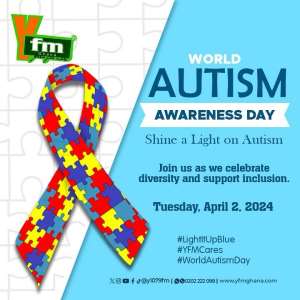
Every year on April 2, landmarks across the world are illuminated in blue to mark World Autism Awareness Day, a global observance dedicated to increasing understanding and acceptance of autism. In Ghana, institutions, schools, advocacy groups, and public figures have increasingly joined the campaign, helping to bring autism into national conversations.
Yet for many Ghanaian families raising children on the autism spectrum, awareness campaigns are only a small part of a much larger struggle. The reality they face is defined by delayed diagnoses, limited access to specialized education, high therapy costs, and persistent social stigma.
As Ghana continues to improve awareness of autism, advocates say the next challenge is turning visibility into meaningful support and inclusion.
A Growing Need, But Limited Data
One of the biggest challenges facing autism advocacy in Ghana is the lack of comprehensive national data. While no nationwide prevalence study has been conducted, global estimates from the World Health Organization suggest that approximately one in every 100 children is on the autism spectrum.
Applied to Ghana's population, this could mean hundreds of thousands of people living with autism. However, many remain undiagnosed, misdiagnosed, or hidden from public view due to stigma and limited access to healthcare services.
Families seeking a diagnosis often encounter significant obstacles. Formal autism assessments are largely concentrated in a few specialized facilities, primarily in Accra, leaving many regions without accessible diagnostic services. Long waiting periods and assessment costs can place an additional burden on families already struggling to find answers.
The consequence is that many children are identified much later than recommended. Experts consistently emphasize the importance of early intervention, noting that support provided during the first few years of life can significantly improve communication, learning, and social development.
Education Remains a Major Challenge
Access to education remains one of the most pressing concerns for children with autism in Ghana.
Although awareness among educators is gradually increasing, many schools still lack teachers trained to support neurodiverse learners. Children with autism are sometimes misunderstood as being disruptive, stubborn, or incapable of learning, leading to exclusion from mainstream classrooms.
Specialized schools and intervention centers provide valuable services, but they are often concentrated in urban areas and may be financially out of reach for many families.
Advocates argue that inclusive education should not be viewed as a luxury but as a right. They stress that with appropriate teacher training, classroom adaptations, and support systems, many children on the spectrum can thrive in mainstream educational settings.
The High Cost of Therapy
Therapy services remain another significant hurdle.
Speech therapy, occupational therapy, and behavioral interventions are essential components of autism support, yet access to these services remains limited. Most therapy options are offered through private providers, making them expensive for many households.
For families requiring multiple sessions each week, costs can quickly become overwhelming. The absence of comprehensive insurance coverage for many autism-related services means parents often shoulder the full financial burden themselves.
This reality creates inequalities in outcomes, with children from wealthier households generally having greater access to the interventions that can support their development.
Confronting Stigma and Misconceptions
Despite growing awareness, misconceptions about autism persist in some communities.
Parents frequently report encountering beliefs that autism is caused by curses, spiritual attacks, or wrongdoing by family members. Such attitudes can delay access to professional support and contribute to social isolation.
Caregivers, particularly mothers, often bear the emotional and social consequences of these misconceptions. Many describe experiences of discrimination, judgment, and inadequate support from their communities.
However, attitudes are gradually changing. Religious leaders, traditional authorities, healthcare professionals, and advocacy organizations are increasingly helping to spread evidence-based information about autism. Their voices have been instrumental in challenging harmful myths and encouraging acceptance.
The message gaining traction across Ghana is clear: autism is a neurodevelopmental condition, not a spiritual affliction.
Signs of Progress
While significant challenges remain, there are encouraging developments across the country.
Parent-led organizations and advocacy groups continue to provide support, training, and public education. Through workshops, outreach programs, and support networks, these organizations are empowering families and helping communities better understand autism.
A growing number of schools are embracing inclusive education models, demonstrating that children with autism can succeed when provided with appropriate support. Their experiences are helping to reshape perceptions about what is possible.
At the policy level, autism is increasingly recognized within broader disability and mental health frameworks. Yet advocates caution that legislation and policy commitments must be matched by adequate funding, implementation, and accountability.
Public awareness campaigns have also benefited from support from media personalities, celebrities, and social influencers who have used their platforms to challenge misconceptions and promote acceptance.
Moving From Awareness to Action
Experts and advocacy groups agree that awareness alone is no longer enough.
They point to four priority areas that require urgent attention:
Early screening and identification. Community health workers and child welfare clinics should be equipped to recognize early signs of autism and refer families for assessment and support.
Affordable therapy services. Expanding access to speech, occupational, and behavioral therapies, including through public financing mechanisms, would reduce barriers for many families.
Inclusive education. Teacher training institutions should incorporate autism education into their curricula, while public schools should receive resources to support neurodiverse learners.
Research and data collection. A national prevalence study would provide policymakers with the evidence needed to plan services, allocate resources, and measure progress.
A National Responsibility
Autism is not a foreign issue or a rare condition affecting only a few families. It touches communities across Ghana and will continue to do so as awareness and diagnosis improve.
Children on the autism spectrum have the potential to contribute meaningfully to society when given the opportunity, support, and acceptance they need. Failing to provide those supports carries costs not only for families but for the nation as a whole.
World Autism Awareness Day therefore represents more than a symbolic moment on the calendar. It is a reminder that awareness must evolve into acceptance, inclusion, and action.
Lighting buildings in blue can help start conversations. But lasting change will come from better-equipped classrooms, accessible healthcare services, stronger support systems, and a commitment to ensuring that every child—regardless of how their brain works—has the opportunity to thrive.
As Ghana continues its journey toward greater inclusion, the goal should be clear: moving beyond awareness and toward a society where people with autism are fully accepted, supported, and empowered to reach their potential.

 Fire Service rescues trapped victim after STC Bus, Taxi collision at Konongo
 Private SHSs in Free SHS pilot programme demand payment of outstanding governmen...
 Police foil planned robbery, recover weapons at Kukuom
 A 53-year-old mechanic remanded for allegedly stabbing another over car battery ...
 Asiedu Nketiah urges IGP to speed up justice for victims of election 2024 killin...
 Each family receives GH¢15,000 support after Accra Police Barracks Fire
 Mussa Dankwah urges ministers to focus on performance amid MoFA–finance minister...
 Selling single cigarette sticks illegal – FDA
 Hungry, unhealthy workforce cannot protect nation’s health – GRNMA
 Health Minister orders suspension of KATH CEO over Emergency admissions directiv...


