




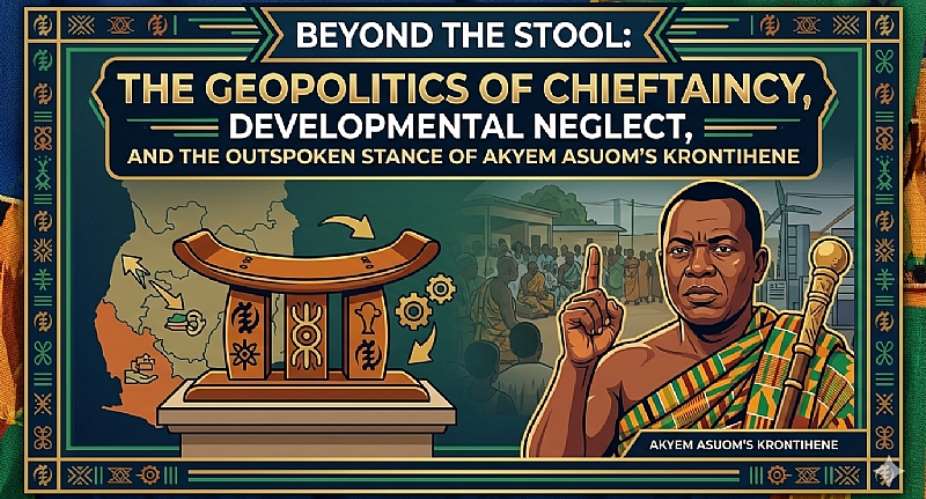
The intersection of traditional authority and constitutional democracy remains one of the most volatile friction points in modern Ghanaian governance. The recent, explosive political declarations of Nana Boadi Amponim Obodade III, the Krontihene of Akyem Asuom, have fractured the long-held facade of absolute chieftaincy neutrality. To simply dismiss the Krontihene’s raw, direct criticisms of national leaders as reckless partisan posturing misses a deeper, highly complex socioeconomic dynamic. Beneath his confrontational language lies a structural cry of desperation, chronic infrastructural isolation, and an existential crisis concerning the role of modern traditional custodians. While the constitutional boundaries governing traditional rulers must be respected to safeguard national cohesion, we must dissect the underlying historical, legal, and economic currents that compel a chief to risk his stool to voice the frustrations of his people.
The Historical Blueprint: The Akyem States and National Power
To contextualize the gravity of the Krontihene's public outburst, one must look at the unique historical trajectory of the Akyem states (Abuakwa, Kotoku, and Bosome) and their relationship with central governance:
- The Intelligentsia Legacy: Historically, the Akyem states, particularly the Abuakwa wing, formed a major hub of the Gold Coast intelligentsia. Standard-bearers like Dr. J.B. Danquah and Edward Akufo-Addo heavily influenced the foundational structure of contemporary political frameworks in Ghana.
- Expectations of Development: Because of this profound historical closeness to elite national leadership, regions like Akyem Asuom have historically expected an unspoken social contract of infrastructure and development, making ongoing local road negligence feel like an active political abandonment.
- The Warrior State Ethos: The three Akyem polities historically operated with a fiercely independent, defensive foreign policy during the pre-colonial era. This ancestral "warrior state" legacy frequently manifests in modern times when traditional leaders feel backed into a corner by socioeconomic stagnation, prompting a return to unfiltered, direct public advocacy.
The Reality of the Deficit: Eastern Region’s Infrastructure in Figures
The Krontihene’s aggressive rhetoric is not born in a vacuum; it is validated by a stark, quantifiable developmental gap. According to reports from the Ministry of Finance and the Global Infrastructure Hub, Ghana scores a low 47 out of 100 in overall infrastructure quality. This reality manifests severely across the Eastern Region:
- The $37 Billion Gap: Ghana faces an national infrastructure financing gap requiring $37.2 billion annually over 30 years. This macro-level deficit directly chokes funding for peripheral feeder roads like those connecting Akyem Asuom.
- The Pavement Disparity: National World Bank assessments reveal that rural accessibility falls under 22%, meaning less than a quarter of the rural population lives within 2 km of an all-season road. In the agricultural hubs of the Eastern Region, this translates to stranded harvests and inaccessible healthcare.
- The Maintenance Backlog: While minor segments like the Suhum-Asamankese and Akim-Oda roads undergo spot improvements, the Ministry of Roads and Highways' actual approved budget frequently hits as low as 18% to 34% of planned funding, leaving vast interior commercial routes completely neglected.
The Legal Precipice: The Threat of Destoolment and Constitutional Boundaries
The public fallout from the chief's remarks has led to aggressive calls for accountability, bringing the strict legal frameworks of the chieftaincy institution to the forefront:
- The Constitutional Prohibition: Article 276(1) of the 1992 Fourth Republic Constitution explicitly states that a chief shall not take part in active partisan politics. Any chief who does so risks direct legal and cultural challenges to their authority.
- The Chieftaincy Act Framework: Under Section 40 of the Chieftaincy Act, 2008 (Act 759), the unmaking of a chief is a highly formal judicial process. Arbitrary public or political threats of destoolment hold no legal weight; a valid destoolment requires a formal petition submitted through the relevant Judicial Committee of the Traditional Council.
- Prerequisites for Removal: For kingmakers to legally execute a destoolment, they must prefer specific charges proving a customary offense, gross financial misconduct, or behavior that brings the stool into absolute disrepute. The High Court and Supreme Court have historically quashed "purported destoolments" that bypassed these strict legal channels.
- The Judicial Bottleneck: While political factions use destoolment as a verbal weapon, the National and Regional Houses of Chiefs are currently facing severe funding and administrative backlogs, making swift, politically driven judicial removals legally tedious and highly unlikely without absolute community consensus.
The Grassroots Catalyst: Youth Revolt Against Political Intrusion
The institutional battle over the Krontihene’s stool has ignited a parallel firestorm among local youth groups, shifting the crisis from a closed-door legal debate into a proactive street-level movement:
- The Anti-Galamsey Alignment: The local youth heavily protect the Krontihene because he previously backed a massive civilian youth-led crackdown that successfully drove out destructive illegal mining operations from the Asuom area. The youth perceive the current destoolment threats by political factions as a retaliatory corporate and political effort to remove a protective traditional leader, allowing illegal miners to reclaim local farmlands.
- Rejection of Political Weaponization: Organized youth groups, including the Asuom Progressive Youth, have issued direct public ultimatums to local kingmakers. They explicitly state that traditional stools belong to the indigenous community, not central government political parties. The youth have threatened to completely boycott all state-sponsored regional developmental events if external political actors attempt to force a wrongful, unconstitutional destoolment.
- Demands for Tangible Development Over Rhetoric: Mirroring the chief's unfiltered frustration, the local youth have launched digital and physical campaigns emphasizing that their loyalty cannot be bought with cheap election-year handouts. They have aggressively taken to local radio networks and social media platforms to declare that if the central government spends more energy fighting an outspoken chief than fixing the regional road infrastructure, the youth will permanently shift their voting patterns away from incumbent party structures.
Anatomy of Frustration: The Krontihene’s Deeper Grievances
While the law demands silence, the stool demands action. Nana Obodade III’s actions show a breaking point where cultural diplomacy feels wholly inadequate to address systemic community failures:
- Infrastructural Stagnation: The central catalyst for the chief's outrage stems from the deteriorating state of the Asuom roads, illustrating a reality where local communities feel isolated despite their contributions to national agricultural and mineral wealth.
- Exasperation with Campaign Routine: The Krontihene’s public exhaustion regarding campaign tours reflects a larger, nationwide weariness toward cyclical political promises that yield few local benefits.
- Systemic Desperation for Accountability: The chief's explicit appeals to firmly institutionalize independent national anti-corruption initiatives demonstrate that traditional rulers recognize that public funds must be protected to ensure grassroots regional development.
- The Shielding Stool: As the primary caretakers of their communities, chiefs act as the immediate buffers for their citizens' daily economic hardships, creating an environment where public diplomatic silence can feel like local complicity.
A Conciliatory Way Forward: Actionable Recommendations
Resolving the growing rift between state governance and traditional leadership requires structural adjustments from both sides of the constitutional divide:
- Adopt Formal Multi-Partisan Lobbies: Traditional councils should transition away from individualized, verbal public remarks and toward formal, non-partisan development coalitions that lobby for infrastructure without compromising specific stools.
- Legitimize Legal Channels for Local Advocacy: The Ministry of Chieftaincy and Religious Affairs should formalize transparent avenues through which traditional rulers can systematically demand local accountability without crossing partisan boundaries.
- Insulate State Watchdogs from Executive Change: National anti-graft bodies and audit infrastructure should be constitutionally fortified to outlast shifting partisan regimes, turning arbitrary anti-corruption programs into institutional legal standards.
- Implement Objective Regional Development Frameworks: The state must deploy data-driven, non-partisan formulas for distributing basic road infrastructure, ensuring local town development is not linked to electoral favoritism.
The fierce national debate surrounding Nana Boadi Amponim Obodade III serves as a critical warning system for Ghanaian democracy. When traditional custodians cast aside centuries-old norms of measured diplomacy, it points to a wider fracturing of the social contract between the state and its grassroots citizens. Demanding strict constitutional compliance from chiefs without addressing the severe infrastructural neglect that drives them to speak out is a hollow exercise. True stability will not be achieved by silencing local leaders, but by listening to the legitimate frustrations of the communities they protect. Ghana's political structure must evolve from a model of cyclical campaign promises to one of verified, equitable national development.
✍️By A Concerned Retired Senior Citizen
For and on behalf of all Senior Citizens of the Republic of Ghana 🇬🇭
Teshie-Nungua
[email protected]

 Mahama Begins Four‑Day State Visit to Belarus to Deepen Ghana–Belarus Cooperatio...
 Adubinsu Tanker Explosion: Fire Service Slams Residents for Attacking Firefighte...
 80 Suspects Grabbed as Police Storm Upper East in Massive Anti‑Crime Sweep
 Abuakwa South MP Pushes for National Disaster Fund to Support Flood Victims
 “Don’t Be Fooled!” — Foh-Amoaning Tells African MPs LGBTQ+ Rights Not Backed by ...
 BoG Mops Up GHS 11.28bn in Fresh Liquidity Sweep as 14‑Day Bill Auction Records ...
 Foreign Digital Content Eroding African Values — Sam George Warns Parents
 Anthropic calls for global AI slowdown, says systems may outpace human control
 Bono Region: Police investigate murder of retired veterinary officer
 VIDEO: Fuel tanker driver burnt to death in fiery crash at Adubinso, seven shops...


