




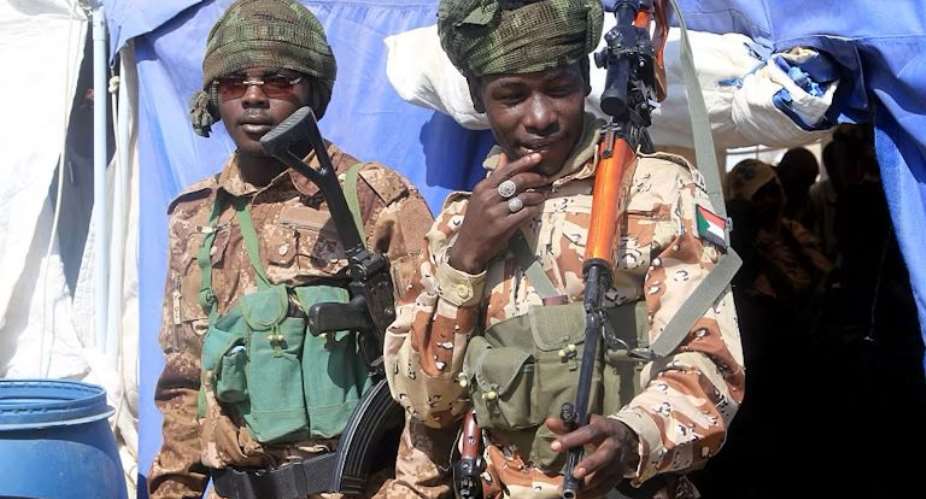
Three years into the civil war in Sudan that began on 15 April 2023, a coalition of civilian, political and armed factions has launched a new peace initiative.
Announced in the Kenyan capital Nairobi in May 2026, the roadmap seeks to end the conflict and revive Sudan's stalled transition to civilian rule.
Its backers – a civilian, anti-war bloc independent of both warring parties – argue that previous peace efforts have failed because signatories weren't given sufficient opportunity to address the root causes of the war.
The Nairobi document proposes a three-track process. It combines humanitarian measures, a renewable internationally monitored ceasefire and a political transition focused on state reform. It also seeks to address grievances, like the marginalisation of regions such as Darfur, to tackle the roots of conflict.
The roadmap seeks to exclude the Sudanese Armed Forces and the paramilitary Rapid Support Forces from the political process. Its signatories argue that this is a result of their responsibility for the war. However, the warring parties are to participate in ceasefire talks.
In addition, the Nairobi initiative seeks to bar leaders of the Islamist movement organisation – including its political arm, the former ruling National Congress Party – from political participation and security-sector reform. The party was in power from 1989 to 2019.
In Sudan, “Islamists” generally refers to political actors associated with the National Congress Party. The party formed the ideological and political backbone of Omar al-Bashir's regime. Bashir was overthrown in 2019. However, many of the movement's networks within the state, security sector and business community have endured.
The Nairobi proposal reflects a belief among the signatories that Islamist actors helped create the conditions that led to war in 2023 as a way to regain power.
The Nairobi initiative primarily brings together the Sudan Liberation Movement and the “Somoud” coalition.
The Sudan Liberation Movement is one of the main armed groups that has remained relatively distant from direct involvement in the ongoing war.
Somoud was formed in February 2025. It is a group of civic and political actors led by former prime minister Abdalla Hamdok. It includes several parties that played leading roles in the transitional government established after Bashir's regime was overthrown. It lasted until the October 2021 military coup.
The Nairobi initiative is part of a broader landscape of peace efforts in Sudan. These include:
the Quad initiative. It involves the United States, Saudi Arabia, the United Arab Emirates and Egypt. It focuses on negotiations between the warring parties: the army and the Rapid Support Forces.
the Quint mechanism. It brings together the UN, African Union, European Union, Arab League and Intergovernmental Authority on Development. It emphasises the design of a future political process in Sudan.
a conference in Berlin in April 2026 with broad international participation.
Drawing on more than a decade of research on Sudanese politics, I argue that the Nairobi initiative has sharpened debate over the role of Islamists in Sudan's post-war political order. How that question is resolved will prove crucial to the prospects for a negotiated settlement.
In my view, a ceasefire without broader political settlement could institutionalise Sudan's current military fragmentation rather than resolve it.
The debate
The Berlin and Nairobi talks illustrate that several important factions are aiming for agreement on a ceasefire in Sudan. However, the issue of whether Islamist parties or leaders should be part of any settlement remains unresolved.
The Islamists' current electoral weight is difficult to assess. Leaders of the Islamic movement have claimed a membership of around two million out of 53 million Sudanese. The former ruling National Congress Party had argued that it represents more than 25% of Sudanese society.
Such claims are difficult to verify. They were challenged by the mass protests that contributed to the fall of Bashir's regime in 2019.
The Berlin conference ended with a statement calling for an “inclusive” political dialogue involving all Sudanese parties.
By contrast, both the Nairobi initiative and the Quad process have called for excluding Islamist leaders from the post-war political order.
Supporters of this position argue that the Islamist movement bears significant responsibility for the conflict. They point to their political and military influence during the three decades following Bashir's 1989 coup, and a continued presence within key state institutions.
These contrasting approaches reflect different political leanings.
The Nairobi coalition emerged largely from forces associated with Sudan's 2019 uprising. It views Islamist exclusion as essential to preventing a return to the old order. The Berlin process, meanwhile, reflects a broader international preference for inclusivity as a foundation for peace.
Excluding Islamists entirely may prove difficult. Despite the collapse of Bashir's regime, the Islamic movement retains influence within parts of the state and security apparatus. This includes government ministries, and intelligence and military institutions.
Sudan and the Islamist movement
Despite Bashir's fall in 2019, Islamists remain one of Sudan's most influential political forces. This is largely through networks linked to the former ruling party.
Since the outbreak of war in April 2023, Islamist groups have broadly aligned themselves with the Sudanese Armed Forces. Some have played a direct military role through armed formations that have fought alongside the army.
Others have supported the army through political mobilisation. They have led fundraising, recruitment campaigns and public advocacy. Their influence within communities in northern, central and eastern Sudan has helped mobilise volunteers for army-aligned forces.
This alignment reflects the legacy of Sudan's post-2019 transition.
After Bashir's removal, transitional authorities sought to exclude former regime networks from political power. Many Islamists came to view an army victory as the best chance of preserving any influence.
As a result, Islamist groups have become a target of several actors in the conflict. The Rapid Support Forces and the Sudan People's Liberation Movement-North are two of the principal forces fighting the army. They have explicitly called for the removal of Islamist influence from state institutions.
The challenge facing future peace efforts is that Islamists still retain significant political and military influence. This makes them difficult to ignore. Yet many of their opponents see their participation as incompatible with a lasting settlement.
What next?
Anti-army actors are unlikely to support the reunification of Sudan's fragmented armed forces without guarantees that Islamist influence within the military and state institutions will be eliminated.
At the same time, any sustainable settlement is likely to require accountability for Islamist figures implicated in violence, abuses or crimes committed against Sudanese civilians.
This points to a difficult middle path: excluding individuals linked to serious violations or the former regime's coercive apparatus, while pursuing broader state reforms designed to reduce party influence.
Efforts to exclude Islamists entirely may prove difficult to enforce. Yet attempts to restore them to the centre of power could deepen mistrust and internal divisions. This could further fragment Sudan's political and military landscape. How Sudanese actors and international mediators handle this dilemma will help determine if peace initiatives produce a lasting settlement.
Samir Ramzy does not work for, consult, own shares in or receive funding from any company or organisation that would benefit from this article, and has disclosed no relevant affiliations beyond their academic appointment.
By Samir Ramzy, Researcher, Helwan University
 Woman fined GH¢1,080 for impersonating Police Commander to defraud bereaved fath...
 "Flagrant disrespect" — Court remands Abronye over failure to surrender passport...
 We're working to restore power in Mamprobi, surrounding areas aftee technical ch...
 Speaker Bagbin must be removed over comments on anti-LGBTQ bill — Solomon Owusu
 Upper East: Angry group fumes over the region’s exclusion from the $500 million ...
 UTAG-KNUST rejects GTEC proposal to harmonise university promotion standards
 Adu-Boahene trial: Kan-Dapaah, others must testify — Atta Akyea
 Aflao youth express displeasure over Interior Minister’s failure to honour plann...
 Tying development aid to adoption of foreign culture alien to our socio-cultural...


