




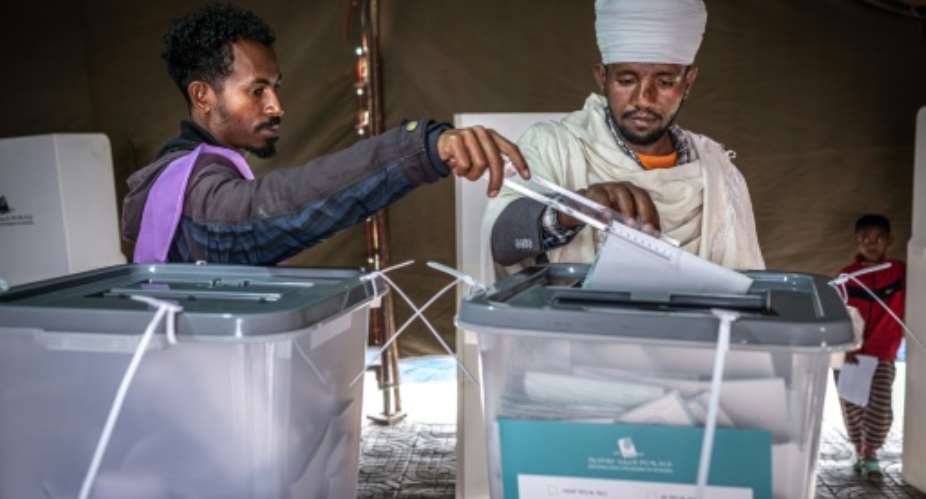
Ethiopians flocked to the polls on Monday, with the Prosperity Party (PP) of incumbent Prime Minister Abiy Ahmed all but guaranteed to win a landslide victory.
Abiy, who has ruled the Horn of Africa nation of 130 million people since 2018, is criticised for growing authoritarianism, in contrast to his early years when he won the Nobel Peace Prize for mending relations with neighbouring Eritrea.
But despite ongoing conflicts and repression, Ethiopia's economy is seeing fast growth thanks largely to a state-led construction boom and surging exports such as coffee.
"The coming five years will be a period of historic transformation for our nation," Abiy told reporters after casting his ballot in his native Oromia region, home to the largest of Ethiopia's 80-odd ethnic groups, who have benefited from his tenure after decades of rulers from other areas.
 Prime Minister Abiy Ahmed is expected to win another landslide. By Marco Simoncelli (AFP)
"Achieving this change will demand even greater determination, sacrifice and effort than we have demonstrated in the past," he said.
Long queues formed at polling stations in the capital Addis Ababa, AFP journalists saw, with some voters waiting since 2:00 am.
"It is a critical time to decide the fate of our country," said Binyam Gideyelem, 38, a telecoms worker voting for the first time, at a station near the international airport.
Despite the enthusiasm, analysts say the vote is little more than a formality to keep Abiy in power.
Abiy's PP won 96 percent of the seats in the last election in 2021 and is running unopposed in dozens of constituencies this time.
 Ethiopia's economy is booming thanks largely to a state-led construction boom and surging exports such as coffee. By Marco Simoncelli (AFP)
Independent journalists are stifled, opposition parties divided and under-resourced, and the country faces multiple insurgencies.
The election is "likely to be among the least competitive of the seven national elections held since multiparty democracy was introduced in 1991," Ahmed Soliman and Abel Abate Demissie of the Chatham House think tank wrote last week.
"Many challengers to the ruling PP will not contest the elections," they noted. "Some are in exile, some are banned, some are imprisoned, and many may see little incentive to abandon their armed struggle against the government."
Results are expected by June 11.
"We have tried our best and we have given it everything we have," said Eyob Mesfin, of opposition party Ezema after voting, adding they would recognise the results if "the process is democratic and fair, and free."
Rapid growth
No election is taking place in the northern region of Tigray, due to ongoing tensions between regional and federal authorities.
More than a million people remain displaced from its brutal civil war of 2020-2022.
 Some voters queued from 2:00 am to cast their ballots. By Marco Simoncelli (AFP)
Ethiopia still faces insurgencies in the two most populous states, Oromia and Amhara.
In Amhara, with a population around 20 million, Fano nationalist militias have threatened to disrupt the electoral process, though the National Election Board cancelled voting in only eight of its 137 constituencies.
It insisted polls would run normally throughout the vast Oromia region covering one third of the country, despite threats from a group called the Oromia Liberation Army.
Despite the challenges, the International Monetary Fund expects the Ethiopian economy to grow by more than nine percent this year -- one of the fastest rates in the world.
It is largely thanks to the infrastructure and industrial investments under previous governments, though recent liberalising reforms under Abiy have boosted exports despite the short-term pain for Ethiopian consumers.
Observers from the African Union, headquartered in Addis Ababa, as well as the East African regional bloc IGAD, are monitoring Monday's poll.
Ethiopia did not accept a proposal from the European Union to send observers, according to an EU source.

 WAEC must open itself to greater scrutiny and accountability – GNAPS
 Parliament unanimously approves Ayariga, Zenator as ministers
 Parliament approves three Supreme Court nominees despite Minority boycott
 James Agalga assumes office as new Majority Leader
 'I promise you well-researched dossier for all my debates; offer different lens ...
 Road accidents costs Ghana approximately US$4.55 billion annually — World Bank
 Only 27% of Ghana’s roads paved – World Bank
 Forgive Ayitey Powers — Bukom Banku begs Yaw Ampofo Ankrah
 [VIDEO] Tricycle rider refuses to comply with plainclothes police man after arre...
 Controlled spillage from Bagré Dam begins Friday — Water Resource Commission

