




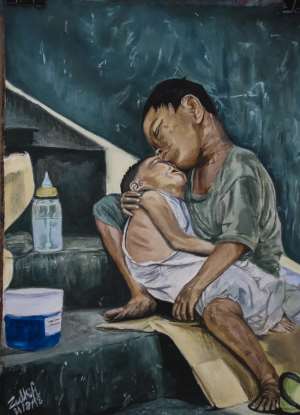
The constitution of every nation provides for the equality of all citizens. Unfortunately, this is more parabolically spoken than acted upon. , the masses of the earth, who knowingly, and in most cases unknowingly, must dance to the whims and caprices of the power games of leadership of countries and nations, exist. Their story is based on hope. The story of the wretched in Africa is beyond mere sympathy. It is a story of the survival of the fittest and a choice between life and death. Ghana has its own share of the wretched.
At dawn in Circle, Madina, and other parts of Accra, they wake up with a sigh and a single prayer, God, provide for us today, for we must eat to survive. In the villages, the frustration is usually assuaged by the communal existence; nonetheless, the extent of the hardship remained unabated. The fight is for food. Most have lost their lofty ambitions and hopes of becoming productive. They have accepted the fate of suffering and penury, erroneously ascribing it to destiny. But how can destiny drag a man into a fate worse than death? I called it a systemic glitch.
Determinism and fatalism based on natural law and divine rights become the consolation of . But is it true that in Ghana, for example, the scarcity of resources makes it so impossible that there can be no equity in the distribution of the national cake? Can we at least keep the hope of the wretched alive by making the system work? The hallmarks of a well-governed country are meritocracy and free will. In Ghana and most African countries, the idea seems to be ‘connection’. Can the Subaltern be given his only hope of an effective functioning system, where hard work, determination and sacrifice pay?
Our systems and institutions have colonial foundations. They were built on the exploitation. The colonial systems in Africa was fundamentally designed as an extractive machine, structured to exploit natural resources and labour for the economic benefit of European powers, rather than to develop the continent. This system transformed African economies into suppliers of raw materials, implemented coercive labour practices, and created infrastructural networks designed to transport wealth out of the continent. When we attained our independence, there was a need for our leaders to recraft and redesign the systems used by the colonisers. Unfortunately, whilst most of them tried, the first group of African leaders after independence ended up replacing the colonial masters with themselves. Whilst the erstwhile colonisers exploited the resources and the people of Africa and used the same to develop their countries in Europe, the first generation of African leaders after independence, exploited their own people and resources to enrich themselves and their families at the expense of the masses, the wretched. Afraid of their own people, they kept their wealth in banks in Europe, thus introducing the concept of neo-colonialism, where African resources were still used to develop Europe, albeit indirectly.
We face a peculiarly similar situation in Ghana today. Our leaders have not distanced themselves from the exploitative tendencies of the coloniser. The systemic flaws in our institutions have not been redesigned to fit into the Ghanaian situation. For example, our constitution gives the president so much power that once elected, he basically becomes a god. He is the source of all attention and attraction. Whilst there is a parliament, which must check and control the president’s power in principle, the president in most cases has a majority of his party members in parliament, enabling him to basically walk over parliament. This is not a system of development; it is a system of exploitation and regression, where the wretched are kept at the bottom, and a few elites are above.
The challenge, however, is not the suffering of the wretched; it is about the unsustainability of such a system. We have seen in recent times the revolt of the masses against such a system, both in Africa and across the globe. That is the real challenge. The collapse of the unfair system.
Benjamin Kwame Amankwa


 ‘Too arrogant, too sure of itself’ France confronts its legacy in Africa
 Nigeria's unwritten power-sharing rule looms over presidential race
 Several killed, dozens wounded in Jordan church shooting
 ‘I killed lots of terrorists, but it didn’t make me feel better’: The trauma hau...
 Casualties feared as multi-storey building collapses in Nairobi
 Cabinet approves bill to regulate public relations practice – Shamima Muslim
 Bawumia was right; NDC's economy is only on paper, not in people's pockets – Kwa...
 NDC should credit Bawumia for introducing gold-for-reserves policy – Kwadwo Poku
 Obuasi SHTS sex scandal: Gender Ministry deploys team to support affected studen...
 Adwoa Safo's Dome-Kwabenya comeback bid must push Elikplim Akurugu to deliver mo...


