




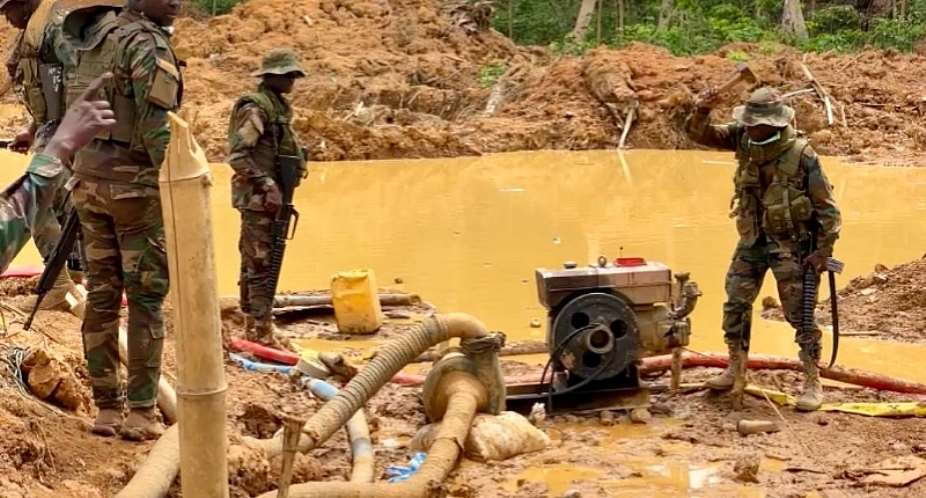
While coup d’état is a disgusting way in removing a non-performing government from power, coup enthusiasts, such as the NDC founders, were of the view that a coarse administration deserves to be supplanted through ballistic missiles, machine guns, bazookas, and not by the thumb.
An account is given, that in the mid 1970’s, the social injustices and harsh living conditions at the time prompted a group of patriotic citizens to stand up against the military government and demanded a democratic rule.
But, before the country could reach a consensus on the question of civilian rule, a group of discontented junior army officers led by the NDC founder, Flight Lieutenant Jerry John Rawlings of blessed memory failed in their insurrection against General Fred Akuffo’s regime on 15th May 1979, which led to the arrest and trial of Rawlings and his cohorts.
Nevertheless, the judicial process was halted prematurely by a group of soldiers sympathetic to Rawlings, who revolted on 4th June 1979.
The June 4 1979 jailbreakers gleefully released suspects and convicts from a lawful penitentiary and deposed the government of the day.
Again, the NDC founders relentlessly breathed down the neck of the then President Limann. They kept criticising Dr Limann’s administration for what the conspiratorial plotters perceived as economic mismanagement, until Rawlings and his jailbreaking geezers decided to depose Dr Limann on 31st December 1981.
I would, therefore, like to believe that the situation being presented by the illegal mining activities would have instigated a coup by the NDC founders to protect the health and well-being of Ghanaians.
My dear reader, let me crave your indulgence just a moment longer and pose: which independent country on this planet (Earth) would its politicians, regulators, and law enforcement bodies sit idly while some obstreperous Ghanaians and their criminally-minded foreign counterparts despoil its natural resources and destroy the environment?
In his 2025 meet the press gathering, President Mahama made it clear to Ghanaians that he has not exhausted all the necessary interventions in the galamsey fight and therefore the state of emergency is not needed at present.
The all-important question every concerned citizen or denizen should be asking then is: why were they forcefully pushing for a state of emergency during Akufo-Addo/Bawumia administration?
I’m afraid, if we think a state of emergency is not warranted in the galamsey fight, then we are deluding ourselves.
Let’s face it, the galamsey menace is more serious than the insidious coronavirus, and therefore a state of emergency is not negotiable in combating the criminals in illegal mining who are wickedly destroying our lands and rivers, and poisoning us with mercury and cyanide .
The boisterous brats are well-prepared, and routinely carry out their illegal activities with military precisions, can strike as lighting, and as deadly and destructive as molten magma.
Given the criminal intent of the unscrupulous illegal miners , we are, more than ever, urgently required our military power to combat the menace of the stubbornly obdurate nation wreckers.
A state of emergency, apparently, is regulated strictly under the international human rights law, specifically, the International Covenant on Civil and Political Rights, in which the authorities are obliged to justify such restrictions upon rights.
Of course, even in a public emergency, the declaration of a state of emergency needs to be based on the rule of law.
In the grand scheme of things, emergency powers should be used within the parameters provided by international human rights law, particularly the International Covenant on Civil and Political Rights (ICCPR), which acknowledges that States may need additional powers to address exceptional situations such as the illegal mining activities.
Such powers, so to speak, should be time-bound and only exercised on a temporary basis with the aim to restoring a state of normalcy.
It is also worth reminding the government that even without formally declaring a state of emergency, Ghana can adopt exceptional measures to protect public health that may restrict certain human rights.
These restrictions must meet the requirements of legality, necessity and proportionality, and be non-discriminatory.
More so, the derogation of certain civil and political rights is only allowed under specific situation of emergency such as galamsey that “threaten the life of the nation” ( OHCHR).
Interestingly, however, Article 4 of the International Covenant on Civil and Political Rights(ICCPR) directs that in the event of public emergency such as galamsey, which may threaten the existence of a nation, such sovereign state may take measures derogating its obligations, provided that such measures are not inconsistent with their other obligations under international law, and do not involve discrimination solely on the ground of race, colour, sex, language, religion or social origin.
Suffice it to stress that derogation is not permitted under any circumstances on Articles 6, 7, 8 (paragraphs I and II), 11, 15, 16 and 18 of ICCPR(UN 1966).
This is because the rights encapsulated in the preceding articles are non-derogable(cannot be suspended), which include the right to life, free from torture, free from slavery, unlawful arrest and detention, equal recognition everywhere before the law, and right to freedom of thought, conscience and religion (UN 1966).
Some rights, such as freedom of movement, freedom of expression or freedom of peaceful assembly may be subject to restrictions for public health reasons, even in the absence of a state of emergency (ICCPR 1966).
The restrictions, however, must meet the following requirements: Legality: The restriction must be “provided by law”. This means that the limitation must be contained in a national law of general application, which is in force at the time the limitation is applied.
The law must not be arbitrary or unreasonable, and it must be clear and accessible to the public.
The restriction must be necessary for the protection of one of the permissible grounds stated in the ICCPR, which include public health, and must respond to a pressing social need such as the galamsey menace.
The restriction must be proportionate to the interest at stake, i.e. it must be appropriate to achieve its protective function; and it must be the least intrusive option among those that might achieve the desired result.
No restriction shall discriminate contrary to the provisions of international human rights law (OHCHR).
Let me humbly submit that given the pernicious and ecumenical effect of the illegal mining activities, the government could be justified in its restrictions upon rights in the declaration of a state of emergency.
K. Badu, UK.
[email protected]


 Germany’s far-right AfD landslide winner in key Saxony-Anhalt vote, early result...
 'The height of absurdity' — Ayew Afriye slams BNI over invitation of Efya Royal ...
 US envoys arrive in Moscow to thrash out plan to end war in Ukraine
 'Chief Justice was talking as a citizen; you have to look at the context in whic...
 Mandatory towing to remove broken-down, stationary vehicles from roads to begin ...
 Domelevo backs OSP probe into alleged GH¢70,000 payment to Appiagyei despite den...
 WAEC releases 2026 WASSCE results, cancels entire results of 861 candidates for ...
 Baffour Agyeman-Duah explains why profitability may not be only reason behind SO...
 5-year-old girl dies after falling into water-filled manhole at Winneba
 Sierra Leone ex-president to return after treason case dropped

