




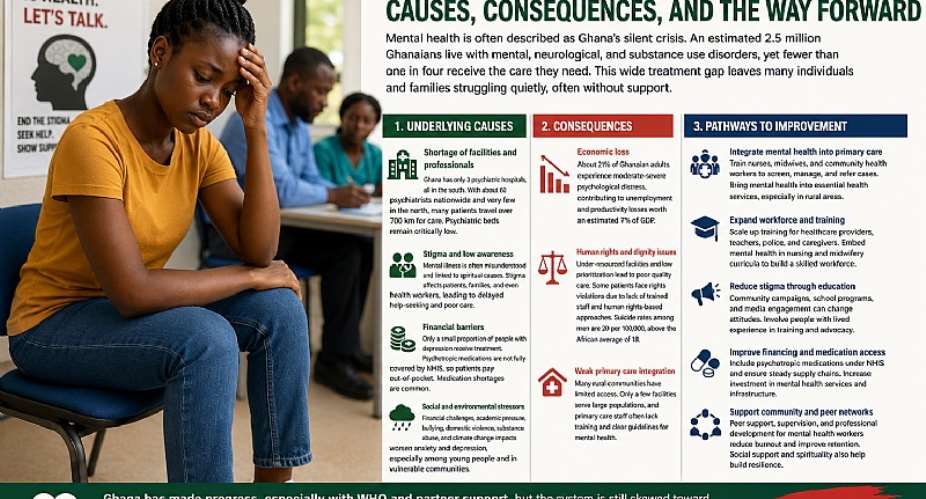
Mental health is often described as Ghana’s silent crisis. An estimated 2.5 million Ghanaians live with mental, neurological, and substance use disorders, yet fewer than one in four receive the care they need. This wide treatment gap leaves many individuals and families struggling quietly, often without support.
Underlying Causes
A major driver of the crisis is the severe shortage of mental health professionals and facilities. Ghana has only three psychiatric hospitals, all located in the southern part of the country. With roughly 60 psychiatrists nationwide—and only a handful serving northern regions—many patients are forced to travel long distances, sometimes over 700 kilometres, just to access care. The availability of psychiatric beds remains critically low.
Stigma and limited awareness also play a significant role. Mental illness is frequently misunderstood and, in many communities, attributed to spiritual or supernatural causes. This discourages people from seeking medical help and can lead to neglect or inappropriate treatment. Even among healthcare workers, stigma can affect the quality of care provided.
Financial barriers further deepen the problem. Access to treatment remains limited, partly because psychotropic medications are not fully covered under the National Health Insurance Scheme (NHIS). As a result, many patients must pay out of pocket, often facing high costs and inconsistent drug availability.
Social and environmental pressures add another layer of complexity. Young people, in particular, face stress from academic demands, unemployment, bullying, and domestic challenges. In vulnerable coastal communities, climate change—through rising sea levels and loss of livelihoods—is increasingly linked to anxiety and depression.
Consequences for Individuals and Society
The impact of poor mental health care extends beyond individuals to the national economy. A significant proportion of Ghanaian adults experience moderate to severe psychological distress, contributing to lost productivity and unemployment. The economic cost is substantial, with mental health-related losses estimated to affect a notable share of the country’s GDP.
There are also serious human rights concerns. Under-resourced facilities and limited trained personnel can lead to substandard care, sometimes compromising patient dignity. In extreme cases, individuals with mental health conditions face neglect, abuse, or social exclusion. Suicide rates, particularly among men, remain a growing concern.
Access to care is further constrained by weak integration of mental health services into primary healthcare. Many rural communities lack even basic services, and frontline health workers often do not have adequate training or clear guidelines to manage mental health conditions effectively.
Pathways to Improvement
Addressing Ghana’s mental health challenges requires a shift from hospital-centred care to community-based solutions. Integrating mental health into primary healthcare is a critical step. Training nurses, midwives, and community health workers to identify and manage common mental health conditions can significantly expand access, especially in underserved areas.
Expanding the mental health workforce is equally important. Ongoing training initiatives—such as those supported by the World Health Organization—should be scaled up, with mental health education embedded in health training institutions.
Reducing stigma must remain a priority. Public education campaigns, school-based programs, and community engagement can help reshape attitudes. Involving individuals with lived experience in advocacy and training can also foster understanding and empathy.
Improving financing and access to medication is essential. Including psychotropic drugs under NHIS coverage and strengthening supply chains would ease the financial burden on patients and ensure consistent treatment.
Finally, strengthening community and peer support systems can provide a vital safety net. Social networks, counselling groups, and culturally relevant coping mechanisms—including faith-based support—can complement formal healthcare services.
Conclusion
Ghana has made important strides in mental health policy and awareness, but much remains to be done. The current system is still heavily concentrated in urban, hospital-based settings, leaving large segments of the population underserved.
Closing the treatment gap will require sustained investment, stronger community-based care, and a national commitment to treating mental health as an integral part of overall health. Until then, the crisis will remain largely unseen—but deeply felt.
FRANK AYIM DAMPTEY


 Health Ministry to open recruitment portal for 36th batch of medical officers, d...
 President Mahama woos British investors, urges global debt reforms
 Ashanti Regional Minister impressed with progress of 24-Hour Economy model marke...
 GTA issue: Sanction whoever leaked Abeiku Santana’s letter to Tourism Minister –...
 Brazil's President Lula da Silva beats Flavio Bolsonaro to win re-election
 TOR briefs IMF on recovery efforts, inherited debt and sustainability plans
 Aseidu Nketia urges NDC contestants to unite after constituency elections
 EC yet to announce Dormaa Central NDC constituency results
 Baaba Cann questions Obuasi SHTS handling of sexual misconduct allegations again...
 Obuasi SHS headmaster case: “It is better to pay for sex with prostitute than ra...


