




As the international art show takes over Italy's canal city for its 61st edition, Russia is returning to the Biennale for the first time since Moscow's invasion of Ukraine in 2022.
Ukrainian feminist collective Femen and Russian punk protest band Pussy Riot joined forces to demonstrate outside the Russian pavilion at the start of press previews on Wednesday.
"We are here to remind that the only Russian culture, the only Russian art today is blood," Femen activist Inna Shevchenko told reporters. "This pavilion stands on Ukrainian mass graves."
Ksenia Malykh, curator of Ukraine's pavilion, said: "They [the Russians] say art is beyond politics but they're using art as a weapon, in a hybrid war in Europe. So it's absolutely insane that they're here. No one progressive could accept that." A Pussy Riot activist holds an Ukrainian flag during a protest against the participation of Russia in the Venice Biennale art show, in front of the Russian pavilion on 6 May 2026.
The art fair's international jury resigned last month, saying they would not hand out awards to countries led by figures subject to arrest warrants issued by the International Criminal Court – namely, Russian President Vladimir Putin and Israeli Prime Minister Benjamin Netanyahu.
EU foreign policy chief Kaja Kallas called Russia's participation in the Biennale "morally wrong" and said the European Union was considering cutting €2 million of funding to the festival.
In March, culture and foreign ministers from 22 European countries, including France, asked the organisers to reconsider. "Culture is not separate from the realities societies face," they wrote in a joint letter, arguing that "granting Russia a prestigious international cultural platform sends a deeply troubling signal".
Italy's Culture Minister Alessandro Giuli – who has repeatedly expressed the Italian government's opposition to Russia's inclusion – has said he will not be going to the opening ceremony.
How the Russian invasion has sparked a renaissance of Ukrainian culture
Russia's pavilion will not be open to the public during the Biennale, which runs until 22 November.
Instead, live performances that took place during press previews this week were recorded and will be shown on outdoor screens. The Russian exhibit will be eligible for the art fair's prizes, which this year will be awarded by visitors' votes.
In a statement on Facebook, Russia's ambassador to Italy, Aleksei Paramonov, said there was "truly something painful and unreasonable about the European Union's obsession with targeting Russian culture and art with sanctions and restrictions of all kinds".
Protests over Gaza
Israeli artists are also back at the Biennale, after refusing to open their exhibit at the last edition in 2024 amid the war in Gaza.
Shortly after Wednesday's demonstration outside the Russian exhibit, about a hundred pro-Palestinian demonstrators gathered in front of Israel's pavilion, holding up banners saying "No artwashing genocide" and brandishing the names of Palestinian artists killed in Gaza.
The artist representing France, Yto Barrada, is among more than 200 participants who have signed a letter demanding Israel's exclusion, saying they refuse to allow organisers "to platform the Israeli state as it commits genocide".
The Israeli government has accused protesters of discrimination.
Representing Israel's pavilion, sculptor Belu-Simion Fainaru that the Biennale should be based on "inclusion and dialogue and free expression. A place where you can feel safe, to create and do whatever you believe in."
Cinema and politics collide at Berlin Film Festival in row over Gaza war
The president of the Biennale, Pietrangelo Buttafuoco, defended his team's choices and said art should remain neutral.
"If the Biennale were to start selecting not works but affiliations, not visions but passports, it would cease to be what it has always been: the place where the world comes together, and all the more so when the world is torn apart," he told reporters on Wednesday.
"Art has a power far greater than any form of oppression. Art opens the way for the future and gives us the possibility of erasing catastrophes," he said.
Iran absent
"La Biennale seeks to be – and must remain – a place of truce in the name of art, culture, and artistic freedom," organisers said in a statement following the jury's resignation last month.
Days before the opening, Iran announced it would not open a pavilion. No reason was given in the Biennale's official statement, but the country is currently at war with Israel and the United States.
That leaves around 100 countries participating in this year's Biennale.
France has ramped up its presence, with some 20 artists participating in solo and group shows.
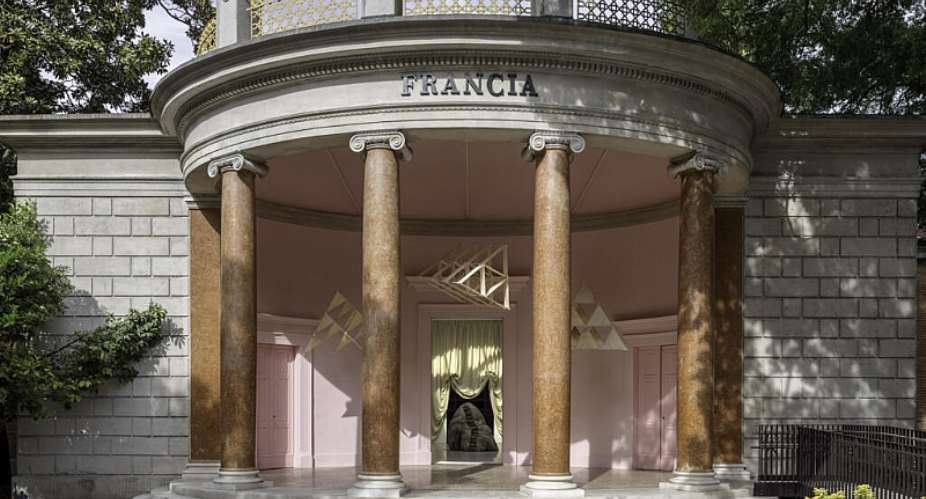
Taking on the event's theme, "In Minor Keys", French-Moroccan artist Yto Barrada is presenting an enigmatic installation in the French pavilion inspired by the ambivalent figure of the Roman god Saturn. Photo of the "La salle des plis" (The Room of Folds), part of the "Comme Saturne" installation by French-Moroccan artist Yto Barrada at the 2026 Venice Biennale.
Curated by Myriam Ben Salah, Comme Saturne brings together numerous textile techniques to blend references to ritual, myth, labour, agriculture, matter and language. The title also refers to the famous phrase by Pierre Victurnien Vergniaud, a figure of the French Revolution who was guillotined in 1793: "The Revolution, like Saturn, devours its children."
According to a prophecy, Saturn would be overthrown by one of his sons. In response, he ate his sons as soon as they were born. But the mother of his children hid one child, Jupiter, who went on to banish his father and rule supreme.
Barrada plays with this image by using a technique known as "dévoré", in which the surface of a fabric is chemically dissolved to create semi-transparent patterns. Photo of the "Salle de Travail" (Working Room), part of the "Comme Saturne" installation by French-Moroccan artist Yto Barrada at the 2026 Venice Biennale.
For Eva Nguyen Binh, head of the Institut Français, the French cultural institute responsible for the pavilion, this project sums up "what art can repair and provide: an ability to break down geographical and artistic boundaries, to foster community, draw from history in order to question the present, and to make overlooked narratives visible, especially those of women and minorities".

 Sandema: Funeral clash leaves four injured, army recruit loses hand
 Upper East: Residents raise concerns over Mahama’s 24-hour market policy
 Ex-Buffer Stock CEO and wife were not denied legal counsel on rearrest — EOCO
 PDS case: Lawyers detained were invited as suspects a day earlier -- EOCO
 Government explores autonomous rapid transit system to modernise intra-city tran...
 AU mourns demise of former Botswana President Festus Mogae
 Economic recovery came at a cost to BoG — Sammy Gyamfi on 2025 losses
 NPP's criticism of BoG 2025 losses disingenuous, hollow — Sammy Gyamfi
 Ghana Armed Forces to conduct counter-insurgency exercise in Bono, Upper East re...
 Site for Adaklu District 24-hour economy market handed over to contractor


