




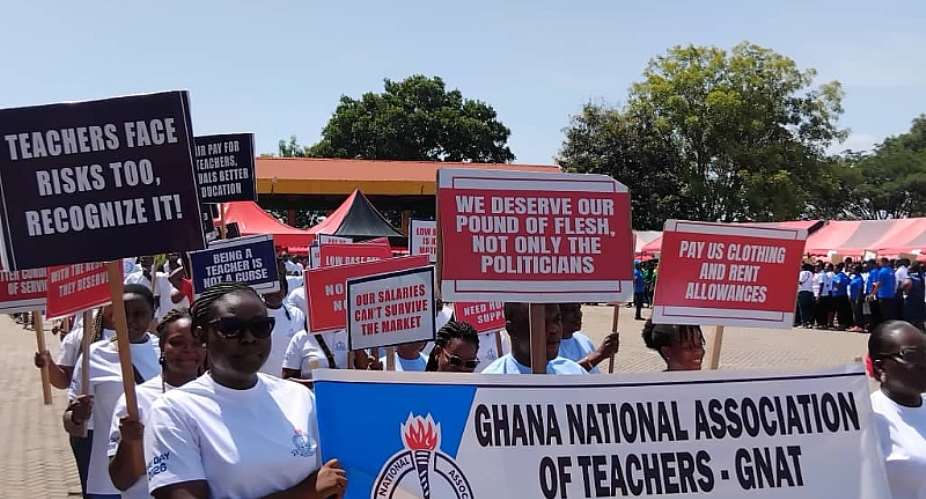
Organised Labour in the Volta and Oti Regions has called on the Government to move beyond macroeconomic stability and pursue policies that ensure decent jobs, living wages and improved livelihoods for Ghanaian workers.
Mrs Edith Abla Amenuvor Afewu, Volta and Oti Regional Secretary of the Trades Union Congress (TUC), made the call at the 2026 May Day celebration of the two regions held in Ho.
She said Ghana's economic recovery would be meaningful only if it translated into quality employment, better incomes and improved living standards for workers.
“Ghana does not need macroeconomic stability alone. Ghana needs stability that creates good-quality jobs in the right quantities. Ghana needs growth that raises incomes, improves and stabilises livelihoods,” Mrs Afewu said.
She identified low wages and salaries as one of the major challenges confronting Ghanaian workers, describing current earnings as grossly inadequate amid rising living costs.
Mrs Afewu noted that the national daily minimum wage of GH¢21.78, equivalent to about GH¢588 a month, was too low to support workers and their families, while the minimum salary on the Single Spine Salary Structure, pegged at about GH¢809 a month, was also insufficient.
“These low salaries are barely enough for survival. How workers on such salaries are expected to pay for food, rent, clothing and utilities remains a puzzle,” she said.
On emoluments, Mrs Afewu welcomed Government's proposal to establish an Independent Emoluments Commission, but expressed concern about suggestions to phase in its implementation, stressing that the Commission alone would not resolve the broader issue of inadequate pay.
Touching on pensions, she said pension coverage in the country remained low, with less than one-fifth of eligible Ghanaians enrolled, while many pensioners survived on less than GH¢500 a month.
She also decried disparities in pension payments, noting that while some pensioners earned as little as GH¢400 monthly, others received more than GH¢213,000.
Mrs Afewu therefore called for comprehensive pension reform and pension unification to promote fairness and reduce pressure on the national budget.
She criticised what she described as increasing Government control over the Social Security and National Insurance Trust (SSNIT) and faulted the transfer of pension oversight from the Ministry of Labour, Jobs and Employment to the Ministry of Finance without adequate consultation with organised labour.
On labour rights, Mrs Afewu expressed concern about the growing abuse of workers' rights, including victimisation for union membership, politically motivated transfers and promotions, and the increasing use of outsourcing arrangements that weaken labour protections.
She said some employers had turned redundancy into a labour substitution tool, where workers were laid off only to be replaced through private employment agencies under poorer conditions.
Mrs Afewu also condemned the politicisation of the public sector, where workers were allegedly promoted, transferred, rewarded or punished based on perceived political affiliations.
She urged Government to expedite reforms to labour laws, particularly to require employers to provide valid reasons before terminating employment.
She commended Government for revoking Legislative Instrument (L.I.) 2462, which allowed mining in forest reserves, but warned that illegal mining continued to pose serious threats to forests and water bodies.
Mrs Afewu reaffirmed organised labour's commitment to dialogue and partnership, stressing the need for genuine, timely and structured engagement between labour and Government.
In a goodwill message, Mr James Gunu, Volta Regional Minister, commended workers in the two regions for their contribution to development and reaffirmed Government's commitment to improving livelihoods and expanding opportunities.
He said May Day was not only a time for celebration, but also a moment for reflection and renewed commitment to inclusive growth and development.
Mr Gunu paid tribute to workers in all sectors, including farmers, traders, teachers, health workers, artisans, drivers, cleaners and public servants, describing them as the backbone of the region's development.
He noted that although the world of work was changing rapidly due to technological advancement, evolving skills demands and increasing competition, discipline, commitment and hard work remained essential.
Mr Gunu assured workers of Government's resolve to create opportunities to improve livelihoods, citing the 24-hour economy initiative as a key policy aimed at expanding jobs, boosting productivity and supporting businesses.
He said Government was also prioritising skills development, particularly among the youth, to prepare them for the demands of a modern economy.
The Regional Minister urged workers to remain dedicated, innovative and professional, while calling on employers to promote fairness, respect and cooperation at the workplace.
He stressed that industrial harmony was critical to national progress and called for stronger collaboration among employers, workers and Government to build a productive and prosperous society.
GNA
 Here are areas to be affected by ECG's planned maintenance today
 Suma Paramount Chief commends President Mahama’s development agenda
 How faulty fan regulator sparked fire, destroyed two rooms at Suhum Konfine
 Don’t store bread beyond four days – Baker advises
 President Mahama hails IGP Yohunu for sterling performance
 Mahama cuts sod for construction of 24-hour economy market at Asesewa
 Mahama commissions divisional police headquarters at Laasi, Krobo-Odumase
 Lambussie district assembly fails to elect presiding member after two rounds of ...
 Public sector workers struggling to meet pressing needs – TUC secretary
 Seven arrested in Ashaiman police operation over robbery, arms supply


