




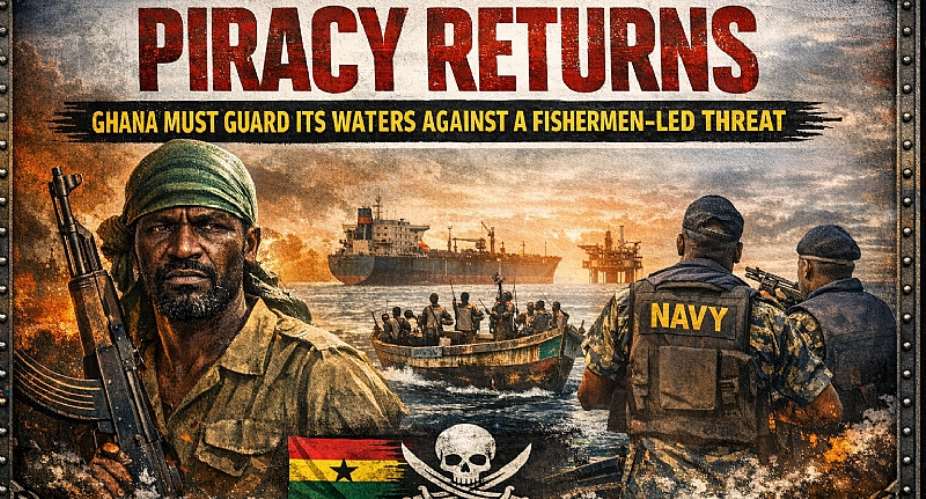
“Piracy is no longer a distant threat—it is here in Ghana’s waters.” — Ministry of Fisheries and Aquaculture
This article highlights the urgent need for Ghana to confront the resurgence of piracy in its waters. Beyond the immediate threat to fishermen and coastal communities, piracy poses a serious risk to regional trade, investment, and ambitious projects such as the proposed West African sea ferry service. By combining naval vigilance, regional cooperation, and economic support, Ghana can safeguard both its security and its economic future.
Somalia’s Lesson for Ghana
In the mid-2000s, Somali fishermen, angered by illegal foreign trawlers depleting their waters, turned to piracy. What began as small-scale attacks escalated into a multi-million-dollar enterprise under leaders like Mohamed Abdi Hassan “Big Mouth” (Afweyne). Somali pirates hijacked oil tankers, container ships, and fishing vessels, holding crews hostage for ransom. At its peak, piracy in the Gulf of Aden threatened nearly 12% of global trade, forcing shipping companies to pay exorbitant insurance premiums and reroute vessels.
Though international naval patrols suppressed Somali piracy by 2017, recent hijackings in 2023–2025 show it is resurging. The lesson is clear: when fishermen’s grievances are ignored, piracy can spiral into a national and global crisis.
The Attack on Ghanaian Fishermen
On February 26–27, 2026, Ghana received its own warning shot. 71 fishermen from Gomoa Nyanyano and Senya Bereku in the Central Region were attacked by armed pirates, reported to be Nigerian. The pirates stripped them of outboard motors and belongings, leaving them stranded at sea.
The Ghana Navy and Armed Forces mounted a coordinated search-and-rescue operation, saving all 71 men. The Ministry of Fisheries and Aquaculture expressed “deep concern” but praised the Navy’s “swift, coordinated and professional response.” Hon. Gizella Tetteh-Agbotui, MP for Awutu Senya West, was also acknowledged for her role in coordinating with fishing communities and state institutions.
This incident is not isolated—it mirrors Somalia’s early piracy phase, where fishermen, driven by desperation and opportunity, began targeting vessels.
Why Ghana Must Be on High Alert
- Strategic Trade Routes: Tema and Takoradi ports are vital gateways for West African commerce. Piracy raises shipping insurance costs, deters foreign investment, and undermines Ghana’s reputation as a safe maritime hub.
- Fishing Industry Under Siege: Just as Somali fishermen turned to piracy after losing livelihoods to foreign trawlers, Ghanaian fishermen face depleted stocks and competition from illegal industrial vessels. Economic desperation could push them toward piracy.
- Regional Spillover: Pirates crossing from Nigeria into Ghanaian waters highlight porous maritime borders. Without coordinated regional action, piracy networks can expand rapidly.
Expert Perspectives
- The Atlantic Council warns that piracy in the Gulf of Guinea is a “widespread, complex security challenge rooted in persistent poverty and onshore insurgencies.”
- The Centre for International Maritime Affairs (CIMAG) stressed after the March 2025 attack on the Ghanaian-registered vessel MENGXIN 1 that kidnappings and armed robberies at sea are increasingly common in Ghana’s territorial waters.
- A University of Ghana study emphasized that piracy tarnishes national reputation, impedes economic development, and requires stronger frameworks for maritime security.
Recommendations for Ghanaian Authorities
1. Strengthen Naval Patrols
- Expand Ghana Navy surveillance in Central and Western waters.
- Deploy radar, drones, and satellite monitoring to detect suspicious vessels.
- Increase rapid-response capacity to intercept pirates before they strike.
2. Support Fishermen Economically
- Subsidize fuel and modern fishing gear to reduce hardship.
- Crack down on illegal foreign trawlers that impoverish local fishermen.
- Provide alternative livelihoods to coastal youth vulnerable to recruitment.
3. Regional Cooperation
- Intensify intelligence-sharing with Nigeria, Togo, and Côte d’Ivoire.
- Use ECOWAS and the Yaoundé Code of Conduct framework for joint patrols.
- Establish a West African Maritime Security Task Force to coordinate responses.
4. Legal & Judicial Preparedness
- Update maritime laws to prosecute piracy swiftly and effectively.
- Train judiciary and police in handling maritime crime cases.
- Ensure captured pirates face justice rather than slipping through legal loopholes.
5. Public Awareness & Community Engagement
- Educate coastal communities about the dangers of piracy.
- Encourage reporting of suspicious activities at sea.
- Build trust between fishermen and security agencies to prevent collusion.
Piracy and the Proposed West African Sea Ferry Routes
As Ghana and its neighbors explore ambitious projects to expand maritime transport—such as the proposed Afropax sea ferry service linking Tema to Nigeria, Togo, Benin, and Côte d’Ivoire—the resurgence of piracy must be factored into planning. The ferry initiative promises to ease congestion on the Lagos–Abidjan highway, boost regional trade, and provide travelers with a modern alternative to road transport.
Yet, the recent attack on 71 Ghanaian fishermen underscores the risks. If pirates can strike fishing boats in Ghana’s waters, passenger ferries and cargo vessels could also become targets. The Gulf of Guinea already accounts for the majority of global maritime kidnappings, and introducing high-capacity ferries without robust security measures could expose businesses and travelers to danger.
Strategic Considerations
- Security Integration: Ferry operations must include naval escort protocols, tracking systems, and onboard security.
- Regional Collaboration: ECOWAS and Yaoundé Code of Conduct patrols should extend to ferry routes.
- Public Confidence: Travelers and businesses will only embrace ferries if safety is guaranteed.
- Economic Safeguards: Ghana must demonstrate proactive measures to reassure investors and insurers.
A Call for High Alert
Somali piracy taught the world that ignoring fishermen’s grievances can spiral into a global crisis. Ghana now faces its own warning shot: the attack on 71 fishermen is a reminder that piracy is not a distant threat but a present danger.
If Ghanaian authorities fail to act decisively, the country risks repeating Somalia’s trajectory—where economic desperation, weak enforcement, and porous borders transformed fishermen into pirates and destabilized an entire region.
The time for high alert is now. Ghana must combine naval vigilance, regional cooperation, and economic support to protect its waters, its fishermen, its future, and its ambitious maritime projects.
✍️ Retired Senior Citizen
For and on behalf of all Senior Citizens of the Republic of Ghana 🇬🇭
Teshie-Nungua
[email protected]


 ‘We treat galamsey with kid gloves compared to other situations’ – A Rocha Ghana
 Ghana ‘missed the boat’ in galamsey fight under President Akufo-Addo – Senyo Hos...
 Judiciary to employ 127 magistrates to fill vacancies
 Government to suspend GH¢1 D-Levy on diesel for two months
 Russia launches major attack on Ukraine’s energy grid, causing power cuts
 EU talks deportations as five nations seek migrant centre in Africa
 Trump renews calls for former Federal Reserve chief Jerome Powell's resignation
 Paramount takeover of Warner Bros. Discovery clears legal hurdle
 Marsh hails improvements after Australia win final one-day international
 British PM alleges there are 'strong indications' Iran was involved in Fairford ...


