




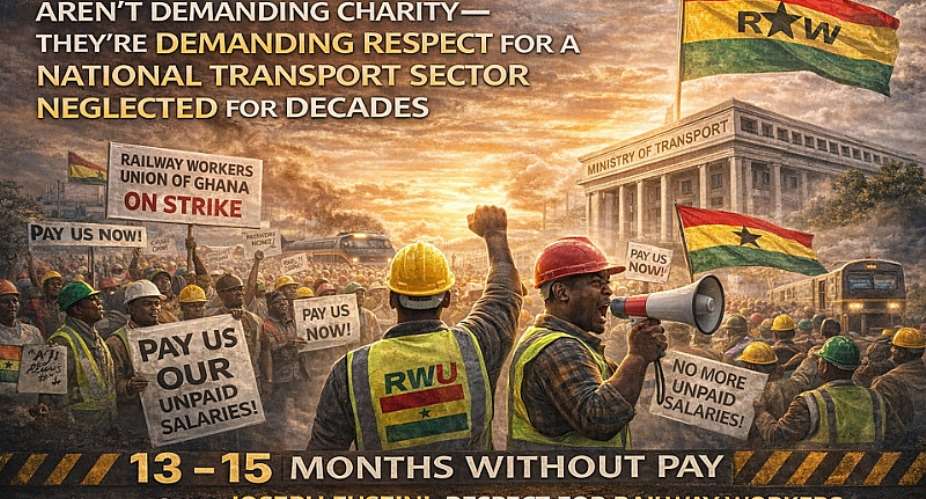
On March 19, 2026, railway workers under the banner of the Railway Workers Union (RWU) marched to the Ministry of Transport in Accra to register their protest over unpaid salaries, arrears dating as far back as 13 to 15 months. What might appear to some as a labor dispute over wages is, upon closer inspection, a deep structural crisis in Ghana’s transport sector that has been unfolding for years.
This protest, peaceful, lawful, and born of desperation, should not be dismissed as just another pay dispute. It is a symptom of systematic neglect of a sector that is essential to national economic resilience, equitable development, and genuine infrastructure sovereignty.
A Protracted Crisis, Not a One‑Off Incident
For more than a year, workers of the Ghana Railway Company Limited (GRCL) have been owed salaries and entitlements dating back to late 2024. Despite meeting deadlines and issuing lawful notice for industrial action, including planned strikes and coordinated picketing that would converge on key state institutions, their plight remains unresolved. Union leaders warned that without concrete action by a specified deadline, workers would escalate their protests, including nationwide peaceful demonstrations and strikes.
This latest action echoes earlier disruptions: in May 2025, workers declared an indefinite strike over seven months of unpaid salaries, a strike that effectively brought train operations to a standstill until government intervention.
What we are witnessing now is not a recurring nuisance but a chronic pattern of non‑payment and piecemeal engagement that fails to address the underlying dysfunction in our railway ecosystem.
The Government’s Response Has Been Reactive, Not Strategic
Officials at the Ministry of Transport have repeatedly expressed empathy and pledged action, including moves to settle arrears and even broader campaigns to secure railway lands and remove encroachments. However, these responses, offered retrospectively and on the eve of industrial actions, reveal a perpetually reactive mode, rather than proactive sector stewardship.
The repeated cycle, unpaid salaries, union escalation, ministerial reassurance, and temporary quelling of dissent, has become predictable. Workers are left bearing the social and economic costs: family hardship, broken homes, health complications, and educational disruption for their children. This Is Not Just a payroll problem; it is a Strategic Transport Failure
The crisis in our rail sector cannot be isolated from the broader malaise afflicting Ghana’s infrastructure management. Ghana’s railways are not merely a means of moving freight and passengers; they are part of the backbone of national logistics linking Tema, Accra, Kumasi, Takoradi, Tarkwa, and other key economic hubs. They have the potential to ease pressure on roads, support industrial supply chains, enhance export competitiveness, and create jobs. Yet, they are treated as a peripheral state enterprise, continually starved of funding and institutional support.
When payments to railway workers are delayed for more than a year, in a company wholly owned by the state, it signals a fundamental governance failure. If the government cannot reliably pay its workforce in a critical state sector, how can it credibly claim to be revitalizing national transport infrastructure?
Beyond Sympathy: Structural Reforms Are Needed
What is needed is not just ad‑hoc salary settlements but a sector recovery strategy that addresses root causes.
- Sustainable financing models for the Ghana Railway Company Limited to ensure timely payroll and operations.
- Strategic integration of rail into national logistics frameworks, so the sector is not left competing with underfunded ministries and parastatals for scarce budget resources.
- Institutional reforms that strengthen management accountability, worker welfare provisions, and sector‑wide planning across Ministries, Parliament, and the National Labour Commission.
- Transparent mechanisms for engaging the Trades Union Congress and other stakeholders in long‑term sector governance.
Workers Are Not the Problem, They Are the Heart of the System
Railway workers have rights protected under Ghana’s Labour Act, including the right to strike and peacefully protest. Their action is lawful, disciplined, and peaceful, carried out with requests for police protection to maintain order. Howver, beyond legality, their protest is moral and economic: they are fighting for dignity, for their families, and for a sector that too often has been promised reform but delivered neglect.
If Ghana is serious about revitalizing its transport sector, it must start by honoring its commitments to the people who keep the wheels turning. Workers paid on time are not an expense, they are an investment in a rail system that can be part of a sovereign, modern, and inclusive infrastructure future for Ghana.
Author: Joseph Fuseini ([email protected])


 Attorney-General appeals ruling halting trial of former Buffer Stock CEO, wife
 NAIMOS destroys 1,970 changfans, 863 Illegal mining structures in three months —...
 Let's see how Asiedu Nketia becomes NDC flagbearer with same people he conspired...
 Asiedu Nketiah opts out of NDC chairmanship race amid flagbearership speculation
 NDC insists Nkwanta North elections will proceed despite court injunction
 'My side of the story will shock you; I'm waiting for court days' – Obuasi SHTS ...
 Obuasi SHTS sexual abuse: 'GES must distant itself, allow the law to work' — For...
 Upper East: Fear grips nine Kusaug communities over mysterious fish deaths in da...
 NDC suspends Amasaman Communications Officer over 'irresponsible' remarks on Obu...
 Parliament secures religious leaders’ support to end witchcraft accusations


