




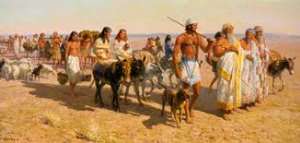
The idea of a “chosen people” is one of the most powerful and most misunderstood concepts in religious history. To many, it suggests divine preference, privilege, or even superiority. But scripture tells a far more demanding story. From the beginning, chosenness was never a conclusion, it was an assignment. It was not a badge of honour, but a burden of responsibility. The story of the Israelites does not end with the claim, “we are chosen.” It reaches its true meaning in a far more challenging command: “you shall be a kingdom of priests and a holy nation.” That is the covenant. That is the calling.
Chosen for Responsibility, Not Privilege
After their dramatic deliverance from Egypt, the Israelites stand at Mount Sinai and enter into a covenant with God. The terms are clear and conditional: “If you obey my voice and keep my covenant, you shall be my treasured possession… and you shall be to me a kingdom of priests and a holy nation.” (Exodus 19:5–6). The structure is unmistakable: if - then. Divine favour is tied to human responsibility. More importantly, the identity they are given -- a kingdom of priests --- redefines chosenness itself. A priest serves. A priest sacrifices. A priest stands between God and humanity. To be a kingdom of priests is not to dominate others, but to serve them. Holiness, therefore, is not abstract. It is practical: justice in trade, fairness in judgment, care for the poor, honesty, discipline, and compassion. To be chosen is to live differently. To reflect divine character in everyday life.
A Pattern Across Scripture
This link between privilege and responsibility runs throughout both the Bible and the Qur’an. The Qur’an acknowledges the special status of the Children of Israel, but immediately ties it to accountability: “Remember My favor… and fulfill My covenant, and I will fulfill your covenant.” (Qur’an 2:40–47). Yet history shows that witnessing miracles is not the same as living in obedience. When commanded to enter the Promised Land, fear overtook faith: “Indeed within it is a people of great strength…” (Qur’an 5:22). The result? A generation lost its opportunity. The lesson is timeless: privilege does not remove responsibility. If anything, it increases it.
What the Scholars Teach Us
Great thinkers across traditions have echoed this same truth. Maimonides argued that divine law exists to shape moral excellence, not to elevate one people above others. Jonathan Sacks captured it simply: “To be chosen is not to be better than others. It is to be summoned to serve.” Augustine of Hippo warned against turning divine favour into entitlement, while John Calvin insisted that true election is proven through conduct, not claims. And Søren Kierkegaard reminds us that truth is only real when it is lived.
A Dangerous Misunderstanding
What emerges from all these sources is a sobering insight. The language of chosenness becomes dangerous when detached from its ethical demands. When people remember only that they are “chosen,” but forget that they are called to be “a kingdom of priests,” religion can easily become a tool of self-congratulation. This is not just an ancient problem. It is a recurring human tendency. Communities of faith, across time and place, including here in Africa, often struggle with the temptation to claim identity without embracing responsibility. It is easier to inherit a sacred title than to live a sacred life. Today, this tension is visible everywhere. Religious identity is sometimes used to justify superiority, exclusion, or even political power. But the scriptures themselves resist this misuse. They redirect us away from privilege and back to purpose. Divine favour is not a reward for greatness. It is a trust to be honoured.
A Call Back to Sinai
To recover the true meaning of chosenness, we must return to Sinai. That vision demands humility. It insists on ethical consistency. And it calls for service. Not domination, not entitlement, but service.
The phrase “a kingdom of priests” still confronts us today:
- Are we living up to the values we claim?
- Are we embodying what we preach?
- Are we serving others, or elevating ourselves?
The story of the Israelites stands as both inspiration and warning. It shows what is possible when people align with divine purpose, and what happens when they do not. History, miracles, and identity are not enough. What matters is the response.
My Thoughts: The Burden of Being Chosen
Chosenness is not an endpoint. It is a beginning. It does not say, “You are better.”
It says, “You are accountable.” It does not grant permission to dominate.
It demands a commitment to uplift. And so, the covenant does not end with the words “you are a chosen people.” It reaches its true meaning in the far more demanding charge: “You shall be a kingdom of priests and a holy nation.” That is the burden, and the enduring dignity of the Israelites.
Columnist’s Note:
Israelites or Israelis --- Why the Distinction Matters: This article refers to Israelites, not Israelis, and the difference is important.
- Israelites: The ancient descendants of Prophet Jacob (Israel), discussed in the Torah, Bible, and Qur’an. The term carries a spiritual and covenantal meaning --- a people bound by moral responsibility.
- Israelis: Modern citizens of the State of Israel (established in 1948), a political and national identity that includes Jews, Muslims, Christians, and others.
Using “Israelis” in this discussion would shift the focus into modern politics and obscure the central message that chosenness in scripture is about responsibility, not entitlement.
FUSEINI ABDULAI BRAIMAH
+233208282575 / +233550558008
[email protected]


 Gov’t renames 24-hour economy markets as District Economy Markets, targets 100% ...
 BoG, Police arrest 7 in Accra over alleged use of cedi notes for money bouquets,...
 SkyTrain trial: High Court adjourns case management conference to October 19
 Edudzi Tameklo recalls how Duffuor was slapped with GH¢100 million bail in 2020,...
 About 800 Director I and II applicants unreachable due to invalid contact number...
 'Boakye Agyarko was seen as anti-Bawumia' – Lecturer on John Boadu’s victory
 'NPP delegates made wrong choice electing John Boadu as chairman' — Political Sc...
 MTN Ghana secures new 5G spectrum in 700 MHz and 3 GHz bands
 Bawumia explains NPP hunt for winnable parliamentary candidates, not deep-pocket...
 Ghana to tap Egypt’s expertise for new capital city, housing projects – Mahama



Comments
Jesus is Lord! Amen.
Author's Reply
Mawuetornam, Yes Prophet Isa (alayhi salam) was a Messenger of God. We Muslims are waiting anxiously for his second coming. He will come, and he will refute your claim that he is the son of God. He will tell you that he never said that. Number two, he will ask if he did not announce the coming of Prophet Muhammad (peace be upon him). Muslims believe in Isa (Jesus). But do you know that Jews do not believe in Jesus? Do you know that Jesus say Jesus is burning in hell? Do you know Jesus was actually not a Jew? And that Jesus did not speak Hebrew but Aramaic? Do you know the word "Christian" or its variant "Christianity" is nowhere in the Bible? We can continue the conversation, can't we?