




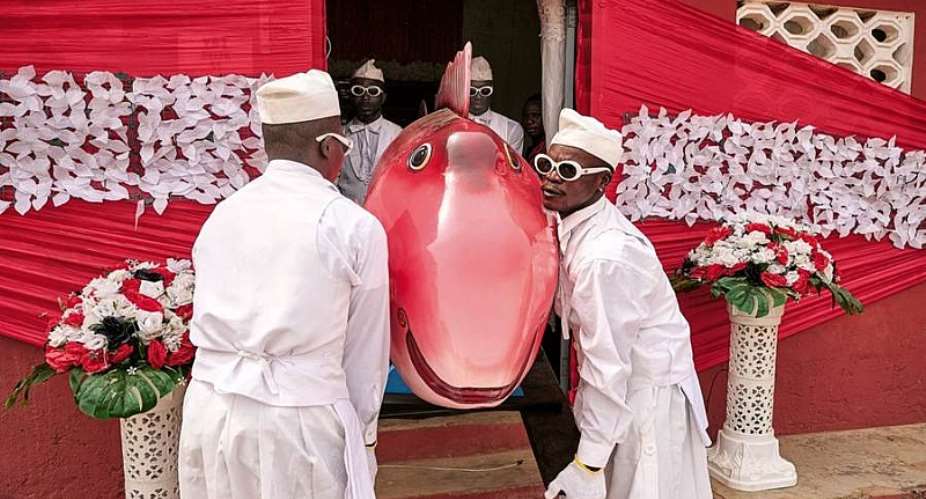
Reports that the celebrated Ghanaian musician Daddy Lumba may have been buried at his East Legon residence have sparked a national debate about where the dead should properly rest in Ghana. The controversy has drawn in commentators, religious figures, and traditional authorities, each advancing competing claims about custom, law, and legitimacy.
Beyond the immediate disagreement lies a deeper question about how burial practices in contemporary Ghana are shaped by the interaction of history, culture, and regulation. While some argue that burial within a house in Accra contravenes Ga tradition unless ritual approval is obtained from a Wulomo, others regard such requirements as an overextension of custom. At stake is a broader issue: how Ghanaians negotiate the relationship between tradition, law, and identity in determining how the dead are honoured.
The debate also reveals a wider problem. Public discussion often proceeds with limited attention to the historical foundations that have shaped burial practices in Ghanaian society. A careful understanding of the present moment requires attention to the long development of funerary customs, the restructuring of burial space under colonial rule, and the continuing negotiation between customary authority and state regulation. In Accra, where family authority, traditional institutions, and statutory law intersect, burial practices reflect a layered historical encounter rather than a single, unified tradition.
Death and the Social Life of the Dead
Across much of Ghana, death has not been understood as a final rupture between the living and the dead. It marks a transition into another state of existence while remaining socially present within the community.
The historian John Parker observes in his book In My Time of Dying: A History of Death and the Dead in West Africa that funerary rituals in many West African societies sustain relationships between the living and the dead. Funerals, therefore, serve not only as moments of mourning but also as social processes through which communities reaffirm continuity across generations.
Anthropologist Sjaak van der Geest makes a similar point in The Good Funeral: Mortuary Rituals and Social Change in Ghana, where he describes Ghanaian funerals as “funerals for the living.” Such ceremonies reaffirm kinship ties, redistribute obligations, and restore social balance within the community.
Among the Akan peoples of southern Ghana, including the Asante, death is interpreted through a layered conception of personhood. The individual consists of the kra, the life force believed to originate from the Creator; the sunsum, the spiritual personality; and the honam, the physical body. Death occurs when the kra departs from the body.
Celebrated Philosophy Professor, Kwame Gyekye, in An Essay on African Philosophical Thought: The Akan Conceptual Scheme, explains that Akan philosophy understands the individual as part of a moral community that includes both the living and the ancestors. If a person dies what is regarded as a “good death” (owu pa), typically at an advanced age and with descendants, the individual may become an ancestor.
As can be seen from the aforementioned studies, funeral rites guide human transition from the physical world, while reaffirming lineage continuity.
Ethnographic accounts show that Akan funerals unfold in stages. The body is washed, prepared, and laid in state. Elders receive mourners, libation is poured, and ancestors are invoked by name. The smell of schnapps poured onto the earth often mingles with the steady rhythm of funeral drums as elders call upon ancestral spirits to receive the departed.
Historical accounts confirm the long-standing importance of these practices. Willem Bosman, writing in 1704, described elaborate funerals along the Gold Coast in which burial formed only one element within a wider ritual sequence. T. C. McCaskie, in State and Society in Pre-Colonial Asante, shows how royal burial sites such as Bantama functioned as political archives, preserving the continuity of the Asante state.
In the Accra region, burial has long been tied to Ga ideas of sacred geography and ritual authority. Land is understood not simply as property but as a spiritual inheritance linking the living with earlier generations. Sacred groves, family compounds, and stool lands serve as sites where these relationships are maintained.
In Ga cosmology, land is a spiritually inhabited landscape in which ancestors, deities, and the living remain interconnected. Burial is therefore not merely a family decision but a ritual act that engages territorial authority. As Mitja Potocnik and Kwame Adum-Kyeremeh demostrate in Transformation of Ga Death and Funeral Rites in Accra, Ghana, burial historically formed part of a wider system of ritual governance in which land, lineage, and authority were inseparable. Their ethnographic and historical analysis further shows that funerary rites involved structured processes such as ritual preparation of the body, formalised mourning, drumming, libation, and the invocation of ancestral presence.
Within this system, ritual authority was not diffused. The Wulomo, as a principal ritual figure, maintained balance between the community, the land, and the spiritual world, while other specialists ensured that funerary processes were properly conducted. Burial, in this context, was never a purely private act but one embedded in a recognised structure of authority.
Burial at Home in Historical Perspective
One of the most contested aspects of the present debate concerns burial within the family compound. However, what now appears controversial was once ordinary.
Many assume that burial must take place in cemeteries. Historical evidence from the Gold Coast suggests otherwise. Across many precolonial societies, burial was closely tied to lineage and land. The dead were often interred within family territory, ensuring that ancestral presence remained part of everyday life.
European observers frequently remarked on this practice. A Danish official in the 1830s noted that inhabitants of Accra buried relatives beneath their houses, a practice later targeted by colonial authorities.
Among the Akan, burial formed part of a broader sequence of rites that marked the transition into ancestorhood. As John Parker notes, burial and funeral were not always simultaneous. Interment could occur first, followed by commemorative rites months or even years later.
Within this framework, burial location carried meaning. Elders and lineage heads were often buried within family compounds, reinforcing the relationship between ancestry and land. The compound itself became a repository of memory and authority.
Seen in this light, burial within family space was not unusual but part of a coherent cultural system linking death, land, and lineage continuity.
This system, however, did not remain unchanged. The historical development of Ga funerary practices was shaped by successive waves of migration and cultural interaction. Potocnik and Adum-Kyeremeh trace significant transformations to the sixteenth century, when Ga groups settled on the Accra Plains and interacted with Guan populations, adopting funeral elements such as dirges and ritual specialists associated with the care of the dead.
Later encounters further reshaped these practices. The expansion of Asante influence in the eighteenth century introduced extended mourning periods and structured family gatherings, while interaction with Ewe groups contributed practices such as ceremonial gunpowder firing and, in some contexts, midnight burial.
Religious change added further layers. Islam, introduced through Hausa and Fulani trading communities in the nineteenth century, brought burial practices involving immediate interment without coffins. Christianity, which expanded significantly from the late nineteenth century, challenged key aspects of Ga cosmology, discouraged ancestral invocation, and gradually shifted funerary authority towards church institutions.
Further changes occurred in the twentieth-century, including return migration from Nigeria, which introduced practices such as organised gift-giving and large-scale feeding at funerals. Contemporary Ga funerals, therefore, reflect not a single inherited tradition but the accumulation of successive historical transformations shaped by migration, religion, and urban change.
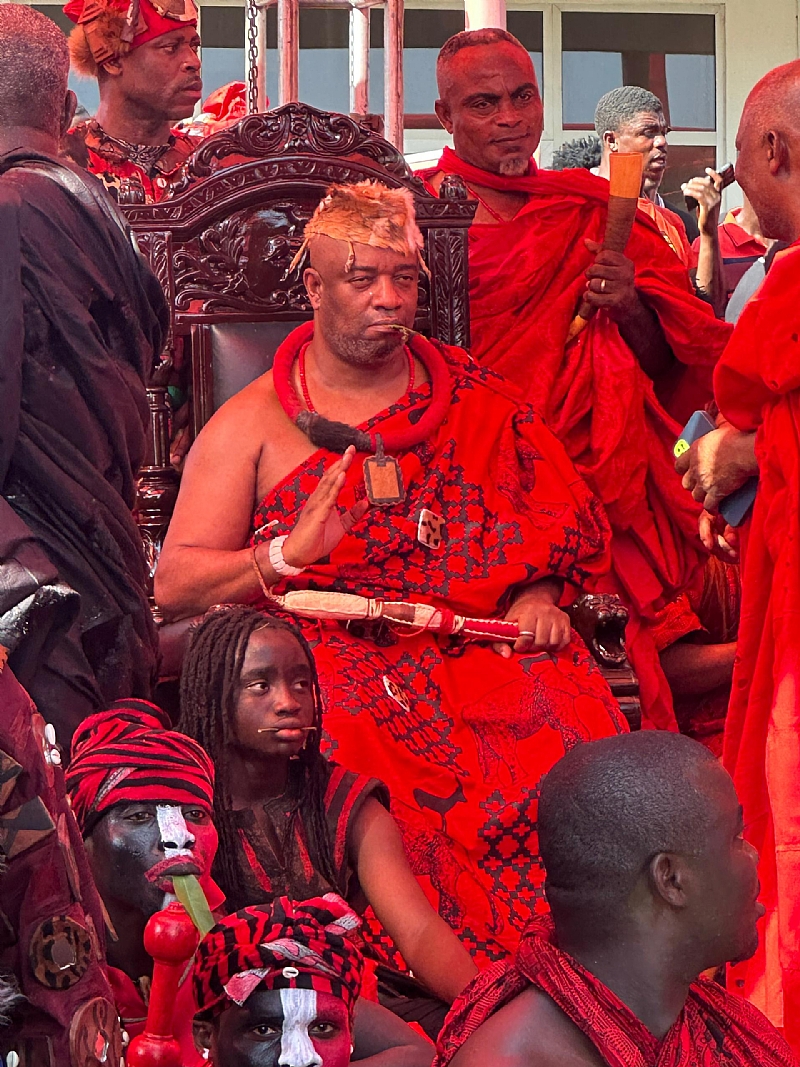
Ga Mantse, King Tackie Teiko Tsuru II, sitting in state during a funeral. Photograph: Citinewsroom
The Colonial Reorganisation of Burial Space
By the late nineteenth century, Accra was expanding rapidly as a colonial administrative centre. British authorities increasingly sought to regulate sanitation, land use, and burial practices within the growing town.
Municipal governance structures introduced during this period brought burial under official control. The Public Health Ordinance of 1878 empowered authorities to regulate sanitation and burial grounds, and by 1888, burial within residential compounds in Accra had been formally prohibited.
Similar measures appeared across colonial cities, where administrators sought to reorganise African settlements according to sanitary and planning principles derived from Europe.
The policy was resisted. Colonial records from the 1890s in Jamestown and Ussher Town, preserved in administrative correspondence from the Gold Coast colonial archives, describe families secretly removing bodies from cemeteries and reburying them within family compounds at night. These acts, described as “midnight exhumations,” prompted surveillance and enforcement measures, including patrols and the use of informants.
While these regulations were justified in terms of sanitation, they also reshaped land relations. By relocating the dead from family compounds to cemeteries, colonial authorities separated burial from lineage land. This introduced a form of urban zoning that distinguished residential space from burial space and facilitated the circulation of land within an emerging property market.
In this sense, the shift from compound burial to cemetery burial was not only a cultural change but part of the wider reorganisation of urban space in colonial Accra.
Death, Land and Belonging
Burial practices in Ghana today operate within a legal framework that combines statutory regulation with customary practice.
Under the Public Health Act, 2012 (Act 851) and the Registration of Births and Deaths Act, 2020 (Act 1027), burial requires formal registration of death and the issuance of a burial permit. Local government bye-laws, enacted under the Local Governance Act, 2016 (Act 936), generally require burial in approved cemeteries and restrict burial within residential premises unless permission is granted in exceptional circumstances.
The authority to grant or refuse such permission rests with the relevant District Assembly, acting through its environmental health structures. Custom may shape ritual practice, but it does not override the Assembly’s statutory control over burial location.
There are no publicly available statistics on how frequently such permissions are granted or denied. Decisions are made on a case-by-case basis, reflecting the decentralised nature of local governance.
In practice, burial regulation in urban Ghana is shaped not only by law but also by uneven enforcement, land pressure, and the social importance attached to funerary display.
Traditional authorities continue to influence funeral practices, particularly in areas where customary land relations remain significant. In many Ga communities, ritual leaders such as the Wulomo still play roles in funerary rites. However, this authority operates within a legal framework in which regulatory control ultimately lies with state institutions.
The point is not to privilege one system of authority over another, but to understand how they intersect in practice.
The controversy surrounding reports of Daddy Lumba’s burial, therefore, reflects the interaction of multiple systems of authority: family, custom, religion, and law.
For centuries, burial practices in Ghana were tied to the idea that the dead remain within the territory of the living. Urbanisation and regulation have altered the spatial organisation of burial, but they have not erased the underlying cultural logic.
Whether or not the burial occurred within a residence, the debate it has generated reveals the continuing importance of questions about land, authority, and belonging. Where the dead are placed remains, in the end, a question about how the living understand their relationship to land, history, and community.
(The writer is an award-winning media executive, historian, educator, and leadership consultant with graduate training in business, communication, education, and African Studies)

 Israel election: Record turnout as Netanyahu and Eisenkot remain deadlocked
 'Ghana Airways will be back in the air before I leave office' — Ghana's Presiden...
 'You can’t make money in journalism' — Speaker Bagbin
 GES sets November 16 date for payment of 2025 promotion arrears
 Wontumi’s lawyers seek recall of prosecution witness in illegal mining case
 Minority urges independent audit of GHS49.7m South Africa evacuation
 Some prison inmates attempted to poison Wontumi – Palgrave
 NACOC Boss reveals how 'smart' suspected drug traffickers are diverting proceeds...
 Minerals Commission defends termination of Northern Ashanti Mines lease over US$...
 Ablakwa will be prosecuted in 2029 under Bawumia – Kwadwo Poku warns


