




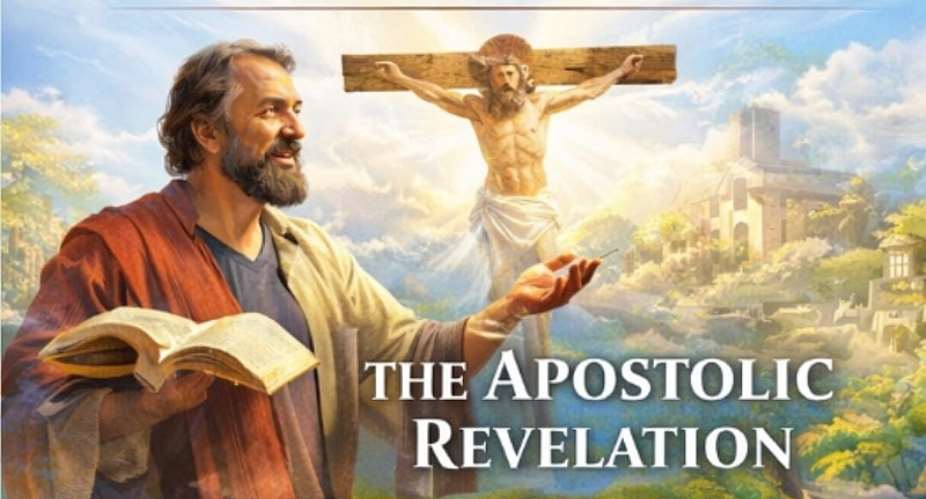
When the New Testament Reinterprets the Beginning
For many readers of Scripture, the Book of Genesis functions primarily as the narrative beginning of the biblical story — a record of origins, early humanity, and the moral drama that unfolds with the fall of Adam and Eve.
Yet one of the most intriguing features of the Bible is how later writers reinterpret its earliest passages. The New Testament, particularly the letters of the Apostle Paul, often returns to Genesis not merely to quote it, but to unlock deeper theological meaning hidden within its language.
One of the clearest examples appears in Paul’s letter to the Ephesians, where a familiar line about marriage becomes something far more expansive: a statement about Christ and the future of humanity itself.
Paul’s Surprising Reading of Genesis
In Ephesians 5:31–32, Paul quotes the well-known line from Genesis:
| “For this reason a man shall leave his father and mother and be joined to his wife, and the two shall become one flesh.”
But Paul does not stop there. Immediately after quoting the verse, he adds a striking interpretation:
|| “This mystery is great, but I speak concerning Christ and the church.”
With those words, Paul reframes the passage entirely.
What many readers had understood as a simple explanation of marriage is now presented as something deeper — a symbolic reflection of the relationship between Christ and the community of believers.
Marriage, in Paul’s reading, is not the final reality. It is a signpost pointing to something larger.
The Language of Scripture
Theologians often describe Paul’s approach using the concept of typology — the idea that earlier biblical figures or institutions foreshadow later ones.
In this framework, the Old Testament contains patterns that only become fully visible in the New Testament.
The Apostle Paul hints at this dynamic elsewhere when he writes that the mystery of Christ was “hidden for ages and generations but is now revealed to His saints.”
In other words, parts of Scripture speak in whispers until later revelation brings clarity.
Genesis, then, may not simply be recounting early human history. It may also be laying down the symbolic architecture of redemption.
Adam as a Prototype
Paul takes this interpretation even further in his letter to the Romans.
In Romans 5:14, he describes Adam as “a type of the one who was to come.”
The language suggests that Adam, the first man in the biblical narrative, serves as a prototype for a later figure — the one Christians identify as Christ.
The comparison unfolds across the New Testament:
| Adam | Christ |
|---|---|
| Head of the first humanity | Head of a renewed humanity |
| Associated with the entrance of sin | Associated with redemption |
| Represents the old order | Represents the new covenant |
The early Christian message, therefore, was not merely about moral reform. It was about the arrival of a new headship for humanity.
Where Adam symbolized the beginning of one human story, Christ represented the beginning of another.
Two Humanities, Two Directions
This theological framework introduces a striking concept: the existence of two covenantal realities.
One is tied to the first Adam — the humanity shaped by mortality, limitation, and the consequences of the fall.
The other is connected to Christ, often referred to by theologians as the “Second Adam.”
The New Testament repeatedly frames salvation in these terms. To belong to Christ is not simply to adopt new beliefs; it is to enter a different spiritual lineage, one defined by renewal rather than decline.
This idea became central to early Christian thought. The story of Scripture, from Genesis to the Gospels, could be read as the movement from the first humanity to the second.
Why the Apostolic Interpretation Matters
Paul’s interpretation of Genesis challenges modern readers to reconsider how biblical texts function.
Rather than existing as isolated passages, the Scriptures form an interconnected narrative, where earlier writings anticipate later fulfillment.
What appears as an ordinary statement in Genesis may carry layers of meaning that only become visible centuries later.
This does not diminish the original context of the text — marriage remains an important institution within the biblical framework. But Paul suggests that the verse also operates symbolically, pointing toward the relationship between Christ and the Church.
In that sense, the Bible is not only a historical record. It is also a theological tapestry, where themes introduced in the opening chapters reappear, transformed, in the story of redemption.
Reflections
“Genesis was never simply about finding a partner; it was about revealing the Second Adam. Christ is not an afterthought in Scripture — He is its centre of gravity.”
Bismarck Kwesi Davis


 Appointment of Emelia Agbenyo as EC deputy chair was well calculated, reasoned –...
 Relief for students as GAUA and TUSAAG call off strike; declare return to work o...
 Who gave Cabinet authority to decide for Ghanaians to join BRICS without parliam...
 Mahama urges Ghanaian businesses to tap CSIR innovations
 Partisan EC appointments could set dangerous precedent — NPP's Kamaldeen
 Winneba: Afenyo-Markin commissions police apartments at Fetteh-Osakam
 Council of State failed Mahama over Emelia Agbenyo’s EC appointment – Prof. Asa...
 CDD‑Ghana: EC Deputy Chair Should Step Down Now
 Family Announces October 23 Memorial Mass for Nana Konadu Agyeman-Rawlings
 Eduwatch Urges Nationwide Audit of Sexual Misconduct in Secondary Schools


